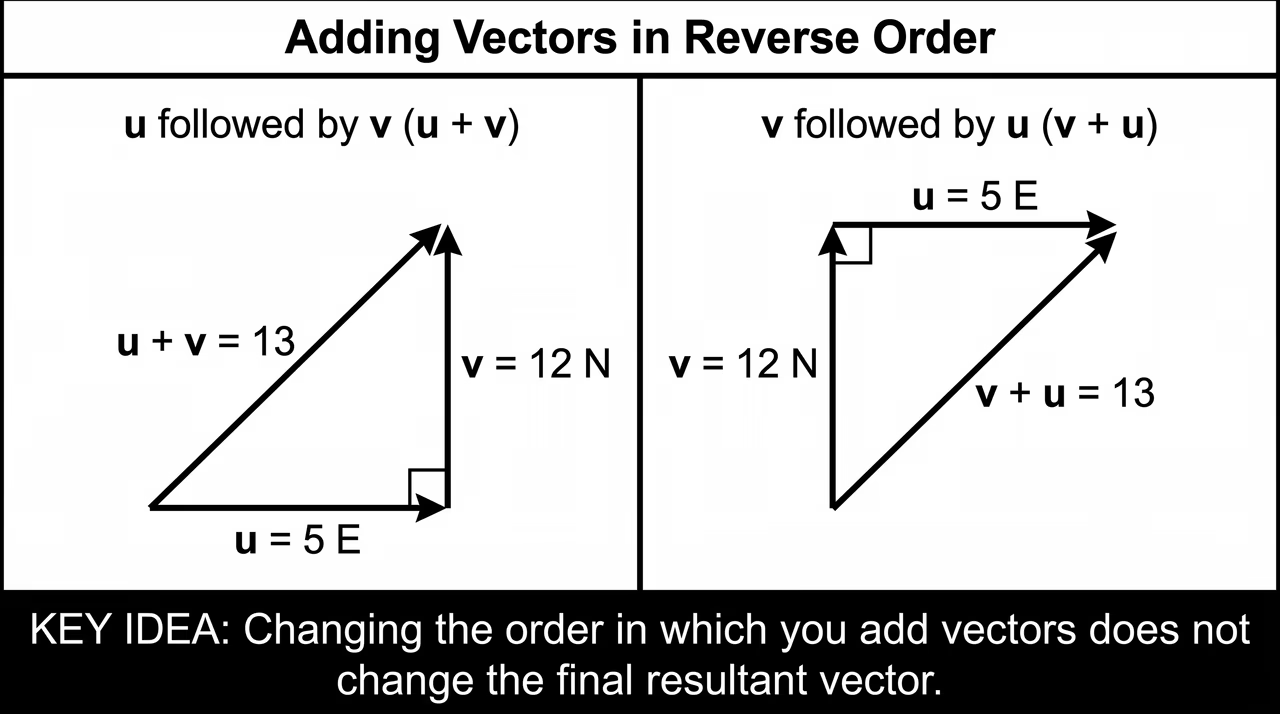
Slide 1 · Head-to-Tail Vector AdditionModel · 18 min
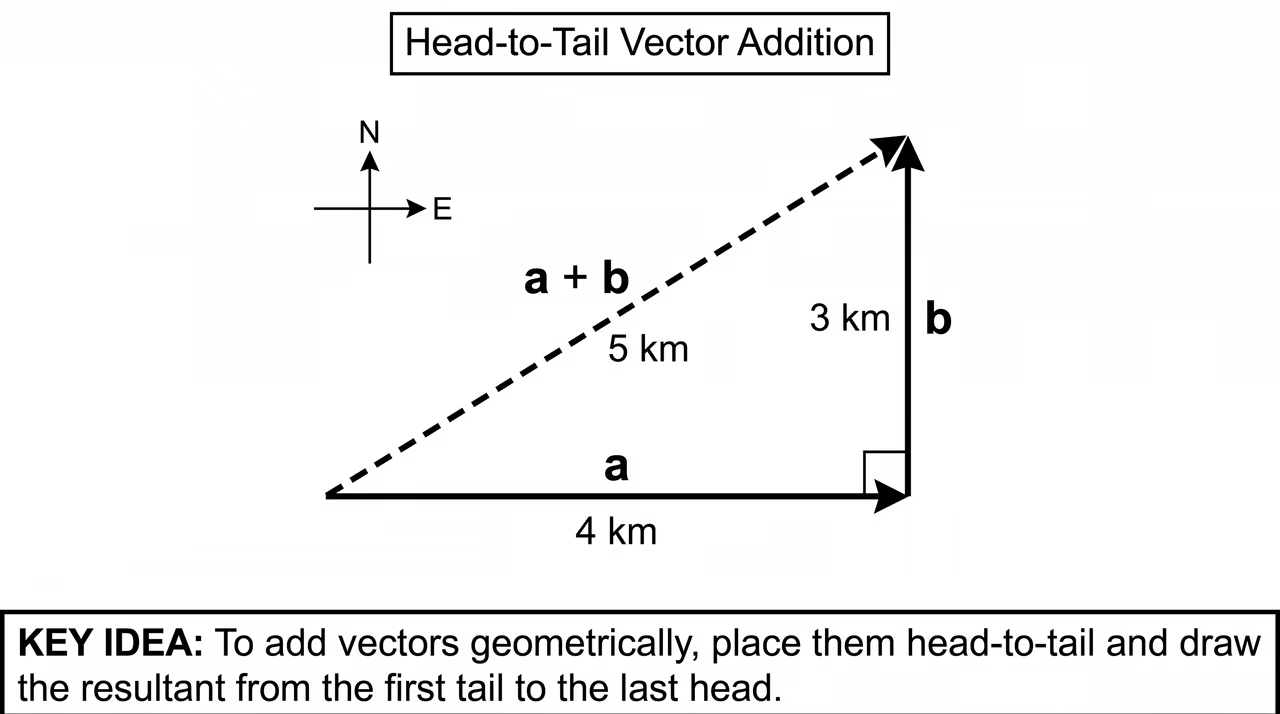
When adding vectors in different situations geometrically, we place the vectors head-to-tail. To add vector to vector , we trace vector and then draw an equivalent vector to starting at the arrowhead of . Completing the triangle by drawing a directed line segment from the initial tail to the final head yields the resultant sum . Use Figure 1 to visualise how connecting vectors head-to-tail forms a triangle representing the resultant sum.
- Adding vectors in different situations requires placing vectors in a head-to-tail sequence on paper.
- To begin, trace vector accurately maintaining its length and original direction.
- Draw an equivalent vector to starting at the head of vector .
- Complete the triangle to represent the resultant sum vector from start to end.
Worked example. Draw vector as a horizontal arrow of length pointing East. From the head of vector , draw an equivalent vector to pointing North with a length of . Complete the triangle by drawing the resultant vector from the tail of to the head of . Calculate magnitude using Pythagoras' theorem: . Calculate angle North of East: , so , giving a bearing of . Answer: The resultant vector has a magnitude of on a bearing of ..
Check question: A boat travels along vector of East and then along vector of South. What is the magnitude of the resultant vector ?
Show answer
. Constructing the head-to-tail triangle gives a right-angled triangle with legs of and . Using Pythagoras' theorem, the resultant magnitude is .