Skip to content

Grade 10 · Core Mathematics · Lesson 2 of 21

Using Vector Notations in Different Ways

A Grade 10 Core Mathematics CBE lesson from the sub-strand Vectors I. In it, learners identify vectors expressed through standard notations including directed arrows, underlines, tildes below, and bold print.

Strand Measurements and GeometrySub-strand Vectors ILesson code 10CM-28-L240 minutes · 2 slides

KICD learning outcome (b)

Use vector notations in different ways.

By the end of this lesson, learners should be able to

  1. Identify vectors expressed through standard notations including directed arrows, underlines, tildes below, and bold print.
  2. Distinguish between vector notations and scalar expressions in mathematical problems.
  3. Write single-letter and two-letter vectors correctly in handwritten work.

Key vocabulary

Vector notation
A standardised symbol or marking used to distinguish a vector quantity from a scalar.
Writing CD⃗ with an arrow above is a standard form of vector notation.
Tilde
A wavy line written below a letter to show that the letter represents a vector.
The symbol w∼ uses a tilde below the letter to represent a vector.
Scalar
A quantity that has magnitude or size only, with no associated direction.
The distance JK=15 cm is a scalar because it lacks directional notation.

Lesson preview

Slide 1 · Notation Conventions for VectorsOpening · 18 min
A diagram showing a directed line segment from point A to point B alongside four equivalent mathematical notations.
Figure 1: A diagram showing a directed line segment from point A to point B alongside four equivalent mathematical notations.

In mathematics, vectors require specific notations to distinguish them from scalar quantities. When representing a vector between two points, we write the starting and ending letters with a directed arrow above them, such as AB⃗. When using single lowercase letters, vectors can be indicated by underlining the letter like u‾, placing a tilde beneath it like u∼, or printing the symbol in bold type as u. Recognising these notation forms ensures we correctly classify vector and scalar quantities in diagrams and calculations. Use Figure 1 to visualise the different ways we can write the same vector.

  • A directed vector from point A to point B is written with an arrow above as AB⃗.
  • A single letter vector in handwriting is commonly underlined as v‾ or written with a tilde below as v∼.
  • Printed textbooks and digital displays often represent single letter vectors using bold type like v.
  • Plain letters without an arrow, underline, tilde below, or bold text denote scalar quantities or ordinary distances.
Worked example. For two capital letters showing direction from point X to point Y, draw a right-pointing arrow above: XY⃗. For a single lowercase letter m in written form, place a tilde beneath the letter: m∼ or underline it: m‾. For printed text, represent the single lowercase letter m in bold font: m. Answer: The notations are XY⃗, m∼ (or m‾), and m..

Check question: Which of the following is the correct mathematical notation for a vector directed from point P to point Q?

  1. PQ⃗
  2. PQ
  3. QP⃗
  4. PQ‾
Show answer

PQ⃗. The standard mathematical convention for a vector directed from initial point P to terminal point Q uses a right-pointing arrow directly above the two capital letters, written as PQ⃗.

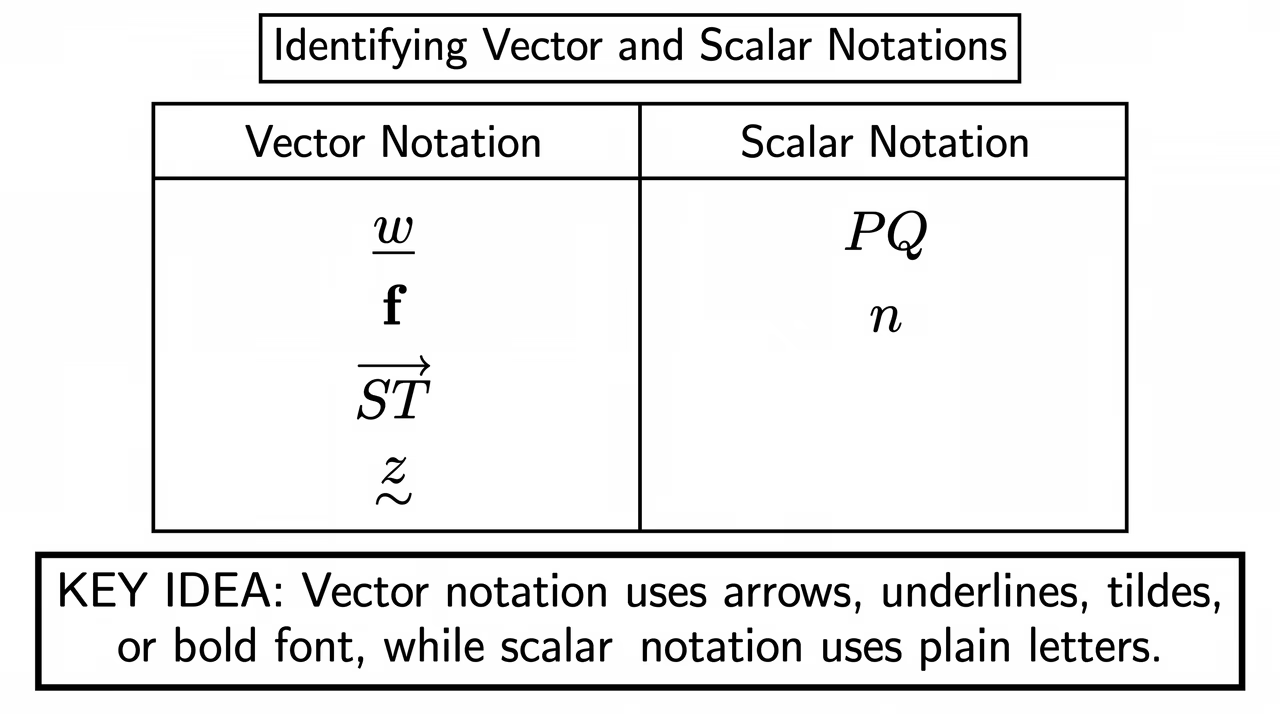
Slide 2 · Identifying Vector and Scalar NotationsPractice · 22 min
A table categorising various mathematical symbols into vector and scalar notations based on their formatting.
Figure 2: A table categorising various mathematical symbols into vector and scalar notations based on their formatting.

Teach the full lesson on the projector

This lesson, and every other Grade 1–10 CBE lesson, comes ready to project with the EAP ClassKit. It runs without electricity or internet.

  • Both slides with diagrams and class activities
  • Teacher notes, SNE adaptations and assessment checks
  • Homework and the other 20 lessons in this sub-strand

All 21 lessons in Vectors I

  1. 1Explaining Vector and Scalar QuantitiesExplain vector and scalar quantities with illustrations
  2. 2Using Vector Notations in Different WaysUse vector notations in different ways
  3. 3Representing Vectors GeometricallyRepresent vectors geometrically in different situations
  4. 4Representing Vectors Geometrically in Different SituationsRepresent vectors geometrically in different situations
  5. 5Identifying Equivalent VectorsIdentify equivalent vectors in different situations
  6. 6Equivalent VectorsIdentify equivalent vectors in different situations
  7. 7Adding Vectors GeometricallyAdd vectors in different situations
  8. 8Adding Vectors Geometrically in Different SituationsAdd vectors in different situations
  9. 9Multiplying Vectors by ScalarsMultiply vectors by scalars
  10. 10Multiplying Vectors by Scalars: Graphical Construction and Scalar RatiosMultiply vectors by scalars
  11. 11Determining Column Vectors from Coordinates and DiagramsDetermine column vectors in different situations
  12. 12Determining Column Vectors and Vector ArithmeticDetermine column vectors in different situations
  13. 13Determining Position Vectors from the OriginDetermine position vectors in different situations
  14. 14Determining Position Vectors and Calculating Vector DisplacementsDetermine position vectors in different situations
  15. 15Calculating the Magnitude of a VectorWork out magnitude of a vector in different situations
  16. 16Working Out Vector Magnitudes in Different SituationsWork out magnitude of a vector in different situations
  17. 17Determining the Midpoint of a VectorDetermine the midpoint of a vector in different situations
  18. 18Determining Vector Midpoints and Endpoint CoordinatesDetermine the midpoint of a vector in different situations
  19. 19Determining Translation Vector as a TransformationDetermine translation vector as a transformation
  20. 20Determining Translation Vectors as TransformationsDetermine translation vector as a transformation
  21. 21Appreciating Vectors in Real-Life SituationsAppreciate the use of vectors in real-life situations