
Skip to content

Grade 10 · Core Mathematics · Lesson 17 of 21

Determining the Midpoint of a Vector

A Grade 10 Core Mathematics CBE lesson from the sub-strand Vectors I. In it, learners locate the midpoint of a directed line segment geometrically using Cartesian component projections.

Strand Measurements and GeometrySub-strand Vectors ILesson code 10CM-28-L1740 minutes · 3 slides

KICD learning outcome (j)

Determine the midpoint of a vector in different situations.

By the end of this lesson, learners should be able to

  1. Locate the midpoint of a directed line segment geometrically using Cartesian component projections
  2. Derive and apply the vector midpoint formula OM⃗=12(a+b) using position vectors
  3. Calculate midpoint coordinates accurately for points located across different Cartesian quadrants

Key vocabulary

Midpoint
The point on a line segment that divides it into two equal parts.
The midpoint of segment AB joining A(2,4) and B(10,10) is M(6,7).
Ordinate
The y-coordinate of a point representing its vertical distance on a Cartesian plane.
The ordinate of point A(2,4) is 4 and for B(10,10) it is 10.
Position vector
A vector that specifies the position of a point relative to the origin.
Point A(2,3) has position vector a=(23).
Column vector
A vector written as one column: horizontal (x) component on top, vertical (y) below.
Vector AB⃗ is written as column vector (68).
Displacement vector
A vector representing the straight-line change in position from a start to an end point.
The displacement vector PQ⃗ from P(−4,6) to Q(6,−2) is (10−8).

Lesson preview

Slide 1 · Discovering Vector Midpoints GeometricallyOpening · 12 min
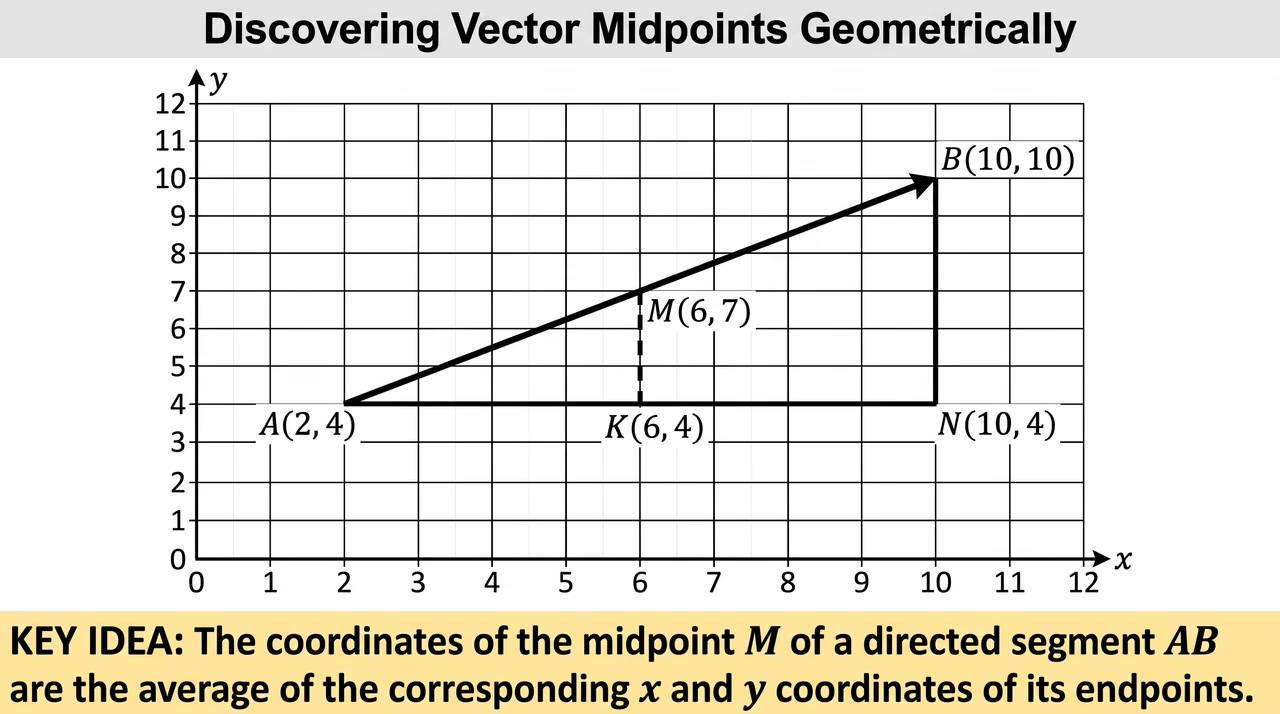
A Cartesian plane shows how to find the midpoint of a line segment by constructing horizontal and vertical component lines.
Figure 1: A Cartesian plane shows how to find the midpoint of a line segment by constructing horizontal and vertical component lines.

To find the midpoint of a directed line segment on a Cartesian plane geometrically, we can construct horizontal and vertical component lines. For two points A(2,4) and B(10,10), a horizontal line through A and vertical line through B meet at N(10,4). Halving the horizontal distance AN gives K(6,4). A vertical line drawn from K intersects AB at midpoint M(6,7). This demonstrates that the coordinates of M equal the average of the x-coordinates and average of the y-coordinates. Use Figure 1 to follow the geometric steps for finding the midpoint.

  • Locating points A(2,4) and B(10,10) on a Cartesian plane defines directed line segment AB.
  • Horizontal component line AN and vertical component line NB intersect at right-angled point N(10,4).
  • The midpoint K(6,4) of segment AN projects vertically upward to meet segment AB at M(6,7).
  • The midpoint M has coordinates equal to the average of the x-coordinates and y-coordinates of A and B.
Worked example. Identify coordinates of A(2,4) and N(10,4) on horizontal segment AN. Find midpoint K of AN: x=2+102=6, y=4, so K(6,4). Draw vertical line from K(6,4) to intersect segment AB at M. Calculate y-coordinate of M by averaging y-coordinates of A and B: y=4+102=7. State coordinates of midpoint M(6,7). Answer: Midpoint K(6,4) and midpoint M(6,7)..

Check question: Points P(2,2) and Q(8,10) are plotted on a Cartesian grid. A horizontal line through P meets a vertical line through Q at point N. What are the coordinates of point N, and what is the midpoint of segment PN?

  1. N(8,2) and midpoint of PN is (5,2)
  2. N(2,10) and midpoint of PN is (2,6)
  3. N(8,2) and midpoint of PN is (6,2)
  4. N(8,2) and midpoint of PN is (4,1)
Show answer

N(8,2) and midpoint of PN is (5,2). Point N shares the x-coordinate of Q(8) and y-coordinate of P(2), giving N(8,2). Segment PN runs horizontally from x=2 to x=8 along y=2, so its midpoint is (2+82,2+22)=(5,2).

Slide 2 · Deriving the Vector Midpoint FormulaModel · 14 min
A coordinate grid displays position vectors used to derive the algebraic formula for the midpoint of a line segment.
Figure 2: A coordinate grid displays position vectors used to derive the algebraic formula for the midpoint of a line segment.

Teach the full lesson on the projector

This lesson, and every other Grade 1–10 CBE lesson, comes ready to project with the EAP ClassKit. It runs without electricity or internet.

  • All 3 slides with diagrams and class activities
  • Teacher notes, SNE adaptations and assessment checks
  • Homework and the other 20 lessons in this sub-strand

All 21 lessons in Vectors I

  1. 1Explaining Vector and Scalar QuantitiesExplain vector and scalar quantities with illustrations
  2. 2Using Vector Notations in Different WaysUse vector notations in different ways
  3. 3Representing Vectors GeometricallyRepresent vectors geometrically in different situations
  4. 4Representing Vectors Geometrically in Different SituationsRepresent vectors geometrically in different situations
  5. 5Identifying Equivalent VectorsIdentify equivalent vectors in different situations
  6. 6Equivalent VectorsIdentify equivalent vectors in different situations
  7. 7Adding Vectors GeometricallyAdd vectors in different situations
  8. 8Adding Vectors Geometrically in Different SituationsAdd vectors in different situations
  9. 9Multiplying Vectors by ScalarsMultiply vectors by scalars
  10. 10Multiplying Vectors by Scalars: Graphical Construction and Scalar RatiosMultiply vectors by scalars
  11. 11Determining Column Vectors from Coordinates and DiagramsDetermine column vectors in different situations
  12. 12Determining Column Vectors and Vector ArithmeticDetermine column vectors in different situations
  13. 13Determining Position Vectors from the OriginDetermine position vectors in different situations
  14. 14Determining Position Vectors and Calculating Vector DisplacementsDetermine position vectors in different situations
  15. 15Calculating the Magnitude of a VectorWork out magnitude of a vector in different situations
  16. 16Working Out Vector Magnitudes in Different SituationsWork out magnitude of a vector in different situations
  17. 17Determining the Midpoint of a VectorDetermine the midpoint of a vector in different situations
  18. 18Determining Vector Midpoints and Endpoint CoordinatesDetermine the midpoint of a vector in different situations
  19. 19Determining Translation Vector as a TransformationDetermine translation vector as a transformation
  20. 20Determining Translation Vectors as TransformationsDetermine translation vector as a transformation
  21. 21Appreciating Vectors in Real-Life SituationsAppreciate the use of vectors in real-life situations