
Slide 1 · Determining Column Vectors from CoordinatesModel · 18 min
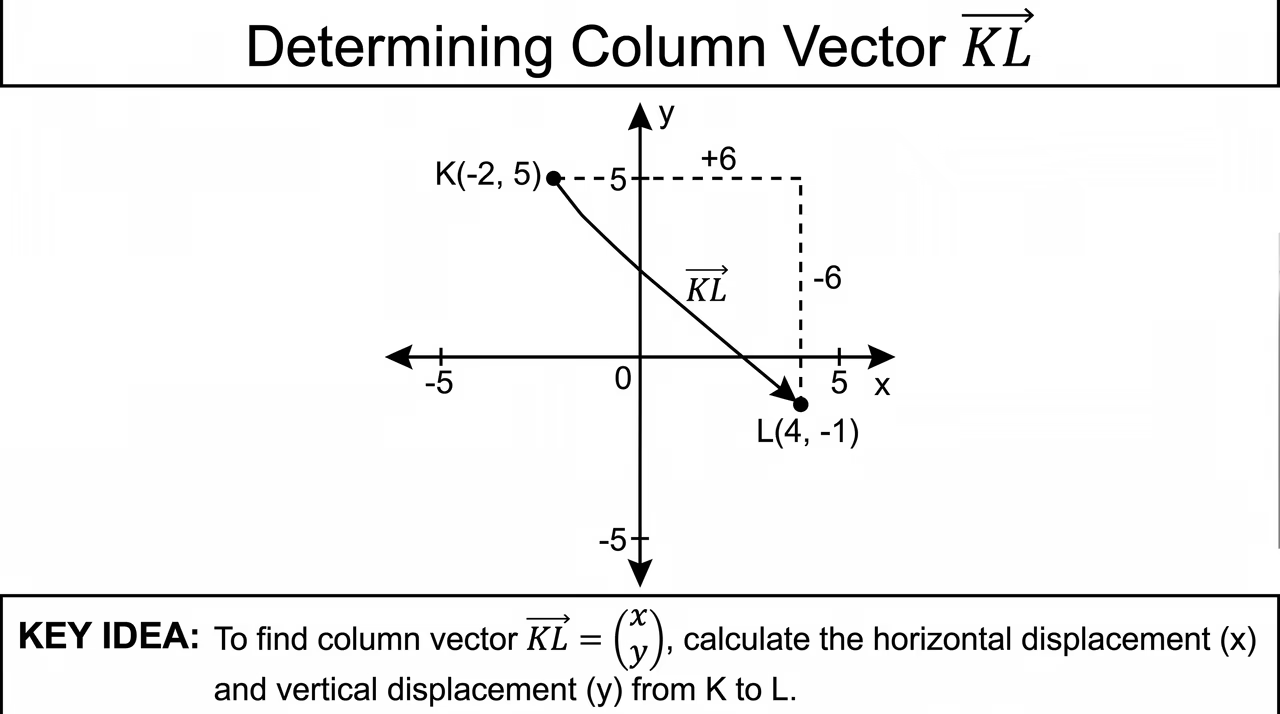
A vector displacement describes movement from an initial point to a terminal point. We express any displacement using horizontal and vertical components together, combined into a single column vector . When given coordinate points and , the column vector is found algebraically by subtracting initial coordinates from terminal coordinates, giving .
- A column vector records horizontal displacement in the top entry and vertical displacement in the bottom entry.
- Rightward and upward displacements are positive, whereas leftward and downward displacements are written as negative values.
- To determine vector algebraically, subtract coordinates of starting point from ending point .
- Learners discuss their component count against coordinate subtraction to confirm both methods produce identical results.
Worked example. Identify initial point as and terminal point as . Calculate horizontal component . Calculate vertical component . Combine components into column vector format . Answer: .
Check question: Points and have coordinates and . What is the column vector ?
Show answer
. Subtracting coordinates of initial point from terminal point yields and , giving column vector .
