
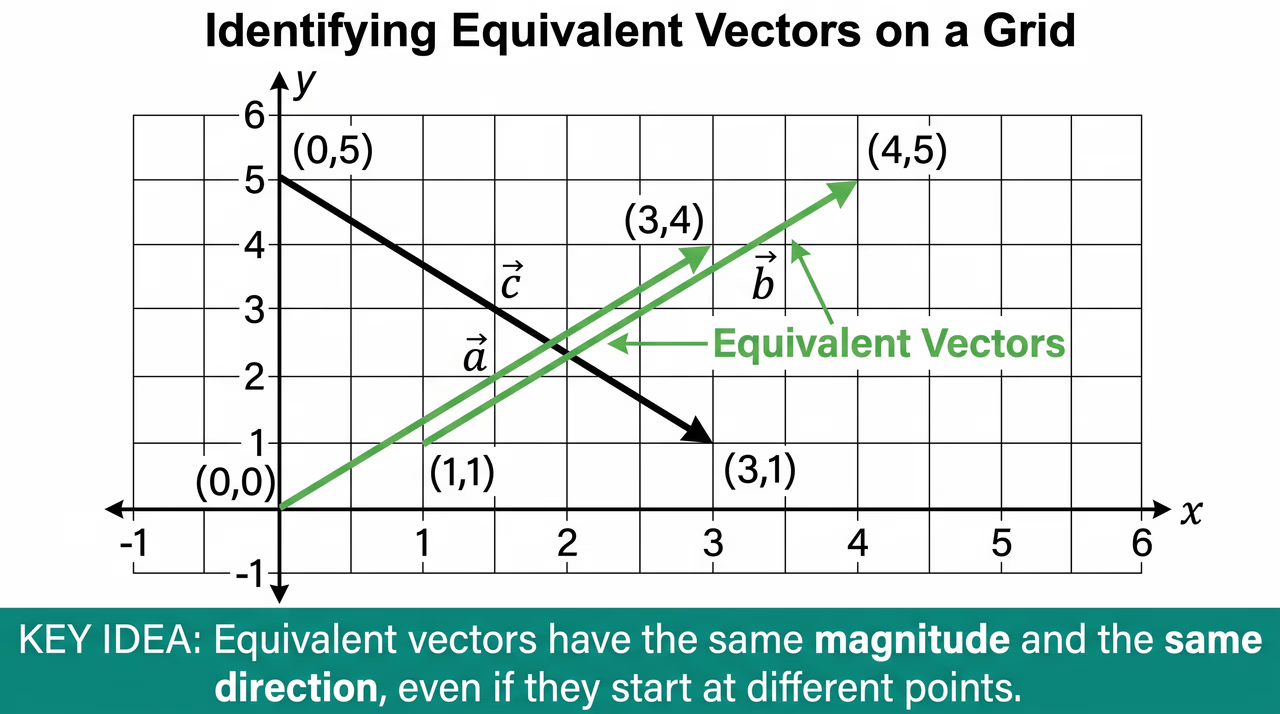
Two vectors are equivalent if and only if they have both the same magnitude and the same direction. When examining vectors drawn on a grid, we compare their horizontal and vertical displacements. Two displacement vectors moving along identical horizontal and vertical steps in the same direction are equivalent, regardless of their starting locations on the plane. Use Figure 1 to see how equivalent vectors have identical horizontal and vertical displacements.
- Equivalent vectors must possess exactly equal lengths and point in the same direction on a grid.
- Vectors with identical horizontal and vertical grid steps in the same direction are equal in magnitude and direction.
- Position does not affect vector equivalence; vectors displaced to different starting points can still be equivalent.
- We test equivalence by calculating magnitude using Pythagoras' theorem and checking direction using horizontal and vertical displacements.
Check question: Vector moves 4 units right and 7 units down. Vector moves 7 units right and 4 units down. Vector moves 4 units right and 7 units down. Which choice correctly identifies the equivalent vectors?
- Vectors and
- Vectors and
- Vectors and
- All three vectors are equivalent
Show answer
Vectors and . Both and have the exact same horizontal displacement (4 units right) and vertical displacement (7 units down). This means they have an equal magnitude of units and point in an identical direction. Vector has different displacements, meaning it points in a different direction.
