
Slide 1 · Anatomy of a four-figure tableOpening · 10 min
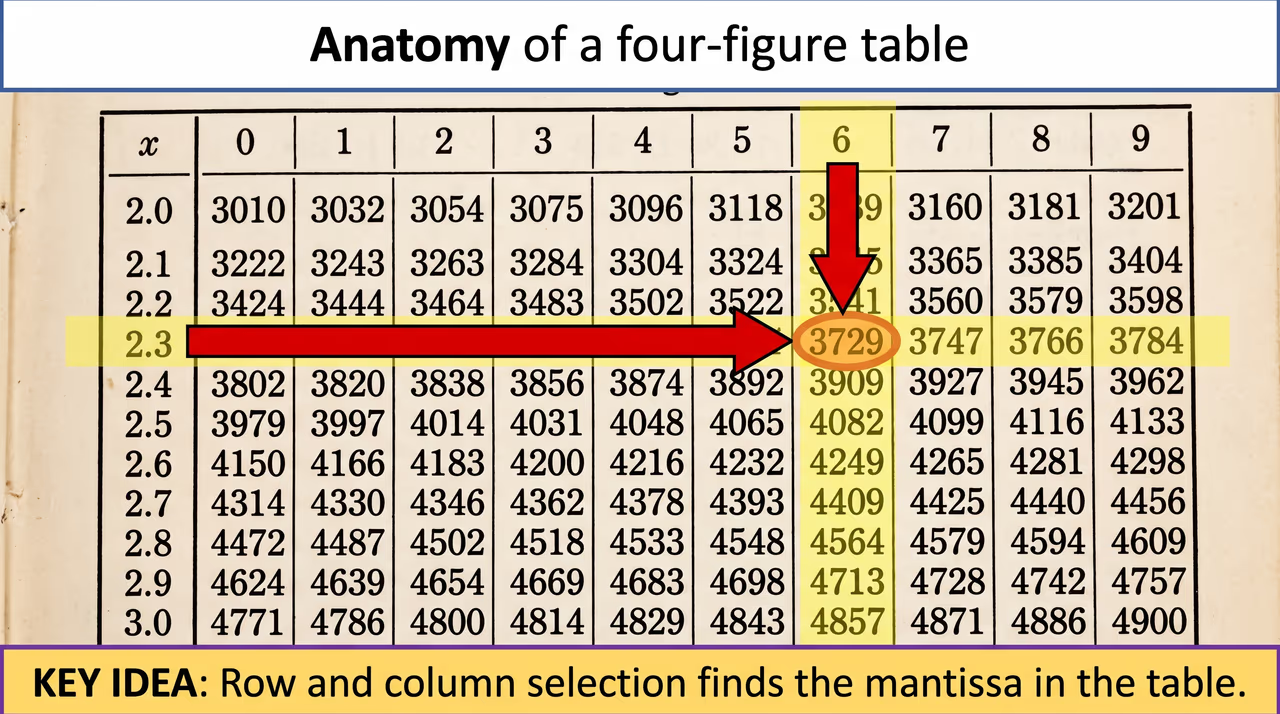
A printed common-logarithm table separates the integer range information from a decimal mantissa. Reading the first significant digits selects a row, the next digit selects a column, and the resulting entry is combined with the characteristic. Use Figure 1 to see how to intersect a row and column to find a mantissa.
- The characteristic comes from the number’s power-of-ten range.
- The row uses the leading significant digits.
- The column supplies the next significant digit.
- The mantissa is combined after table location is complete.
Worked example. Use 2.3 to choose the row. Use 6 to choose the column. Read the mantissa where that row and column meet. Answer: Row 2.3 and column 6.
Check question: When looking up the mantissa for 8.14 in a common-logarithm table, which row and column pair should be used?
- Row 8.1, column 4
- Row 8, column 1
- Row 8.14, column 0
- Row 4, column 8.1
Show answer
Row 8.1, column 4. The first two significant digits (8.1) form the row label, and the third digit (4) selects the column.
