
Slide 1 · Multiplication joins factor stringsOpening · 12 min
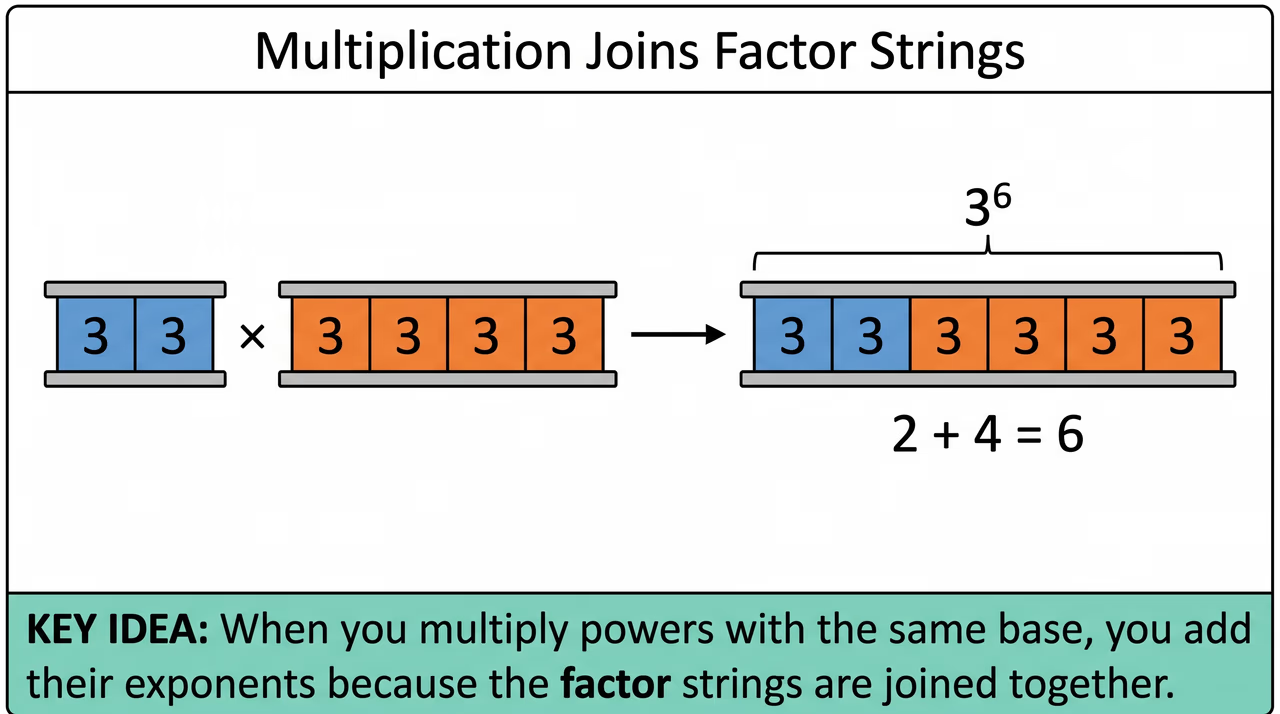
When powers share a base, multiplying them joins their repeated-factor strings. Counting every copy shows why exponents add; the rule is not a shortcut to memorise without understanding its factor structure. Use Figure 1 to observe how repeated-factor strings join together when multiplying powers.
- Equal bases allow factor strings to be joined directly.
- The first exponent counts factors in the first string.
- The second exponent counts factors in the second string.
- Joining strings explains addition of exponents precisely.
Worked example. Confirm both powers have the common base 3. Add the exponents: 2 + 4 = 6. Write 3^2 × 3^4 = 3^6. Answer: 3^6.
Check question: Which statement correctly uses factors to explain why ?
- Joining a string of two s and a string of three s gives a combined string of five s.
- Multiplying the exponents gives , so the result should actually be .
- Adding the two bases gives , which then halves to give a base of .
- Multiplying the two bases gives , so the result should actually be .
Show answer
Joining a string of two s and a string of three s gives a combined string of five s. Expanding both powers gives . Counting the total number of s gives five, which is written as . The base remains unchanged while the counts of repeated factors add.
