
Grade 10 · Core Mathematics · Lesson 1 of 13
Reading Repeated Factors as Indices
A Grade 10 Core Mathematics CBE lesson from the sub-strand Indices and Logarithms. In it, learners represent repeated multiplication with index notation.
Strand Numbers and AlgebraSub-strand Indices and LogarithmsLesson code 10CM-12-L140 minutes · 2 slides
KICD learning outcome (a)
Express numbers in index form.
By the end of this lesson, learners should be able to
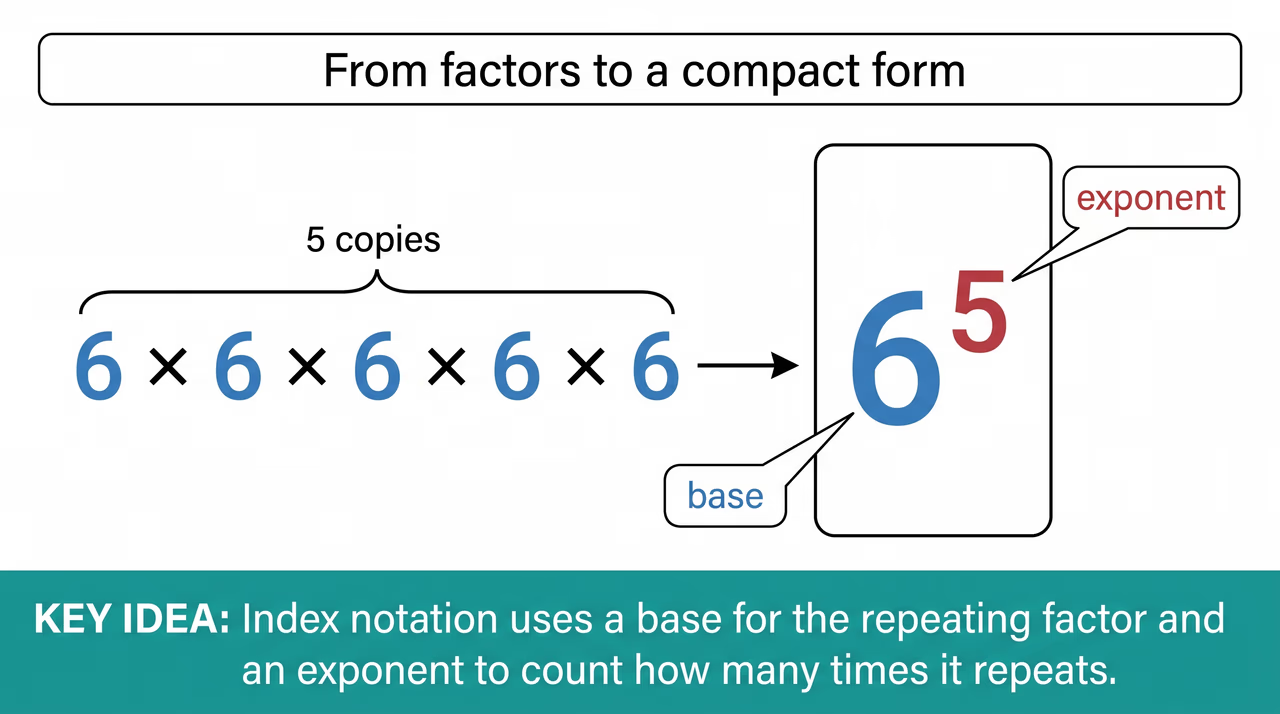
- Represent repeated multiplication with index notation.
- Name the base and exponent accurately.
- Check an index form by expanding it.
Key vocabulary
- Base
- The repeated factor multiplied throughout an index expression.
- In 4⁵, the base is four, repeated five times.
- Exponent
- The small raised number counting repeated factors.
- The exponent three means three copies of the base occur.
- Index form
- A number written as a base raised to an exponent.
- Twenty-five can be written as 5² in index form.
- Factor
- A number multiplied with another number to make a product.
- Five is a factor of twenty-five because 5 × 5 equals 25.
Lesson preview

All 13 lessons in Indices and Logarithms
- 1Reading Repeated Factors as IndicesExpress numbers in index form
- 2Index Forms with a Specified BaseExpress numbers in index form
- 3Discovering Product and Quotient LawsDerive the laws of indices using factors
- 4Power of a Power and Identity CasesDerive the laws of indices using factors
- 5Indices in Measurement and DesignApply the laws of indices in different situations
- 6From Powers of Ten to Common LogsRelate index notation to logarithm notation to base 10
- 7Interpreting Base-Ten LogarithmsRelate index notation to logarithm notation to base 10
- 8Reading Common Logarithms in TablesDetermine common logarithms of numbers from mathematical tables and calculators
- 9Comparing Table and Calculator LogarithmsDetermine common logarithms of numbers from mathematical tables and calculators
- 10Logarithms for Multiplication and DivisionApply common logarithms in multiplication, division, powers and roots of numbers
- 11Logarithms for Powers and RootsApply common logarithms in multiplication, division, powers and roots of numbers
- 12Integrated Logarithmic ComputationApply common logarithms in multiplication, division, powers and roots of numbers
- 13Why Indices and Logarithms MatterAppreciate the use of indices and common logarithms in mathematical computations