
Skip to content

Grade 10 · Core Mathematics · Lesson 10 of 13

Logarithms for Multiplication and Division

A Grade 10 Core Mathematics CBE lesson from the sub-strand Indices and Logarithms. In it, learners transform a product into a sum of logarithms.

Strand Numbers and AlgebraSub-strand Indices and LogarithmsLesson code 10CM-12-L1040 minutes · 4 slides

KICD learning outcome (f)

Apply common logarithms in multiplication, division, powers and roots of numbers.

By the end of this lesson, learners should be able to

  1. Transform a product into a sum of logarithms.
  2. Transform a quotient into a difference of logarithms.
  3. Use antilogarithms or calculator checks to recover results.

Key vocabulary

Antilogarithm
The inverse operation that returns a number from its logarithm.
The antilogarithm of 2 is 100 for base ten.
Product
A result formed by multiplying two or more factors.
The product of 12 and 5 is 60.
Quotient
The result of dividing one quantity by another.
The quotient 84 ÷ 7 equals 12.
Difference
A result obtained by subtracting one value from another.
The log difference for a quotient subtracts denominator log.
Logarithmic form
An expression rewritten using logarithms and their laws.
(ab)/c becomes log a + log b − log c.
Estimate
A quick size prediction used to check a computed result.
A quotient near ten should have a logarithm near one.
Inverse
An operation that reverses another operation.
Antilogarithm is the inverse of taking a common logarithm.
Intermediate
A value appearing during a multi-step calculation.
Keep intermediate log sums before taking the final antilog.

Lesson preview

Slide 1 · Products become logarithm sumsOpening · 10 min
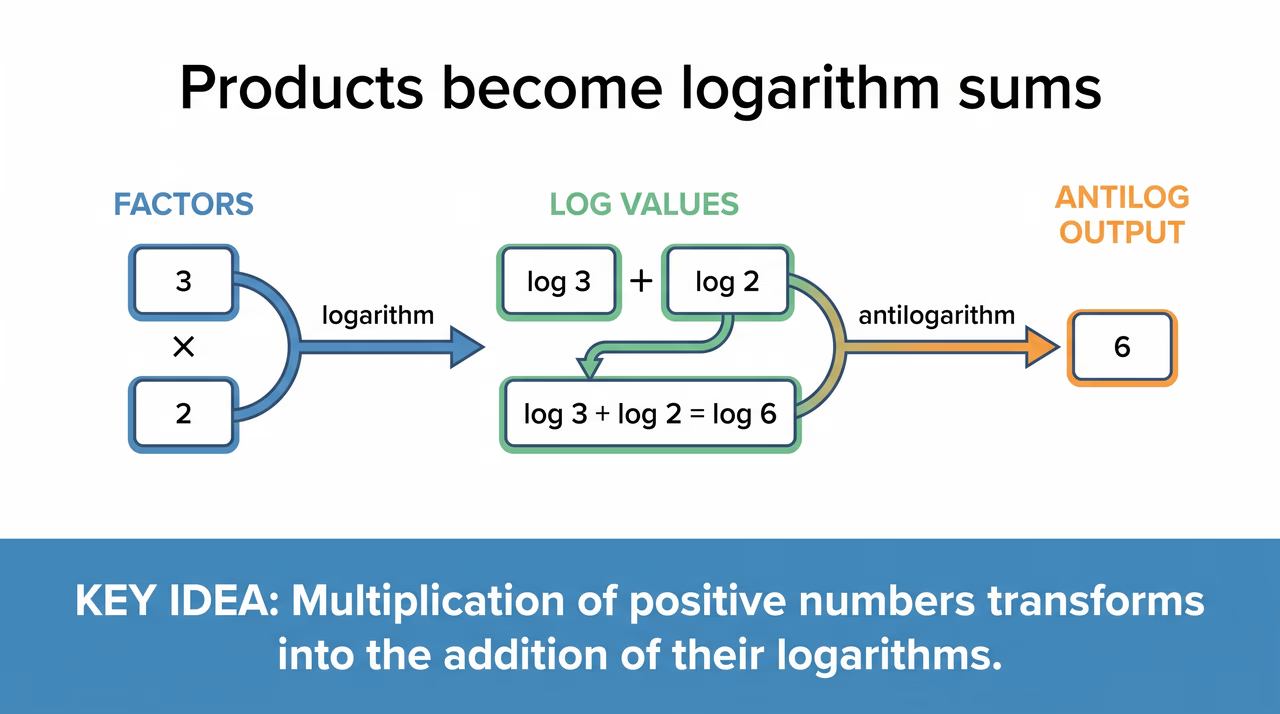
A flow diagram showing how multiplying the factors three and two is equivalent to adding their logarithms and finding the antilogarithm.
Figure 1: A flow diagram showing how multiplying the factors three and two is equivalent to adding their logarithms and finding the antilogarithm.

The product law for common logarithms turns multiplication into addition. After adding logarithms, the original product is recovered by taking the antilogarithm, so the method has a clear forward transformation and reverse transformation.

  • Logarithm products require positive factors so each common logarithm is defined.
  • Add the logarithms of separate factors to represent their product.
  • An antilogarithm reverses a common logarithm and recovers the product.
  • Estimate product size before trusting a result.
Worked example. Use the product law to identify L = log₁₀(100). Apply the inverse relationship. Conclude 10ᴸ = 100. Answer: 100.

Check question: Which expression is equivalent to log⁡10(8×15) using the product law for logarithms?

  1. log⁡10(8)+log⁡10(15)
  2. log⁡10(8)×log⁡10(15)
  3. log⁡10(8)−log⁡10(15)
  4. log⁡10(8)÷log⁡10(15)
Show answer

log⁡10(8)+log⁡10(15). The product law of logarithms states that the logarithm of a product is equal to the sum of the logarithms of its factors. Therefore, multiplication changes into the addition of logarithms.
Slide 2 · Quotients become logarithm differencesModel · 10 min
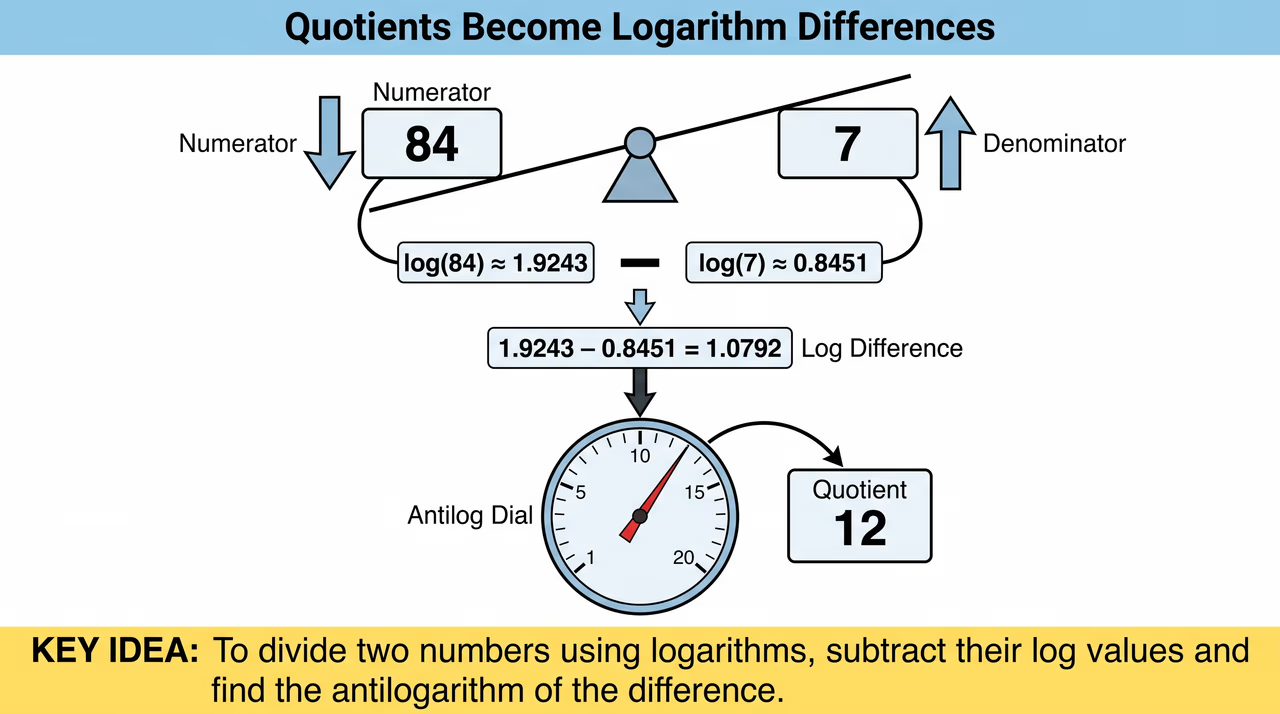
A visual breakdown showing how dividing eighty-four by seven uses the subtraction of their common logarithms to find the quotient.
Figure 2: A visual breakdown showing how dividing eighty-four by seven uses the subtraction of their common logarithms to find the quotient.

Teach the full lesson on the projector

This lesson, and every other Grade 1–10 CBE lesson, comes ready to project with the EAP ClassKit. It runs without electricity or internet.

  • All 4 slides with diagrams and class activities
  • Teacher notes, SNE adaptations and assessment checks
  • Homework and the other 12 lessons in this sub-strand

All 13 lessons in Indices and Logarithms

  1. 1Reading Repeated Factors as IndicesExpress numbers in index form
  2. 2Index Forms with a Specified BaseExpress numbers in index form
  3. 3Discovering Product and Quotient LawsDerive the laws of indices using factors
  4. 4Power of a Power and Identity CasesDerive the laws of indices using factors
  5. 5Indices in Measurement and DesignApply the laws of indices in different situations
  6. 6From Powers of Ten to Common LogsRelate index notation to logarithm notation to base 10
  7. 7Interpreting Base-Ten LogarithmsRelate index notation to logarithm notation to base 10
  8. 8Reading Common Logarithms in TablesDetermine common logarithms of numbers from mathematical tables and calculators
  9. 9Comparing Table and Calculator LogarithmsDetermine common logarithms of numbers from mathematical tables and calculators
  10. 10Logarithms for Multiplication and DivisionApply common logarithms in multiplication, division, powers and roots of numbers
  11. 11Logarithms for Powers and RootsApply common logarithms in multiplication, division, powers and roots of numbers
  12. 12Integrated Logarithmic ComputationApply common logarithms in multiplication, division, powers and roots of numbers
  13. 13Why Indices and Logarithms MatterAppreciate the use of indices and common logarithms in mathematical computations