
Slide 1 · Compact notation reveals structureOpening · 20 min
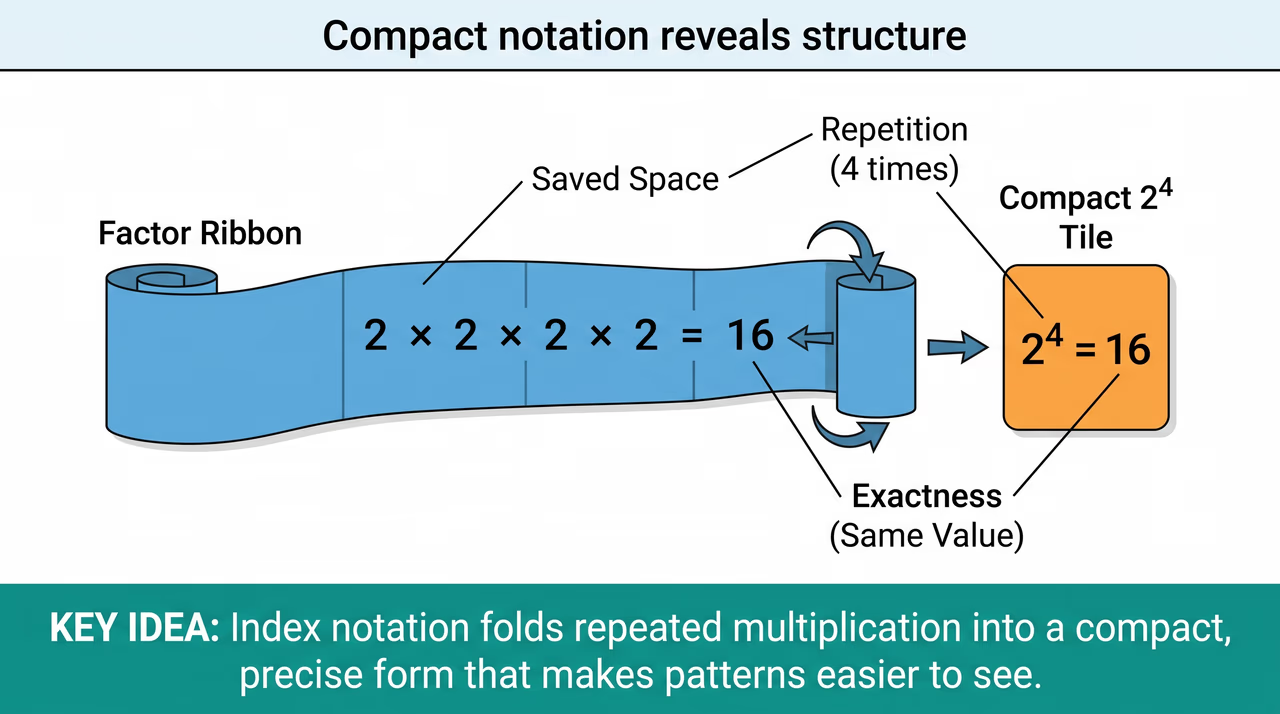
Indices expose repeated multiplication, scale, and dimension in a form that can be compared quickly. A well-chosen index representation helps a learner notice patterns that would be hidden inside long strings of ordinary multiplication.
- Indices make repeated growth easier to read and compare.
- Powers describe dimensions in area and volume.
- A compact expression can preserve exactness while making repeated structure easier to compare.
- The base and exponent each carry useful information.
Worked example. Count the four equal factors. Use the base 2 and exponent 4. Compare the compact form with the original product. Answer: 2⁴ records the same exact value while showing the repeated-factor structure..
Check question: What information does the exponent preserve when repeated multiplication is written in compact index notation?
- How many times the base is used as a factor
- The sum of the bases added together
- The product of the base and the exponent
- The number of digits in the final evaluated result
Show answer
How many times the base is used as a factor. The exponent communicates repetition without listing every multiplication sign, showing exactly how many times the base is used as a factor.
