Skip to content

Grade 10 · Core Mathematics · Lesson 6 of 13

From Powers of Ten to Common Logs

A Grade 10 Core Mathematics CBE lesson from the sub-strand Indices and Logarithms. In it, learners translate powers of ten into common logarithms.

Strand Numbers and AlgebraSub-strand Indices and LogarithmsLesson code 10CM-12-L640 minutes · 2 slides

KICD learning outcome (d)

Relate index notation to logarithm notation to base 10.

By the end of this lesson, learners should be able to

  1. Translate powers of ten into common logarithms.
  2. Translate common logarithms back into powers of ten.
  3. Explain the exponent-logarithm relationship in words.

Key vocabulary

Common logarithm
A logarithm whose base is ten.
log₁₀(100) is two because 10² equals 100.
Logarithm
The exponent needed to produce a number from a base.
The logarithm of 1,000 to base ten is three.
Argument
The positive number inside a logarithm expression.
In log₁₀(10,000), the argument is 10,000.
Equivalent
Having the same mathematical meaning or value.
10² = 100 and log₁₀(100) = 2 are equivalent.

Lesson preview

Slide 1 · A logarithm names an exponentOpening · 18 min
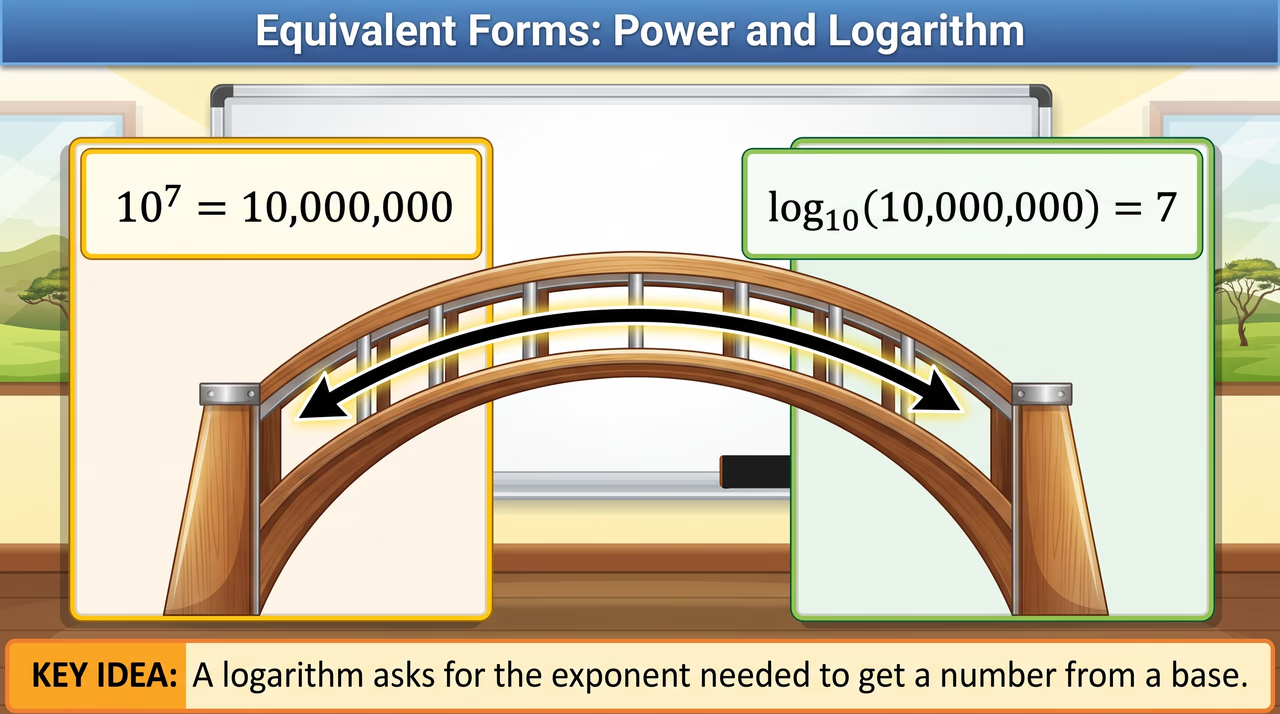
A bridge diagram illustrates the mathematical equivalence between ten to the power of seven and its logarithm to base ten.
Figure 1: A bridge diagram illustrates the mathematical equivalence between ten to the power of seven and its logarithm to base ten.

A common logarithm asks which power of ten produces a positive number. Thus 10ᵏ = N and log₁₀(N) = k are two descriptions of one relationship, with the index moving from the power position to the logarithm value. See Figure 1 for an example of how the index moves to become the logarithm value.

  • The base ten is understood in a common logarithm.
  • A logarithm is an exponent, not an ordinary quotient.
  • Power and logarithm statements can be read in both directions.
  • Positive powers of ten produce integer common logarithms.
Worked example. Identify base 10 and exponent 7. Place the power result inside the logarithm. Write log10(10,000,000) = 7 and reverse the statement to check. Answer: log10(10,000,000) = 7.

Check question: What is the value of log⁡10(100,000,000)?

  1. 8
  2. 7
  3. 9
  4. 108
Show answer

8. One hundred million is written as 108. Since the exponent needed to produce 100,000,000 from base 10 is 8, its common logarithm is 8.

Slide 2 · Read the relationship in reversePractice · 22 min
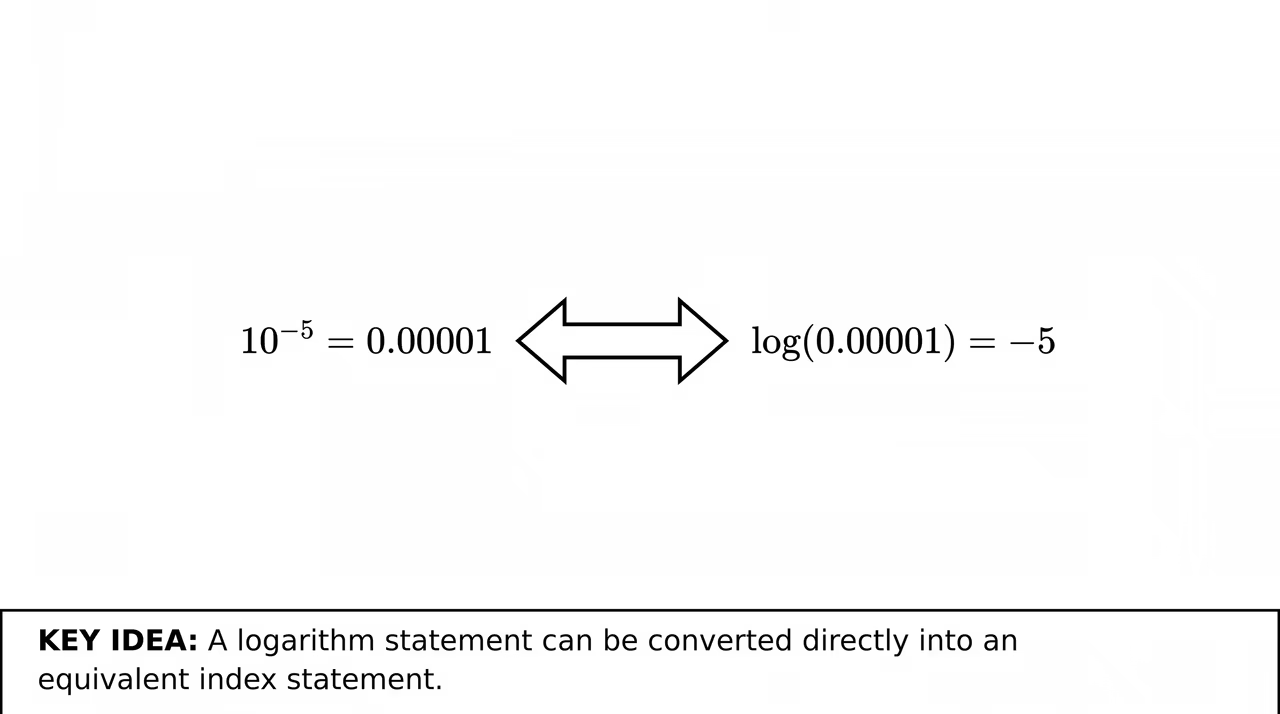
A two-way arrow shows the direct relationship between ten to the power of negative five and its common logarithm.
Figure 2: A two-way arrow shows the direct relationship between ten to the power of negative five and its common logarithm.

Teach the full lesson on the projector

This lesson, and every other Grade 1–10 CBE lesson, comes ready to project with the EAP ClassKit. It runs without electricity or internet.

  • Both slides with diagrams and class activities
  • Teacher notes, SNE adaptations and assessment checks
  • Homework and the other 12 lessons in this sub-strand

All 13 lessons in Indices and Logarithms

  1. 1Reading Repeated Factors as IndicesExpress numbers in index form
  2. 2Index Forms with a Specified BaseExpress numbers in index form
  3. 3Discovering Product and Quotient LawsDerive the laws of indices using factors
  4. 4Power of a Power and Identity CasesDerive the laws of indices using factors
  5. 5Indices in Measurement and DesignApply the laws of indices in different situations
  6. 6From Powers of Ten to Common LogsRelate index notation to logarithm notation to base 10
  7. 7Interpreting Base-Ten LogarithmsRelate index notation to logarithm notation to base 10
  8. 8Reading Common Logarithms in TablesDetermine common logarithms of numbers from mathematical tables and calculators
  9. 9Comparing Table and Calculator LogarithmsDetermine common logarithms of numbers from mathematical tables and calculators
  10. 10Logarithms for Multiplication and DivisionApply common logarithms in multiplication, division, powers and roots of numbers
  11. 11Logarithms for Powers and RootsApply common logarithms in multiplication, division, powers and roots of numbers
  12. 12Integrated Logarithmic ComputationApply common logarithms in multiplication, division, powers and roots of numbers
  13. 13Why Indices and Logarithms MatterAppreciate the use of indices and common logarithms in mathematical computations