Slide 1 · Area and volume use repeated dimensionsOpening · 18 min
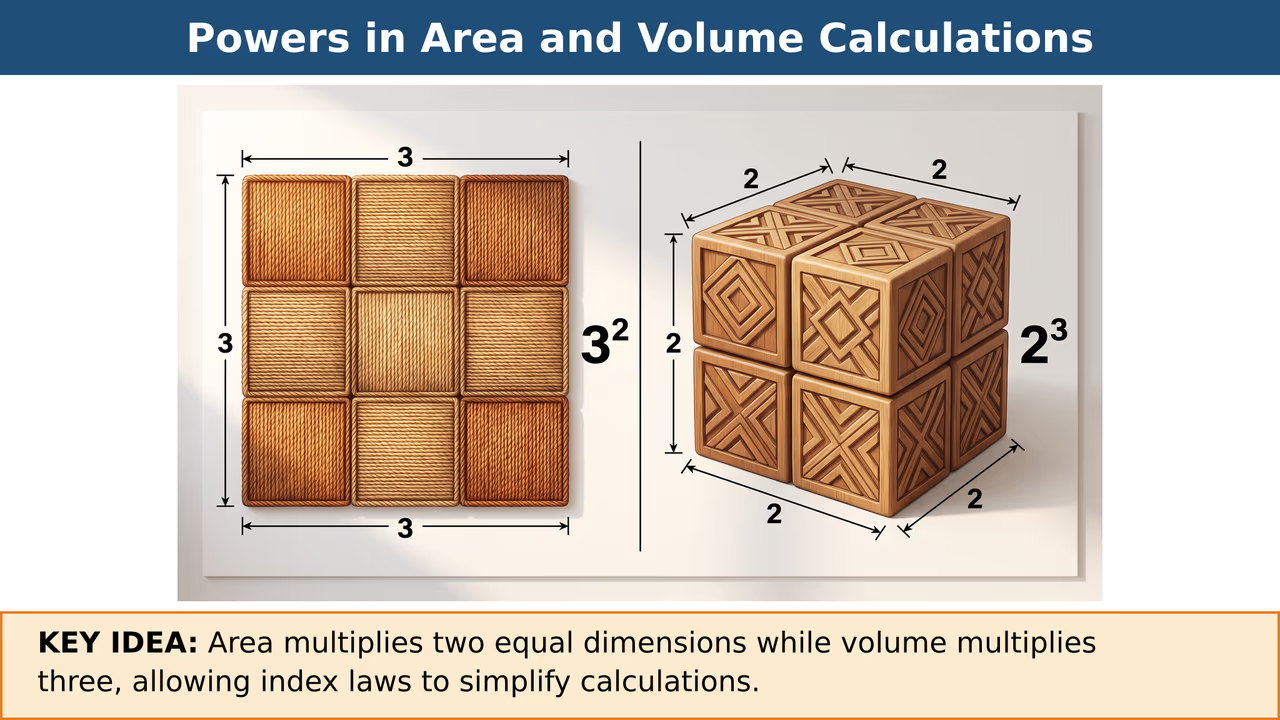
Many measurements naturally create powers because equal lengths are multiplied. A square uses two dimensions and a cube uses three, so index laws can simplify scaled dimensions before a numerical answer is found. Study Figure 1 to see how index laws can simplify these scaled dimensions.
- Area multiplies two lengths with compatible units.
- Volume multiplies three lengths with compatible units.
- Repeated scaling can be represented as powers.
- The final power should still match the context.
Worked example. Area is side × side, so write ()(). Add exponents: 2 + 2 = 4. State area as square centimetres. Answer: cm².
Check question: A storage box is designed as a perfect cube with a side length of units. What power of represents the volume of this box?
Show answer
. The volume of a cube is found by multiplying its length, width, and height. Since all sides are equal, the volume is . According to the laws of indices, when multiplying terms with the same base, we keep the base and add the exponents: . Therefore, the volume is cubic units.