Skip to content

Grade 10 · Core Mathematics · Lesson 12 of 13

Integrated Logarithmic Computation

A Grade 10 Core Mathematics CBE lesson from the sub-strand Indices and Logarithms. In it, learners select logarithm laws from an operation structure.

Strand Numbers and AlgebraSub-strand Indices and LogarithmsLesson code 10CM-12-L1240 minutes · 4 slides

KICD learning outcome (f)

Apply common logarithms in multiplication, division, powers and roots of numbers.

By the end of this lesson, learners should be able to

  1. Select logarithm laws from an operation structure.
  2. Combine several transformations accurately.
  3. Validate a result using magnitude and inverse operations.

Key vocabulary

Operation structure
The arrangement of operations in a mathematical expression.
A quotient of powers has division as its outer structure.
Plan
An ordered set of steps prepared before calculation.
A log plan lists additions, subtractions, multiplication, and division.
Transformation
A change from one mathematical representation to another.
A product transforms into a sum of logarithms.
Intermediate value
A result used before the final answer is obtained.
The combined log is an intermediate value before antilog.
Model
A mathematical description of a real situation.
A cube model represents volume as side cubed.
Unit
A standard quantity used to measure something.
Area is reported in square metres, not metres.
Audit
A systematic check of reasoning, arithmetic, and interpretation.
An audit verifies the log law, antilog, size, and units.
Inverse operation
An operation that reverses the effect of another.
Cubing reverses taking a cube root.

Lesson preview

Slide 1 · Read the operation before calculatingOpening · 9 min
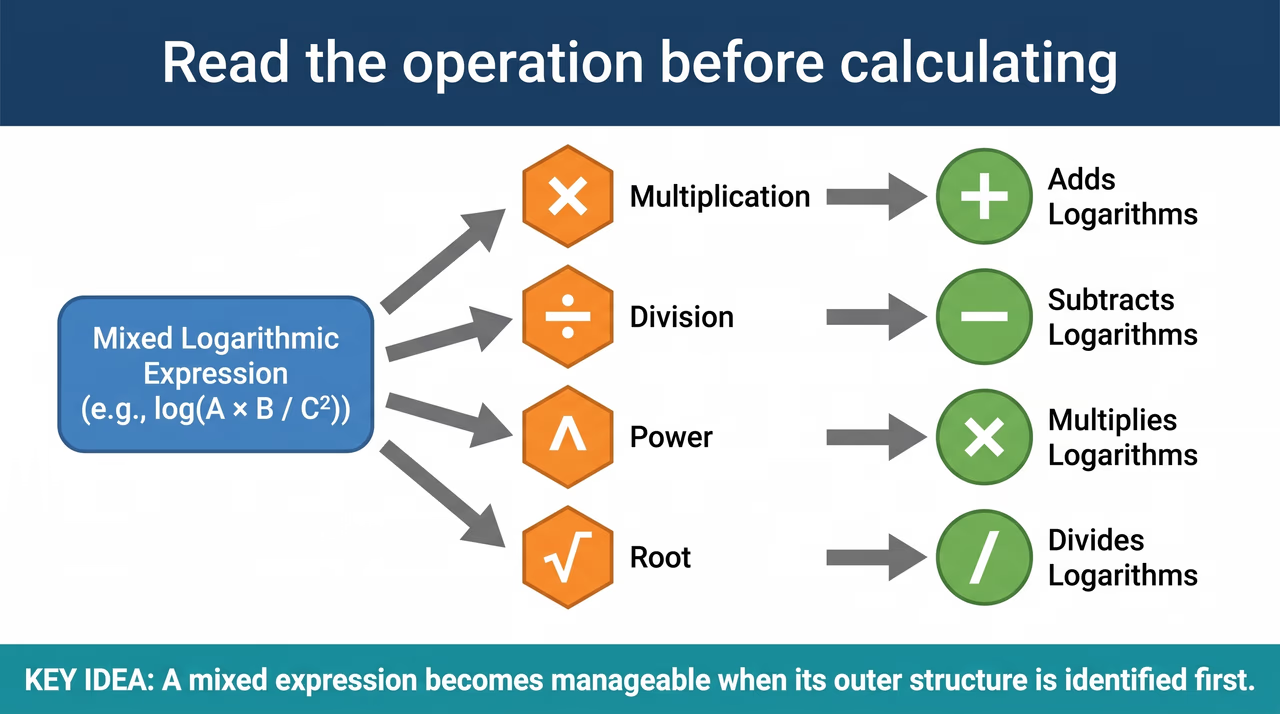
A flowchart shows how the outer structure of a mixed expression dictates whether to add, subtract, multiply, or divide the corresponding logarithms.
Figure 1: A flowchart shows how the outer structure of a mixed expression dictates whether to add, subtract, multiply, or divide the corresponding logarithms.

A mixed expression becomes manageable when its outer structure is identified first. Multiplication adds logarithms, division subtracts them, powers multiply, and roots divide; writing this plan prevents sign and factor errors. Use Figure 1 to plan your operations before calculating.

  • Parentheses reveal the order of a mixed expression.
  • Operation structure determines the logarithm law that should be applied first.
  • A symbolic plan should precede decimal substitution.
  • Magnitude estimates provide an independent safety check.
Worked example. Power law gives 3log₁₀(12). Division subtracts log₁₀(4). Write 3log₁₀(12) − log₁₀(4). Answer: 3log₁₀(12) − log₁₀(4).

Check question: How do you use logarithms to calculate the square root of a positive expression x?

  1. Divide log⁡10(x) by 2.
  2. Multiply log⁡10(x) by 2.
  3. Subtract 2 from log⁡10(x).
  4. Find the square root of log⁡10(x).
Show answer

Divide log⁡10(x) by 2. A square root is equivalent to a power of 12. According to the power law of logarithms, log⁡10(x12)=12log⁡10(x), which means the correct plan is to divide the logarithm of the expression by 2.

Slide 2 · A complete mixed calculationModel · 11 min
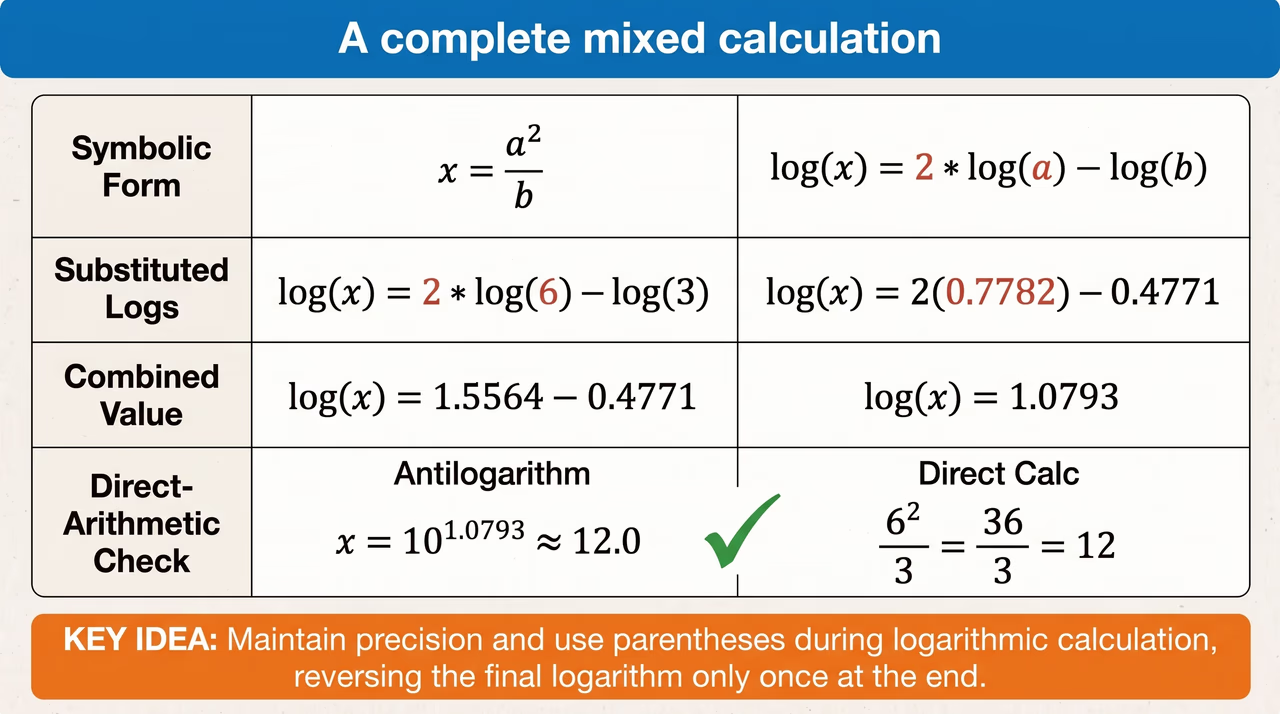
A four-row table demonstrates a complete calculation for a power divided by a factor, comparing logarithmic steps with a direct arithmetic check.
Figure 2: A four-row table demonstrates a complete calculation for a power divided by a factor, comparing logarithmic steps with a direct arithmetic check.

Teach the full lesson on the projector

This lesson, and every other Grade 1–10 CBE lesson, comes ready to project with the EAP ClassKit. It runs without electricity or internet.

  • All 4 slides with diagrams and class activities
  • Teacher notes, SNE adaptations and assessment checks
  • Homework and the other 12 lessons in this sub-strand

All 13 lessons in Indices and Logarithms

  1. 1Reading Repeated Factors as IndicesExpress numbers in index form
  2. 2Index Forms with a Specified BaseExpress numbers in index form
  3. 3Discovering Product and Quotient LawsDerive the laws of indices using factors
  4. 4Power of a Power and Identity CasesDerive the laws of indices using factors
  5. 5Indices in Measurement and DesignApply the laws of indices in different situations
  6. 6From Powers of Ten to Common LogsRelate index notation to logarithm notation to base 10
  7. 7Interpreting Base-Ten LogarithmsRelate index notation to logarithm notation to base 10
  8. 8Reading Common Logarithms in TablesDetermine common logarithms of numbers from mathematical tables and calculators
  9. 9Comparing Table and Calculator LogarithmsDetermine common logarithms of numbers from mathematical tables and calculators
  10. 10Logarithms for Multiplication and DivisionApply common logarithms in multiplication, division, powers and roots of numbers
  11. 11Logarithms for Powers and RootsApply common logarithms in multiplication, division, powers and roots of numbers
  12. 12Integrated Logarithmic ComputationApply common logarithms in multiplication, division, powers and roots of numbers
  13. 13Why Indices and Logarithms MatterAppreciate the use of indices and common logarithms in mathematical computations