
Skip to content

Grade 10 · Core Mathematics · Lesson 13 of 14

Appreciating Linear Motion in Real-Life Situations

A Grade 10 Core Mathematics CBE lesson from the sub-strand Linear Motion. In it, learners identify and model straight-line motion in everyday Kenyan contexts such as highway driving and inclined surfaces.

Strand Measurements and GeometrySub-strand Linear MotionLesson code 10CM-29-L1340 minutes · 3 slides

KICD learning outcome (h)

Appreciate use of linear motion in real-life situations.

By the end of this lesson, learners should be able to

  1. Identify and model straight-line motion in everyday Kenyan contexts such as highway driving and inclined surfaces.
  2. Calculate velocity, acceleration, and displacement for real-world scenarios including cruising vessels and accelerating vehicles.
  3. Construct and interpret multi-stage linear motion representations including stopovers and return trips.

Key vocabulary

Linear Motion
Movement of an object along a continuous straight-line path in space.
A matatu travelling along a straight section of highway demonstrates linear motion.
Acceleration
The rate of change of velocity with respect to time taken.
The matatu experiences positive acceleration of 2.5 m/s2 while speeding up.
Displacement
Distance measured in a specified straight direction from a fixed reference origin point.
The boat had a displacement of 3 km North-East from the landing site.
Cruising Velocity
Uniform velocity of a vessel moving steadily in one particular direction.
The fishing boat maintains a steady cruising velocity of 5 m/s heading North-East.
Rest Interval
Period during a journey where an object remains stationary with zero velocity.
The fish farmer had a rest interval of 2 hours while inspecting fish cages.

Lesson preview

Slide 1 · Linear Motion on Roads and Inclined SurfacesOpening · 12 min
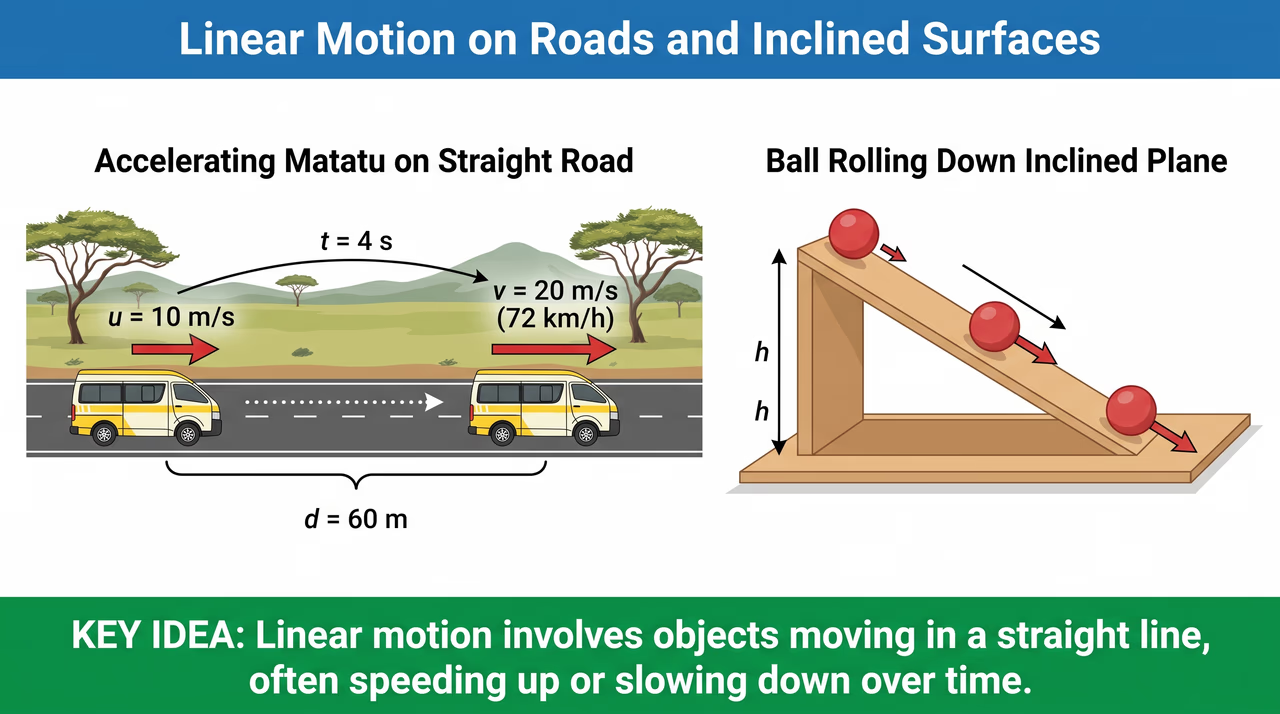
A matatu accelerating on a straight road alongside a red ball rolling down an inclined plane to demonstrate linear motion.
Figure 1: A matatu accelerating on a straight road alongside a red ball rolling down an inclined plane to demonstrate linear motion.

Linear motion models straight-line movement in real-world Kenyan transport and physical experiments. When a vehicle speeds up on a flat highway or a ball rolls down an inclined surface, its velocity changes at a constant rate called acceleration. Understanding changes in velocity over precise time intervals enables us to predict stopping distances, track travel durations, and evaluate mechanical safety in everyday scenarios.

  • Linear motion describes straight-line movement of vehicles, objects on inclined planes, and practical laboratory setups.
  • Acceleration measures the rate at which velocity changes as an object speeds up or slows down.
  • Average velocity multiplied by time gives the total straight-line distance covered during constant acceleration.
  • Inclined surfaces demonstrate natural acceleration due to gravity, providing practical insights into motion dynamics.
Worked example. Calculate acceleration using a=v−ut=20 m/s−10 m/s4 s=104=2.5 m/s2. Determine average velocity: Average velocity=10+202=15 m/s. Multiply average velocity by time to find distance: s=15 m/s×4 s=60 m. Answer: Acceleration is 2.5 m/s2 and distance covered is 60 m..

Check question: A bicycle rolling down a straight inclined ramp increases its velocity from 2 m/s to 8 m/s in 4 seconds. Find its acceleration and total distance covered down the ramp.

  1. Acceleration is 1.5 m/s2 and distance is 20 m
  2. Acceleration is 2.5 m/s2 and distance is 20 m
  3. Acceleration is 1.5 m/s2 and distance is 40 m
  4. Acceleration is 2.0 m/s2 and distance is 32 m
Show answer

Acceleration is 1.5 m/s2 and distance is 20 m. Acceleration a=v−ut=8−24=64=1.5 m/s2. Average velocity = u+v2=2+82=5 m/s. Distance = Average velocity × time = 5 m/s×4 s=20 m.

Slide 2 · Maritime Displacement and Vessel CruisingModel · 14 min
A vector map showing a fishing boat cruising in a North-East direction from a landing point over time.
Figure 2: A vector map showing a fishing boat cruising in a North-East direction from a landing point over time.

Teach the full lesson on the projector

This lesson, and every other Grade 1–10 CBE lesson, comes ready to project with the EAP ClassKit. It runs without electricity or internet.

  • All 3 slides with diagrams and class activities
  • Teacher notes, SNE adaptations and assessment checks
  • Homework and the other 13 lessons in this sub-strand

All 14 lessons in Linear Motion

  1. 1Distance, Displacement, Speed, Velocity and AccelerationExplain the terms distance, displacement, speed, velocity and acceleration in real-life situations
  2. 2Determining Velocity and AccelerationDetermine velocity and acceleration in different situations
  3. 3Determining Velocity and Acceleration in Different SituationsDetermine velocity and acceleration in different situations
  4. 4Drawing Displacement-Time Graphs in Linear MotionDraw a displacement-time graph of different situations
  5. 5Interpreting Displacement-Time GraphsInterpret displacement-time graph in different situations
  6. 6Interpreting Displacement-Time Graphs in Different SituationsInterpret displacement-time graph in different situations
  7. 7Drawing Velocity-Time Graphs from Data TablesDraw a velocity-time graph from given tables in different situations
  8. 8Drawing Velocity-Time Graphs from Data Tables: Deceleration and ScenariosDraw a velocity-time graph from given tables in different situations
  9. 9Interpreting Velocity-Time Graphs in Linear MotionInterpret velocity-time graph in different situations
  10. 10Interpreting Velocity-Time Graphs in Practical SituationsInterpret velocity-time graph in different situations
  11. 11Relative Speed in Linear MotionDetermine relative speed of two moving bodies in different situations
  12. 12Relative Speed in Linear Motion: Advanced ApplicationsDetermine relative speed of two moving bodies in different situations
  13. 13Appreciating Linear Motion in Real-Life SituationsAppreciate use of linear motion in real-life situations
  14. 14Real-Life Applications of Linear MotionAppreciate use of linear motion in real-life situations