Slide 1 · Delayed Departures and Overtaking TimesOpening · 12 min
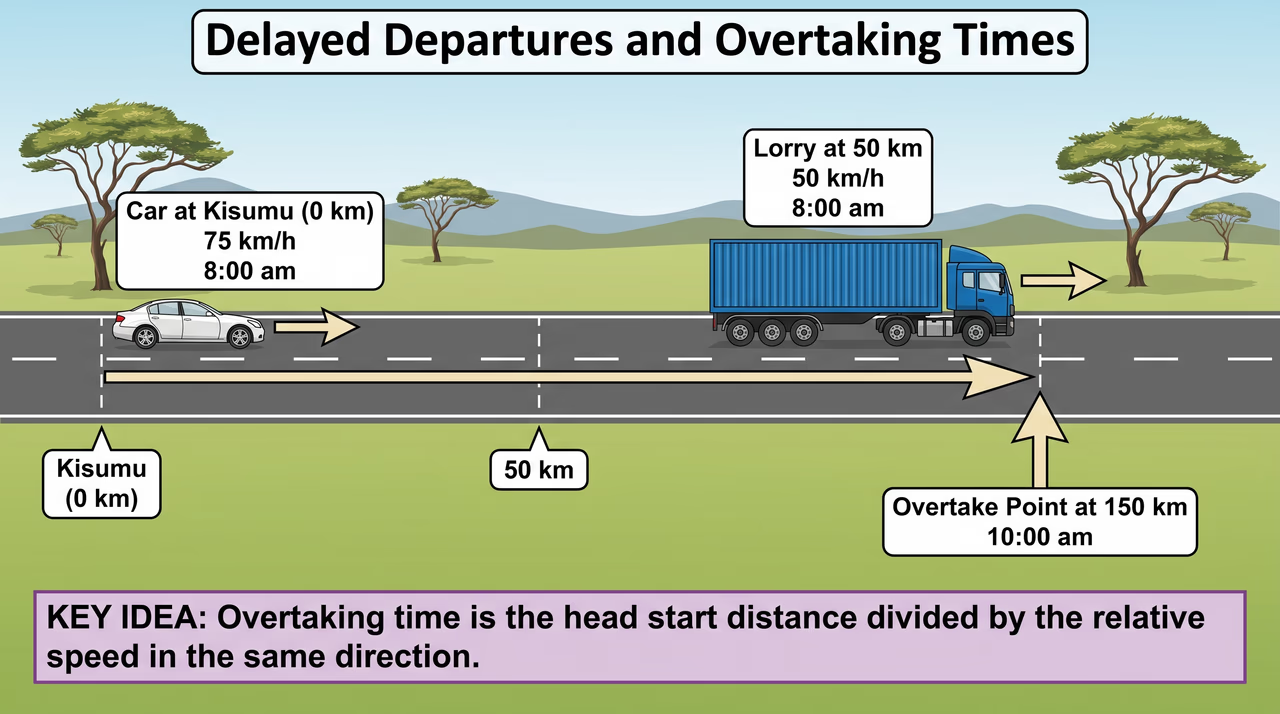
When one vehicle departs earlier than another, it gains a distance head start before the second vehicle begins moving. To find when the faster vehicle overtakes the slower one, first calculate this head start distance. Next, divide the head start distance by the relative speed of the two vehicles moving in the same direction. Adding this travel duration to the second vehicle's departure time yields the exact clock time of overtaking.
- Calculate head start distance by multiplying the earlier vehicle's speed by the difference in departure times.
- Determine relative speed in the same direction by subtracting the slower speed from the faster speed.
- Find overtaking time by dividing the head start distance by the calculated relative speed.
- Add the overtaking time to the later departure time to determine the exact clock time.
Worked example. Calculate departure time difference: . Calculate lorry's head start distance: . Calculate relative speed in same direction: . Calculate time needed to overtake: . Determine overtaking clock time: . Calculate distance from Kisumu: . Answer: The car overtakes the lorry at , at a distance of from Kisumu..
Check question: A cyclist leaves Kapsabet at 6:30 am travelling at . A matatu departs Kapsabet at 7:30 am along the same road at . At what exact clock time does the matatu overtake the cyclist?
- 6:50 am
- 7:42 am
- 7:45 am
- 7:50 am
Show answer
7:50 am. Head start distance . Relative speed . Time taken . Overtaking time .