Skip to content

Grade 10 · Core Mathematics · Lesson 8 of 9

Surface Area and Volume of Solids: Real-Life Applications (Part 1)

A Grade 10 Core Mathematics CBE lesson from the sub-strand Surface Area and Volume of Solids. In it, learners calculate curved surface areas in real-life containers, flower vessels, and open lampshades.

Strand Measurements and GeometrySub-strand Surface Area and Volume of SolidsLesson code 10CM-27-L840 minutes · 3 slides

KICD learning outcome (e)

Explore the use of the surface area and volume of solids in real-life situations.

By the end of this lesson, learners should be able to

  1. Calculate curved surface areas in real-life containers, flower vessels, and open lampshades.
  2. Determine total surface area for pyramids, regular tetrahedrons, and pyramid frustums in practical contexts.
  3. Compute external surface area of composite real-world structures like animal kennels and grain barns.

Key vocabulary

Curved surface area
The total area of the rounded outer surface of a three-dimensional curved geometric solid.
The curved surface area of the conical vase determines the surface touching liquid.
Regular tetrahedron
A three-dimensional solid figure bounded by four identical congruent equilateral triangular faces.
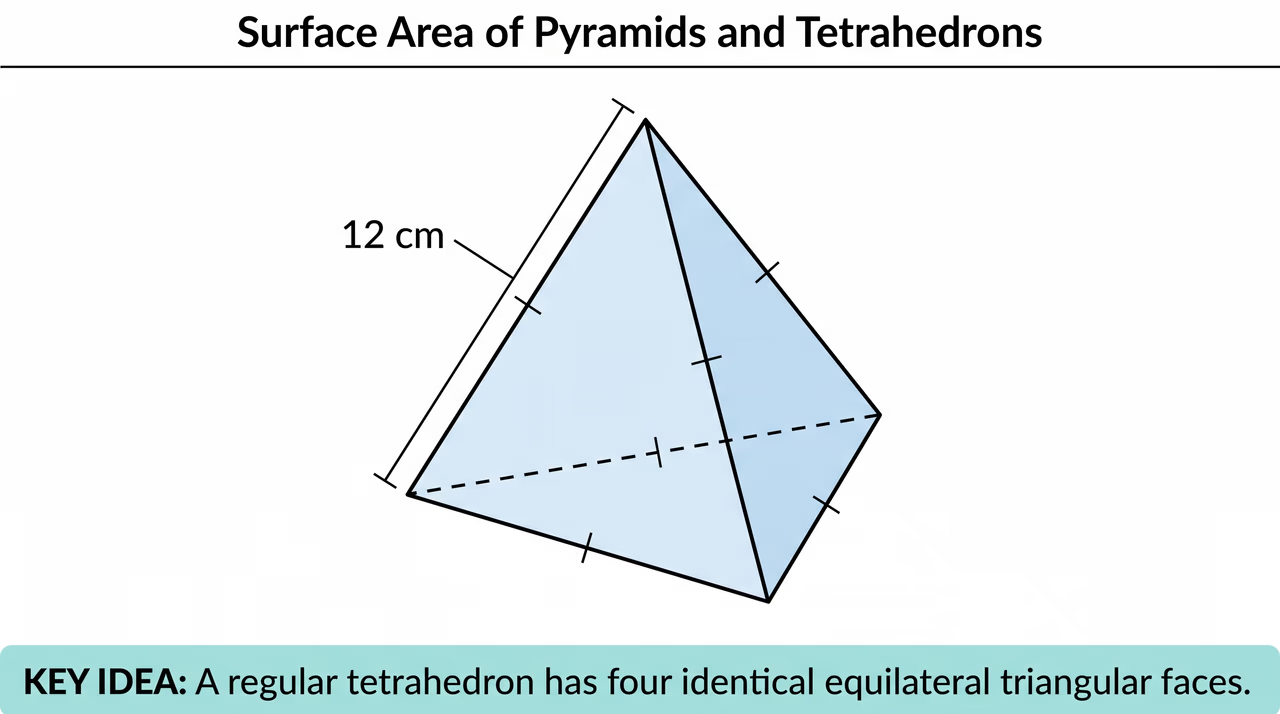
A regular tetrahedral carton with edge length 12 cm has four identical triangular faces.
Composite solid
A three-dimensional solid structure created by combining two or more basic geometric shapes.
The grain barn is a composite solid formed by a cuboid base and semi-cylinder roof.

Lesson preview

Slide 1 · Practical Surface Area of Cones, Frustums, and HemispheresOpening · 12 min
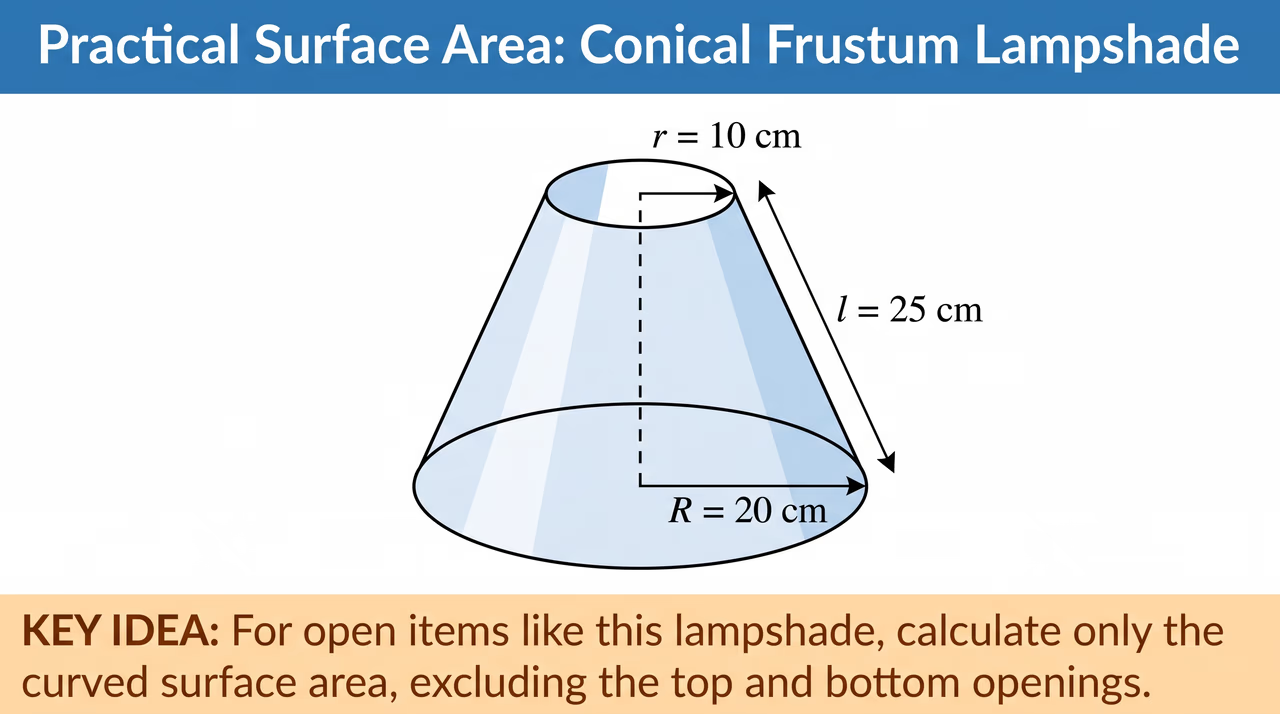
This diagram displays a conical frustum lampshade with a top radius of 10 cm, a bottom radius of 20 cm, and a slant height of 25 cm.
Figure 1: This diagram displays a conical frustum lampshade with a top radius of 10 cm, a bottom radius of 20 cm, and a slant height of 25 cm.

Everyday containers and decorative items like lampshades, hemispherical bowls, and conical vases rely on surface area formulas for their material design. When calculating surface area for open containers or lampshades, internal surfaces or open top and bottom faces are excluded. Applying the curved surface area formula πrl for cones and π(R+r)l for frustums allows us to find exact material needs in real-life applications.

  • In practical applications, surface area calculations often exclude open apertures and internal unexposed boundaries.
  • An inverted cone vessel holding liquid has fluid in contact with only its curved lateral surface area.
  • A lampshade shaped as an open conical frustum requires calculating only its curved outer material area.
  • Hemispherical bowls and spherical objects use curved surface area formulas derived from πd2 or 2πr2.
Worked example. Identify the formula for the curved surface area of an open frustum: A=π(R+r)l. Substitute R=20 cm, r=10 cm, and slant height l=25 cm. Calculate: A=3.142×(20+10)×25=3.142×30×25. Evaluate: 3.142×750=2356.5 cm2. Answer: 2356.5 cm2.

Check question: A flower vase in the shape of an inverted cone has a top radius of 7 cm and a vertical height of 24 cm. Liquid is poured in until it completely reaches the top rim. Calculate the area of the vase touched by the liquid. (Take π=227).

  1. 528 cm2
  2. 550 cm2
  3. 704 cm2
  4. 1232 cm2
Show answer

550 cm2. First, find the slant height of the cone using Pythagoras' theorem: l=72+242=49+576=625=25 cm. The area touched by the liquid is the curved surface area of the cone. A=πrl=227×7×25=550 cm2.

Slide 2 · Surface Area of Pyramids, Tetrahedrons, and Pyramid FrustumsModel · 14 min
A regular tetrahedron is displayed with a side length of 12 cm and tick marks indicating that all of its edges are equal in length.
Figure 2: A regular tetrahedron is displayed with a side length of 12 cm and tick marks indicating that all of its edges are equal in length.

Teach the full lesson on the projector

This lesson, and every other Grade 1–10 CBE lesson, comes ready to project with the EAP ClassKit. It runs without electricity or internet.

  • All 3 slides with diagrams and class activities
  • Teacher notes, SNE adaptations and assessment checks
  • Homework and the other 8 lessons in this sub-strand

All 9 lessons in Surface Area and Volume of Solids

  1. 1Surface Area of Prisms and PyramidsDetermine the surface area of prisms, pyramids, cones, frustums and spheres
  2. 2Surface Area of Pyramids, Cones, and FrustumsDetermine the surface area of prisms, pyramids, cones, frustums and spheres
  3. 3Surface Area of Frustums, Spheres, and HemispheresDetermine the surface area of prisms, pyramids, cones, frustums and spheres
  4. 4Surface Area of Composite SolidsCalculate the surface area of composite solids
  5. 5Volume of Prisms, Pyramids, and ConesCalculate the volume of prisms, pyramids, cones, frustums and spheres
  6. 6Volume of Frustums and SpheresCalculate the volume of prisms, pyramids, cones, frustums and spheres
  7. 7Volume of Composite SolidsDetermine the volume of composite solids
  8. 8Surface Area and Volume of Solids: Real-Life Applications (Part 1)Explore the use of the surface area and volume of solids in real-life situations
  9. 9Real-Life Applications of Surface Area and Volume of SolidsExplore the use of the surface area and volume of solids in real-life situations