Skip to content

Grade 10 · Core Mathematics · Lesson 7 of 9

Volume of Composite Solids

A Grade 10 Core Mathematics CBE lesson from the sub-strand Surface Area and Volume of Solids. In it, learners decompose composite solids into basic 3D shapes along joining planes.

Strand Measurements and GeometrySub-strand Surface Area and Volume of SolidsLesson code 10CM-27-L740 minutes · 2 slides

KICD learning outcome (d)

Determine the volume of composite solids.

By the end of this lesson, learners should be able to

  1. Decompose composite solids into basic 3D shapes along joining planes.
  2. Calculate individual component volumes and apply the additive principle to find total volume.

Key vocabulary

Composite solid
A three-dimensional figure constructed by joining two or more basic geometric shapes together.
The kennel structure is a composite solid made of a cuboid and a pyramid.
Additive principle
The rule stating that total volume equals the sum of component shapes' individual volumes.
We applied the additive principle to sum the cuboid and pyramid volumes together.
Compound cross-section
A composite two-dimensional face formed by combining two or more basic geometric plane figures.
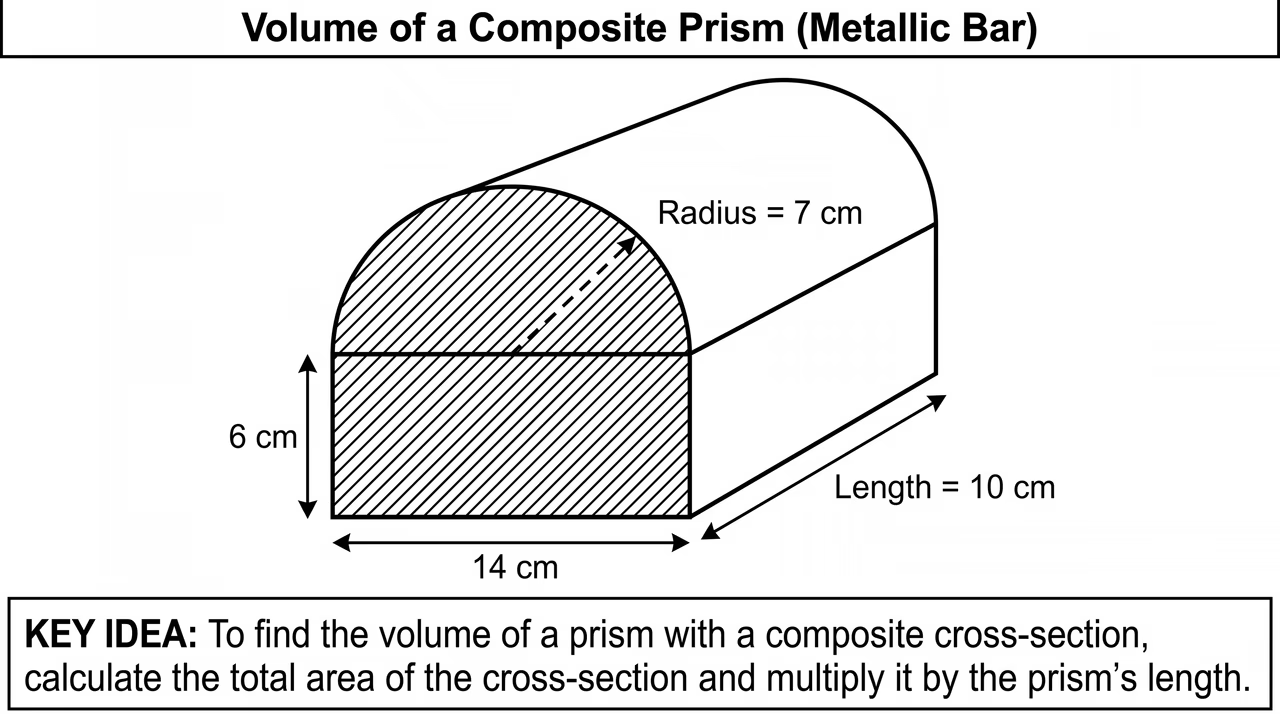
The bar's compound cross-section combines a rectangle and a semi-circle of radius 7 cm.

Lesson preview

Slide 1 · Decomposing Composite Solids into Individual ShapesModel · 18 min
A composite solid representing a kennel is split along a dashed joining plane into a rectangular cuboid base and a rectangular pyramid top.
Figure 1: A composite solid representing a kennel is split along a dashed joining plane into a rectangular cuboid base and a rectangular pyramid top.

A composite solid is created by joining two or more standard three-dimensional shapes together along a shared plane. To determine the volume of a composite solid, we apply the additive principle: we divide the composite figure into its individual component shapes, calculate the volume of each component using its standard formula, and then sum the individual volumes. Unlike surface area calculations, we do not subtract joined faces when calculating volume because volume measures total internal space.

  • A composite solid is formed by combining two or more distinct three-dimensional geometric figures along a common boundary.
  • The total volume of a composite solid equals the sum of the volumes of its component shapes.
  • Decompose complex structures along joining planes into recognisable 3D solids like prisms, pyramids, cones, or cylinders.
  • Standard geometric volume formulas are applied independently to each component shape before summing their calculated values.
Worked example. Calculate the volume of the cuboid base: V1=length×width×height=6×4×3=72 m3. Calculate the volume of the pyramid top: V2=13×base area×height=13×(6×4)×2.5=20 m3. Add the component volumes: Vtotal=V1+V2=72+20=92 m3. Answer: The total volume of the grain container is 92 m3..

Check question: A water reservoir model consists of a cylinder of radius 7 cm and height 5 cm, capped with a cone of the same radius 7 cm and height 6 cm. Taking π=227, calculate the total volume of the structure.

  1. 154 cm3
  2. 770 cm3
  3. 1078 cm3
  4. 1694 cm3
Show answer

1078 cm3. Volume of the cylinder V1=πr2h1=227×72×5=770 cm3. Volume of the cone V2=13πr2h2=13×227×72×6=308 cm3. Total volume V=770+308=1078 cm3.

Slide 2 · Calculating Volumes of Complex Composite StructuresPractice · 22 min
A composite prism representing a metallic bar features a shaded cross-section made of a rectangle and a semi-circle, with its length indicated.
Figure 2: A composite prism representing a metallic bar features a shaded cross-section made of a rectangle and a semi-circle, with its length indicated.

Teach the full lesson on the projector

This lesson, and every other Grade 1–10 CBE lesson, comes ready to project with the EAP ClassKit. It runs without electricity or internet.

  • Both slides with diagrams and class activities
  • Teacher notes, SNE adaptations and assessment checks
  • Homework and the other 8 lessons in this sub-strand

All 9 lessons in Surface Area and Volume of Solids

  1. 1Surface Area of Prisms and PyramidsDetermine the surface area of prisms, pyramids, cones, frustums and spheres
  2. 2Surface Area of Pyramids, Cones, and FrustumsDetermine the surface area of prisms, pyramids, cones, frustums and spheres
  3. 3Surface Area of Frustums, Spheres, and HemispheresDetermine the surface area of prisms, pyramids, cones, frustums and spheres
  4. 4Surface Area of Composite SolidsCalculate the surface area of composite solids
  5. 5Volume of Prisms, Pyramids, and ConesCalculate the volume of prisms, pyramids, cones, frustums and spheres
  6. 6Volume of Frustums and SpheresCalculate the volume of prisms, pyramids, cones, frustums and spheres
  7. 7Volume of Composite SolidsDetermine the volume of composite solids
  8. 8Surface Area and Volume of Solids: Real-Life Applications (Part 1)Explore the use of the surface area and volume of solids in real-life situations
  9. 9Real-Life Applications of Surface Area and Volume of SolidsExplore the use of the surface area and volume of solids in real-life situations