Skip to content

Grade 10 · Core Mathematics · Lesson 1 of 9

Surface Area of Prisms and Pyramids

A Grade 10 Core Mathematics CBE lesson from the sub-strand Surface Area and Volume of Solids. In it, learners unfold three-dimensional prisms and pyramids into flat two-dimensional nets to identify all face shapes.

Strand Measurements and GeometrySub-strand Surface Area and Volume of SolidsLesson code 10CM-27-L140 minutes · 4 slides

KICD learning outcome (a)

Determine the surface area of prisms, pyramids, cones, frustums and spheres.

By the end of this lesson, learners should be able to

  1. Unfold three-dimensional prisms and pyramids into flat two-dimensional nets to identify all face shapes.
  2. Calculate the total surface area of uniform prisms by summing cross-sectional and lateral face areas.
  3. Determine the surface area of right pyramids using base area and lateral slant triangular face areas.

Key vocabulary

Prism
A solid with two identical parallel end faces and flat uniform rectangular side faces.
A triangular prism has two congruent triangle ends and three rectangular face sides.
Net
A two-dimensional flat pattern unfolded from a three-dimensional solid shape showing faces.
Unfolding the prism net exposes two triangles and three rectangles flat on paper.
Trapezoidal prism
A solid prism whose two congruent parallel base ends are four-sided trapezia.
A wooden block with a trapezium cross-section forms a trapezoidal prism solid.
Pyramid
A solid figure having a polygonal base and triangular faces meeting at a top apex.
A square-based pyramid has one square base and four triangular slant faces.
Slant height
The height of a triangular face, measured along the face from base edge to apex.
The slant height of a square pyramid face is perpendicular to its base edge.
Apex
The highest vertex point where all lateral triangular faces of a pyramid meet.
All four triangular side faces meet at the apex of the rectangular pyramid.

Lesson preview

Slide 1 · Surface Area of Prisms using NetsOpening · 10 min
A right-angled triangular prism with its dimensions and its corresponding unfolded net showing three rectangular and two triangular faces.
Figure 1: A right-angled triangular prism with its dimensions and its corresponding unfolded net showing three rectangular and two triangular faces.

A prism is a solid figure with uniform cross-section throughout its length. To find the surface area of a prism, we unfold its 3D shape into a 2D net and sum the areas of all individual faces. For a right triangular prism, the net consists of two congruent triangular end faces and three rectangular side faces. If the triangular height is not given directly, we apply Pythagoras' theorem on the cross-section. Use Figure 1 to visualise how a three-dimensional prism unfolds into a two-dimensional net.

  • A prism possesses two congruent parallel bases and rectangular lateral faces connecting those congruent end faces.
  • Unfolding a prism into its net reveals all individual two-dimensional face polygon shapes for area calculation.
  • Total surface area equals the combined sum of cross-sectional end face areas and lateral face areas.
  • Apply Pythagoras' theorem a2+b2=c2 to determine missing triangular height dimensions before finding face areas.
Worked example. Area of one triangular face = 12×5×12=30 cm2. Combined area of two triangular faces = 2×30=60 cm2. Areas of three rectangular faces = 5×20=100 cm2, 12×20=240 cm2, and 13×20=260 cm2. Total surface area = 60+100+240+260=660 cm2. Answer: 660 cm2.

Check question: Find the surface area of a right triangular prism with triangular leg dimensions 3 cm and 4 cm, hypotenuse 5 cm, and prism length 10 cm.

  1. 120 cm2
  2. 126 cm2
  3. 132 cm2
  4. 144 cm2
Show answer

132 cm2. The two triangular ends have area 2×(12×3×4)=12 cm2. The three rectangular faces have areas 3×10=30 cm2, 4×10=40 cm2, and 5×10=50 cm2. Total surface area = 12+30+40+50=132 cm2.

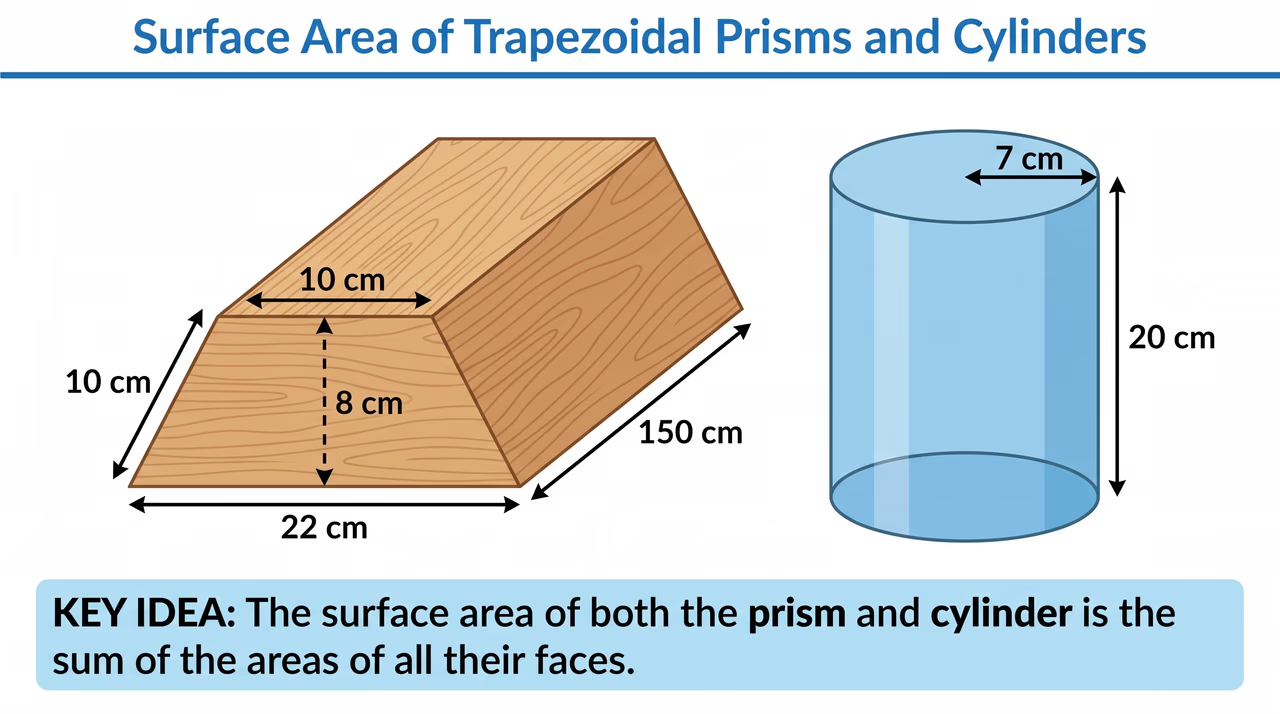
Slide 2 · Surface Area of Trapezoidal Prisms and CylindersModel · 10 min
A wooden trapezoidal prism and a closed blue cylinder, showing their dimensions for calculating surface area.
Figure 2: A wooden trapezoidal prism and a closed blue cylinder, showing their dimensions for calculating surface area.

Teach the full lesson on the projector

This lesson, and every other Grade 1–10 CBE lesson, comes ready to project with the EAP ClassKit. It runs without electricity or internet.

  • All 4 slides with diagrams and class activities
  • Teacher notes, SNE adaptations and assessment checks
  • Homework and the other 8 lessons in this sub-strand

All 9 lessons in Surface Area and Volume of Solids

  1. 1Surface Area of Prisms and PyramidsDetermine the surface area of prisms, pyramids, cones, frustums and spheres
  2. 2Surface Area of Pyramids, Cones, and FrustumsDetermine the surface area of prisms, pyramids, cones, frustums and spheres
  3. 3Surface Area of Frustums, Spheres, and HemispheresDetermine the surface area of prisms, pyramids, cones, frustums and spheres
  4. 4Surface Area of Composite SolidsCalculate the surface area of composite solids
  5. 5Volume of Prisms, Pyramids, and ConesCalculate the volume of prisms, pyramids, cones, frustums and spheres
  6. 6Volume of Frustums and SpheresCalculate the volume of prisms, pyramids, cones, frustums and spheres
  7. 7Volume of Composite SolidsDetermine the volume of composite solids
  8. 8Surface Area and Volume of Solids: Real-Life Applications (Part 1)Explore the use of the surface area and volume of solids in real-life situations
  9. 9Real-Life Applications of Surface Area and Volume of SolidsExplore the use of the surface area and volume of solids in real-life situations