Skip to content

Grade 10 · Core Mathematics · Lesson 2 of 9

Surface Area of Pyramids, Cones, and Frustums

A Grade 10 Core Mathematics CBE lesson from the sub-strand Surface Area and Volume of Solids. In it, learners calculate the total surface area of right pyramids using base area and triangular face areas.

Strand Measurements and GeometrySub-strand Surface Area and Volume of SolidsLesson code 10CM-27-L240 minutes · 4 slides

KICD learning outcome (a)

Determine the surface area of prisms, pyramids, cones, frustums and spheres.

By the end of this lesson, learners should be able to

  1. Calculate the total surface area of right pyramids using base area and triangular face areas.
  2. Determine the surface area of cones using base radius, perpendicular height, and slant height.
  3. Calculate the total surface area of pyramid frustums by summing base areas and trapezoidal side face areas.

Key vocabulary

Pyramid
A three-dimensional solid with a polygonal base and triangular sides meeting at an apex.
The surface area of a square pyramid includes one square base and four triangles.
Slant height
The perpendicular distance along a slanted face from the base to the apex.
A pyramid with a slant height of 20 cm has large triangular side faces.
Cone
A solid figure with a circular base and a single curved surface reaching an apex.
A cone with base radius 21 cm has a circular face and curved surface.
Curved surface area
The area of the non-flat side face of a curved three-dimensional geometric figure.
The curved surface area of this cone with radius 21 cm is 2310 cm².
Frustum
The bottom part of a pyramid or cone left after cutting the top off.
The surface area of the frustum includes both bases and four side faces.
Trapezoid
A quadrilateral having one pair of parallel sides of different lengths.
Each side face is a trapezoid with parallel lengths of 10 cm and 18 cm.
Net
A two-dimensional flat pattern that folds to form a three-dimensional solid.
Unfolding the open frustum net shows four congruent trapezia and one square base.

Lesson preview

Slide 1 · Surface Area of Right PyramidsOpening · 10 min
A square-based right pyramid and its unfolded net show a base side length of 14 cm and a slant height of 20 cm.
Figure 1: A square-based right pyramid and its unfolded net show a base side length of 14 cm and a slant height of 20 cm.

To find the surface area of a right pyramid, calculate the area of its base and add the total area of its sloping triangular faces. Unfolding the pyramid into its flat net clearly displays each individual face. For a regular square-based pyramid with side length s and slant height l, the four side triangles are identical, each having area 12sl. Summing the square base area s2 and the four triangular face areas gives the total surface area.

  • A right pyramid has a polygonal base and triangular faces meeting at a top vertex.
  • The total surface area of a pyramid equals base area plus area of triangular faces.
  • Slant height is the altitude of a triangular face, measured perpendicular to base edge.
  • Unfolding a square pyramid net reveals one square base and four congruent triangular faces.
Worked example. Step 1: Calculate the area of the square base: Base area=14 cm×14 cm=196 cm2. Step 2: Calculate the area of one triangular face: Triangle area=12×14 cm×20 cm=140 cm2. Step 3: Calculate the area of all four triangular faces: 4×140 cm2=560 cm2. Step 4: Add base area and total triangular area: Total Surface Area=196 cm2+560 cm2=756 cm2. Answer: 756 cm2.

Check question: A right pyramid has a square base of side 8 cm and a slant face height of 12 cm. What is its total surface area?

  1. 112 cm2
  2. 192 cm2
  3. 256 cm2
  4. 448 cm2
Show answer

256 cm2. The base area is 8×8=64 cm2. The area of the four triangular side faces is 4×(12×8×12)=192 cm2. The total surface area is 64+192=256 cm2.

Slide 2 · Surface Area of ConesModel · 10 min
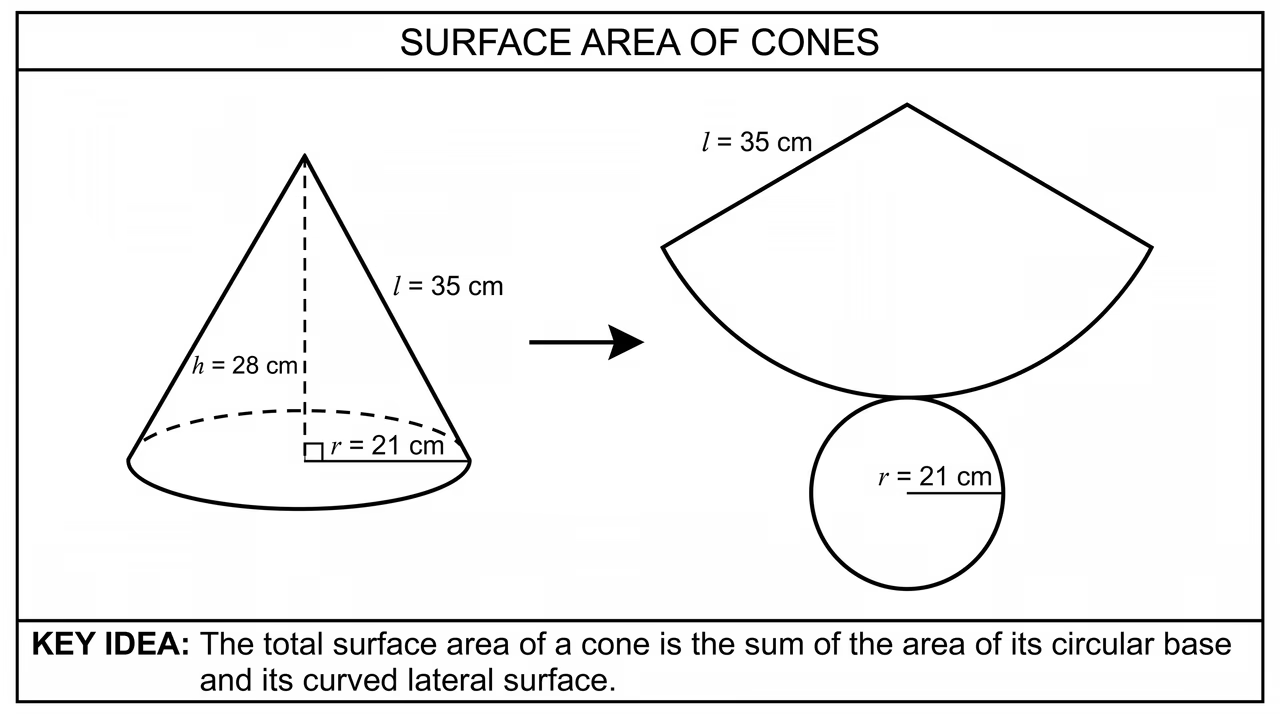
A cone and its unfolded net display a perpendicular height of 28 cm, a base radius of 21 cm, and a slant height of 35 cm.
Figure 2: A cone and its unfolded net display a perpendicular height of 28 cm, a base radius of 21 cm, and a slant height of 35 cm.

Teach the full lesson on the projector

This lesson, and every other Grade 1–10 CBE lesson, comes ready to project with the EAP ClassKit. It runs without electricity or internet.

  • All 4 slides with diagrams and class activities
  • Teacher notes, SNE adaptations and assessment checks
  • Homework and the other 8 lessons in this sub-strand

All 9 lessons in Surface Area and Volume of Solids

  1. 1Surface Area of Prisms and PyramidsDetermine the surface area of prisms, pyramids, cones, frustums and spheres
  2. 2Surface Area of Pyramids, Cones, and FrustumsDetermine the surface area of prisms, pyramids, cones, frustums and spheres
  3. 3Surface Area of Frustums, Spheres, and HemispheresDetermine the surface area of prisms, pyramids, cones, frustums and spheres
  4. 4Surface Area of Composite SolidsCalculate the surface area of composite solids
  5. 5Volume of Prisms, Pyramids, and ConesCalculate the volume of prisms, pyramids, cones, frustums and spheres
  6. 6Volume of Frustums and SpheresCalculate the volume of prisms, pyramids, cones, frustums and spheres
  7. 7Volume of Composite SolidsDetermine the volume of composite solids
  8. 8Surface Area and Volume of Solids: Real-Life Applications (Part 1)Explore the use of the surface area and volume of solids in real-life situations
  9. 9Real-Life Applications of Surface Area and Volume of SolidsExplore the use of the surface area and volume of solids in real-life situations