Slide 1 · Understanding Frustum Volume by SubtractionOpening · 10 min

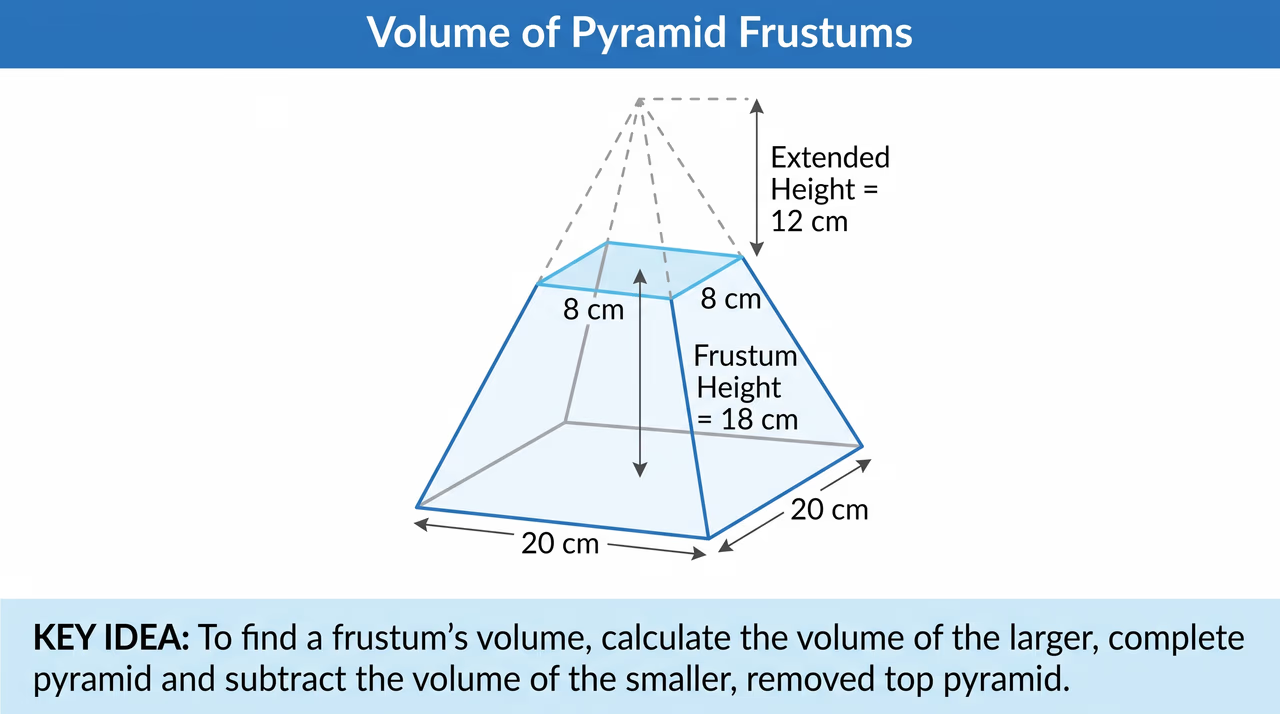
A frustum is formed when the apex of a cone or pyramid is sliced off parallel to its base. Visualising the original complete shape allows us to find its volume by subtraction. The volume of the frustum equals the volume of the large initial solid minus the volume of the small solid that was cut away. Because the small solid is similar to the original whole solid, linear dimensions are proportional.
- A frustum is formed by slicing a cone or pyramid parallel to its base and removing the part containing the apex.
- The volume of a frustum equals the volume of the original solid minus the smaller cut-off solid.
- The height and base dimensions of the small cut-off solid are proportional to those of the whole solid.
- For a conical frustum, subtract the smaller cone volume from the larger original cone volume.
Worked example. Identify heights: the complete cone (apex below the bucket, up to the top rim) has height ; the small cone cut off below the bottom has height . Calculate volume of the complete cone with top radius : . Calculate volume of the small cone below the bottom, with radius : . Subtract the small cone volume from the complete cone volume: . Answer: .
Check question: A rectangular-based pyramid frustum has bottom base dimensions , top base dimensions , total original pyramid height , and top pyramid height . Calculate its volume.
Show answer
. Volume of full pyramid = . Volume of top pyramid = . Frustum volume = .