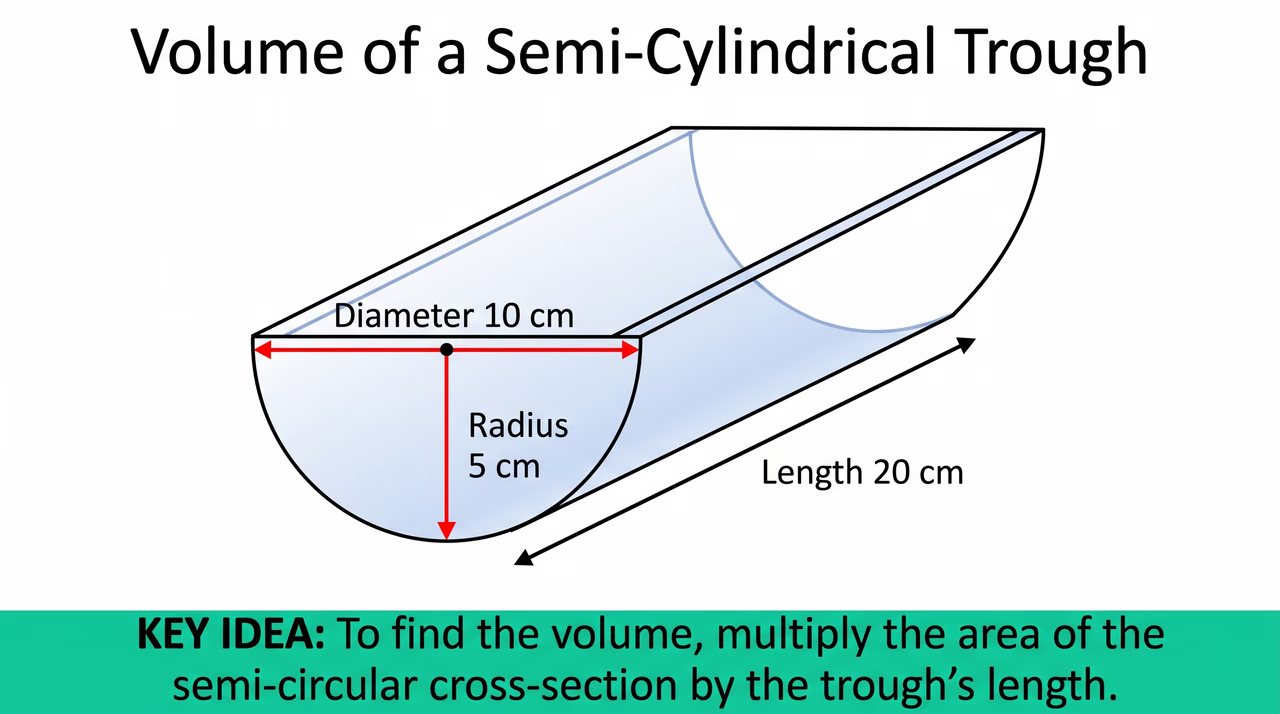
Slide 1 · Determining Volume of a PrismOpening · 10 min
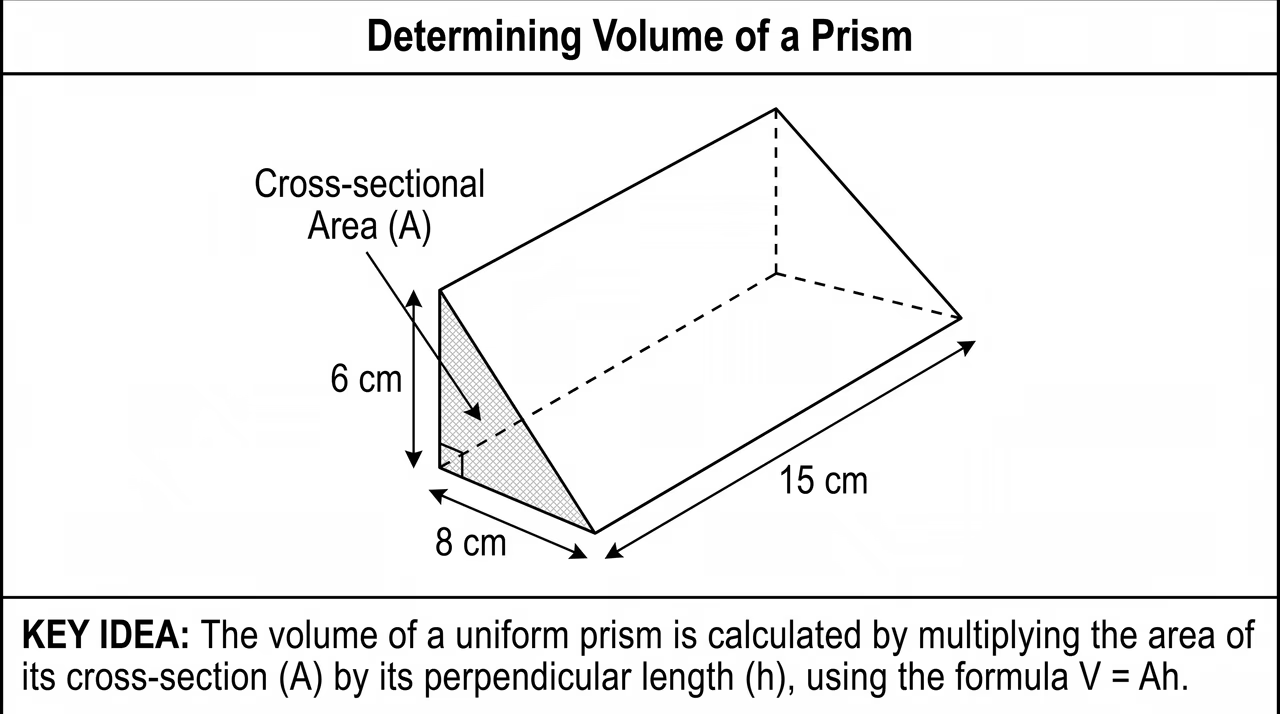
The volume of solids measures the total three-dimensional space enclosed within a boundary. For any uniform prism, the cross-section remains identical along its entire length. Determining volume of a prism requires finding the cross-sectional area and multiplying it by the length of the solid. The general formula applies to all right prisms, where represents the area of the uniform cross-section and is the perpendicular length.
- Volume quantifies the amount of three-dimensional space contained within a closed solid object.
- A prism possesses a uniform cross-section along its entire length from end to end.
- Determining volume of a prism uses the key formula volume equals cross-sectional area times length.
- The formula V equals A h applies to rectangular, triangular, and composite right prisms.
Worked example. Identify the area of the uniform triangular cross-section: . Apply the prism volume formula: where is the length. Multiply cross-sectional area by length: . Answer: .
Check question: A prism has a uniform trapezoidal cross-section with parallel sides of and , a height of , and a solid length of . What is its volume?
Show answer
. First, calculate the cross-sectional area of the trapezium: . Next, multiply the cross-sectional area by the length of the solid: Volume .