
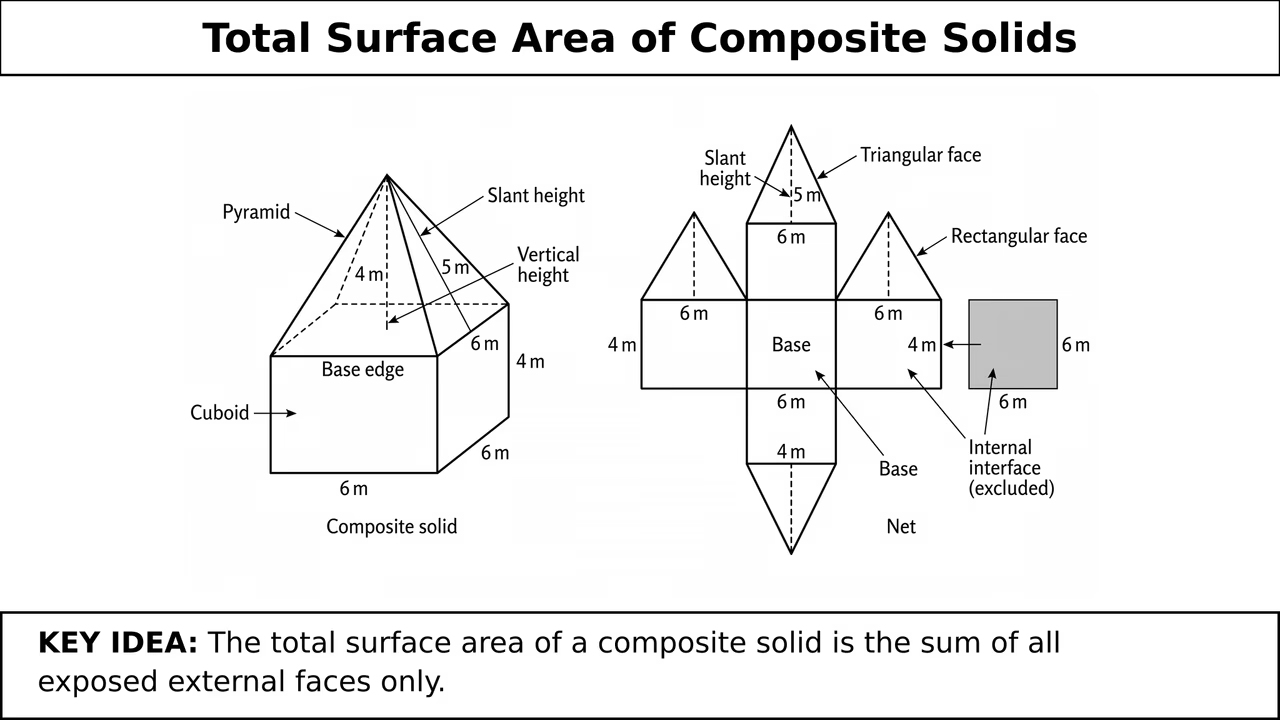
A composite solid is formed by combining two or more simple 3D shapes, such as a cuboid base topped by a pyramid roof or a cylinder joined to a cone. When determining the total surface area of a composite solid, we only sum the areas of all visible external faces. Any face where two component solids join is internal and hidden, so its area must be excluded from the total sum. Use Figure 1 to see how the hidden internal face is excluded from the unfolded net.
- A composite solid is created by joining two or more standard geometric 3D shapes together.
- Visualising the unfolded net helps identify every individual exposed outer face of the composite solid.
- Internal contact faces where the component solids connect must be excluded from the total surface area.
- Calculate the area of each outer face separately before summing them to find the total area.
Check question: A closed-bottom cylindrical tank (, height ) is topped by a cone (, slant height ). What is the total outer surface area of the composite solid? Take .
Show answer
. The outer surface comprises the circular base (), the curved cylinder wall (), and the curved cone face (). Summing gives .
