
Skip to content

Grade 10 · Core Mathematics · Lesson 7 of 11

Using Tools to Find Reciprocals

A Grade 10 Core Mathematics CBE lesson from the sub-strand Real Numbers. In it, learners enter positive and negative values correctly on a calculator.

Strand Numbers and AlgebraSub-strand Real NumbersLesson code 10CM-11-L740 minutes · 2 slides

KICD learning outcome (d)

Determine the reciprocal of real numbers by use of mathematical tables and calculators.

By the end of this lesson, learners should be able to

  1. Enter positive and negative values correctly on a calculator.
  2. Use a reciprocal function when available and recognise its result.
  3. Use a printed reciprocal table and record its precision.
  4. Estimate and check a displayed decimal.

Key vocabulary

Estimate
A sensible nearby value used to judge a calculation.
Estimate one divided by four as about zero point two five.
Display
The numerical result shown on a calculator screen.
The display rounds one-third to a finite visible string.
Reciprocal key
A calculator function that evaluates one divided by input.
Press the reciprocal key after entering negative two.

Lesson preview

Slide 1 · Estimate Before Pressing KeysOpening · 18 min
Four panels display the predicted sign and magnitude of reciprocals alongside their calculated decimal results.
Figure 1: Four panels display the predicted sign and magnitude of reciprocals alongside their calculated decimal results.

A calculator is useful only when its display is interpreted. Estimate the size and sign first, then enter one divided by the number; this catches misplaced negatives and decimal-key errors. Use Figure 1 to see how estimating the sign and magnitude helps verify calculator results.

  • A reciprocal of a number above one has magnitude below one always.
  • A reciprocal preserves the original number's sign exactly.
  • A reciprocal table gives an approximation at a stated precision, while estimation checks its reasonableness.
  • Write the intended division expression before entering calculator keys.
Worked example. Because negative four is negative, its reciprocal is negative. Because its magnitude exceeds one, the reciprocal magnitude is below one. Calculate one divided by negative four to obtain negative zero point two five. The display agrees with the estimate. Answer: The reciprocal is negative zero point two five..

Check question: Which statement correctly predicts the sign and magnitude of the reciprocal of 8?

  1. It is positive and has a magnitude less than one.
  2. It is positive and has a magnitude greater than one.
  3. It is negative and has a magnitude less than one.
  4. It is negative and has a magnitude greater than one.
Show answer

It is positive and has a magnitude less than one. The reciprocal of 8 is calculated as 1÷8=18. The reciprocal always preserves the sign of the original number, so it is positive. Because the original number is greater than one, dividing one by it produces a proper fraction, meaning its magnitude must be less than one.
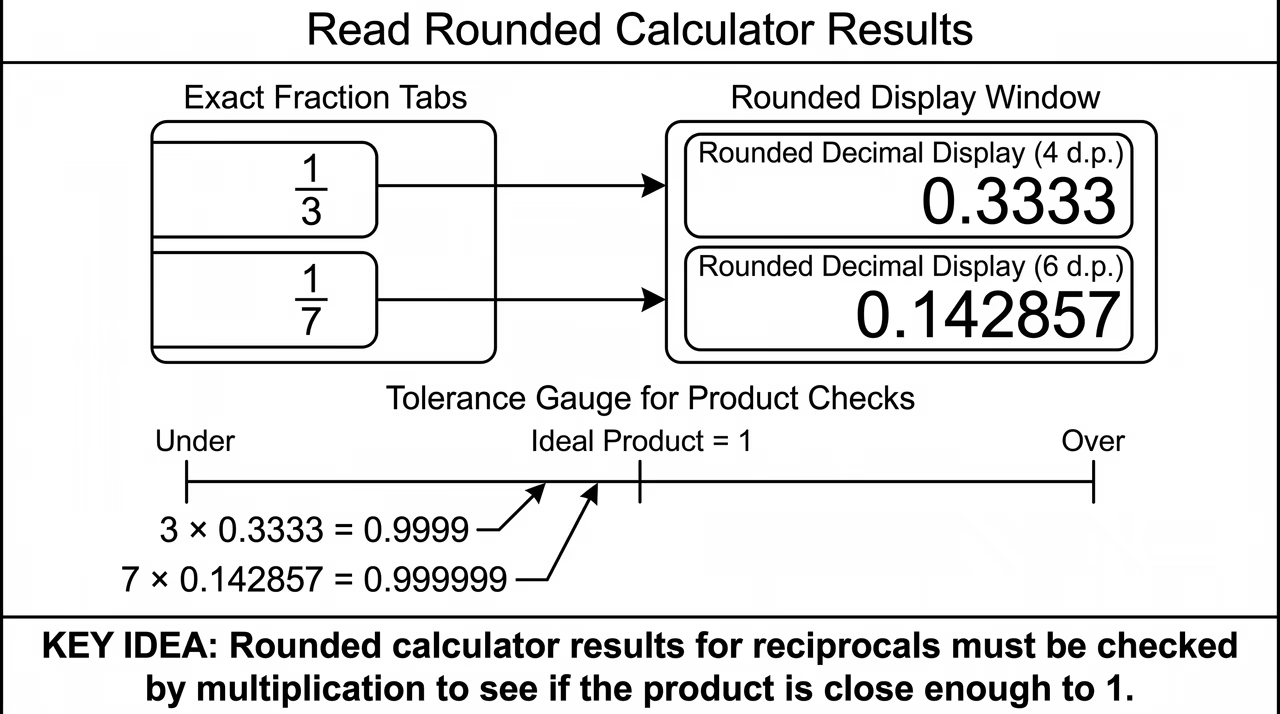
Slide 2 · Read Rounded Calculator ResultsCheck · 22 min
A diagram compares exact fractions to rounded decimal displays and uses a tolerance gauge for product checks.
Figure 2: A diagram compares exact fractions to rounded decimal displays and uses a tolerance gauge for product checks.

Teach the full lesson on the projector

This lesson, and every other Grade 1–10 CBE lesson, comes ready to project with the EAP ClassKit. It runs without electricity or internet.

  • Both slides with diagrams and class activities
  • Teacher notes, SNE adaptations and assessment checks
  • Homework and the other 10 lessons in this sub-strand

All 11 lessons in Real Numbers

  1. 1Sorting Whole Numbers by StructureClassify whole numbers as odd, even, prime and composite in different situations
  2. 2Classifying Numbers in SituationsClassify whole numbers as odd, even, prime and composite in different situations
  3. 3Recognising Rational and Irrational NumbersClassify real numbers as rational and irrational in different situations
  4. 4Justifying Real-Number ClassificationsClassify real numbers as rational and irrational in different situations
  5. 5Finding Reciprocals by DivisionDetermine the reciprocal of real numbers by division
  6. 6Reciprocals with Signs and DecimalsDetermine the reciprocal of real numbers by division
  7. 7Using Tools to Find ReciprocalsDetermine the reciprocal of real numbers by use of mathematical tables and calculators
  8. 8Reciprocals in Fraction ComputationApply reciprocal of real numbers in mathematical computations
  9. 9Reciprocal Methods for RatesApply reciprocal of real numbers in mathematical computations
  10. 10Real Numbers in Daily DecisionsPromote the use of real numbers in day-to-day activities
  11. 11Communicating Real-Number SolutionsPromote the use of real numbers in day-to-day activities