
Skip to content

Grade 10 · Core Mathematics · Lesson 1 of 11

Sorting Whole Numbers by Structure

A Grade 10 Core Mathematics CBE lesson from the sub-strand Real Numbers. In it, learners classify whole numbers as odd or even from their final digit.

Strand Numbers and AlgebraSub-strand Real NumbersLesson code 10CM-11-L140 minutes · 2 slides

KICD learning outcome (a)

Classify whole numbers as odd, even, prime and composite in different situations.

By the end of this lesson, learners should be able to

  1. Classify whole numbers as odd or even from their final digit.
  2. Use factor pairs to distinguish prime and composite numbers.
  3. Explain why one and zero need special classification care.

Key vocabulary

Factor
A whole number that divides another number without a remainder.
Six is a factor of thirty because thirty divided by six equals five.
Prime
A whole number greater than one with exactly two factors.
Thirteen is prime because only one and thirteen divide it.
Composite
A whole number greater than one having more than two factors.
Twelve is composite because several factor pairs produce twelve.

Lesson preview

Slide 1 · Two Different Number TestsOpening · 18 min
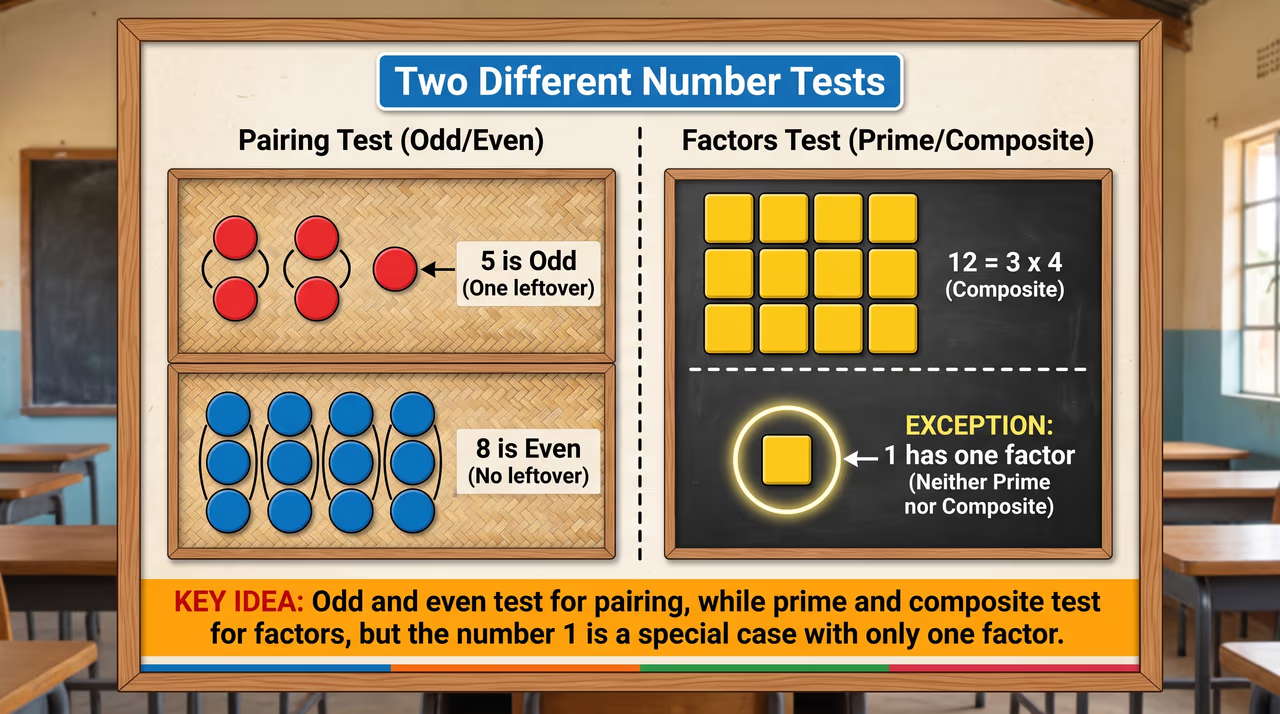
This board shows the pairing test for odd and even numbers alongside the factors test for prime and composite numbers.
Figure 1: This board shows the pairing test for odd and even numbers alongside the factors test for prime and composite numbers.

Definition: Odd and even tell how a whole number behaves when shared into pairs, while prime and composite tell how many positive factors it has. These are related tests, but they answer different questions. Study Figure 1 to see visual examples of how these two different tests work.

  • A whole number is even when two divides it exactly.
  • A whole number is odd when pairing leaves one.
  • Prime and composite labels apply only above one.
  • The number one has exactly one positive factor.
Worked example. The final digit is eight, so eighteen is even. Factor pairs are one times eighteen, two times nine, and three times six. More than two factors means eighteen is composite. Answer: Eighteen is even and composite..

Check question: A learner claims that the number 1 is prime because it is divisible by 1 and by itself. Why is this reasoning incorrect?

  1. A prime number requires exactly two distinct positive factors, but the number 1 has only one.
  2. Any number divisible by 1 and itself is a composite number, so 1 must be composite.
  3. The number 1 has more than two positive factors, which disqualifies it from being prime.
  4. A number cannot be prime if it leaves a remainder of one when divided into pairs.
Show answer

A prime number requires exactly two distinct positive factors, but the number 1 has only one. To be classified as prime, a number must have exactly two distinct positive factors: 1 and the number itself. For the number 1, the factors are not distinct, meaning it has only a single positive divisor. Therefore, it is neither prime nor composite.
Slide 2 · Factor Pairs Reveal the LabelModel · 22 min
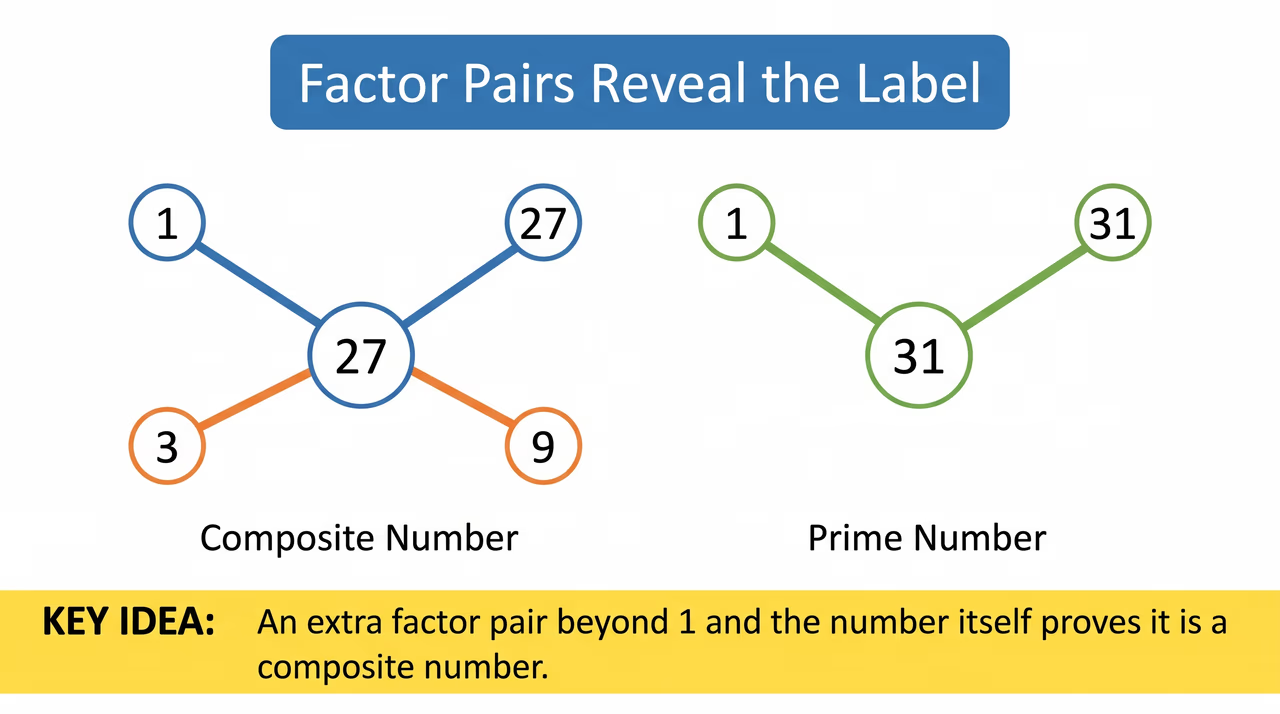
These diagrams display the connected factor pairs for the composite number 27 and the prime number 31.
Figure 2: These diagrams display the connected factor pairs for the composite number 27 and the prime number 31.

Teach the full lesson on the projector

This lesson, and every other Grade 1–10 CBE lesson, comes ready to project with the EAP ClassKit. It runs without electricity or internet.

  • Both slides with diagrams and class activities
  • Teacher notes, SNE adaptations and assessment checks
  • Homework and the other 10 lessons in this sub-strand

All 11 lessons in Real Numbers

  1. 1Sorting Whole Numbers by StructureClassify whole numbers as odd, even, prime and composite in different situations
  2. 2Classifying Numbers in SituationsClassify whole numbers as odd, even, prime and composite in different situations
  3. 3Recognising Rational and Irrational NumbersClassify real numbers as rational and irrational in different situations
  4. 4Justifying Real-Number ClassificationsClassify real numbers as rational and irrational in different situations
  5. 5Finding Reciprocals by DivisionDetermine the reciprocal of real numbers by division
  6. 6Reciprocals with Signs and DecimalsDetermine the reciprocal of real numbers by division
  7. 7Using Tools to Find ReciprocalsDetermine the reciprocal of real numbers by use of mathematical tables and calculators
  8. 8Reciprocals in Fraction ComputationApply reciprocal of real numbers in mathematical computations
  9. 9Reciprocal Methods for RatesApply reciprocal of real numbers in mathematical computations
  10. 10Real Numbers in Daily DecisionsPromote the use of real numbers in day-to-day activities
  11. 11Communicating Real-Number SolutionsPromote the use of real numbers in day-to-day activities