Slide 1 · The Fraction TestOpening · 18 min
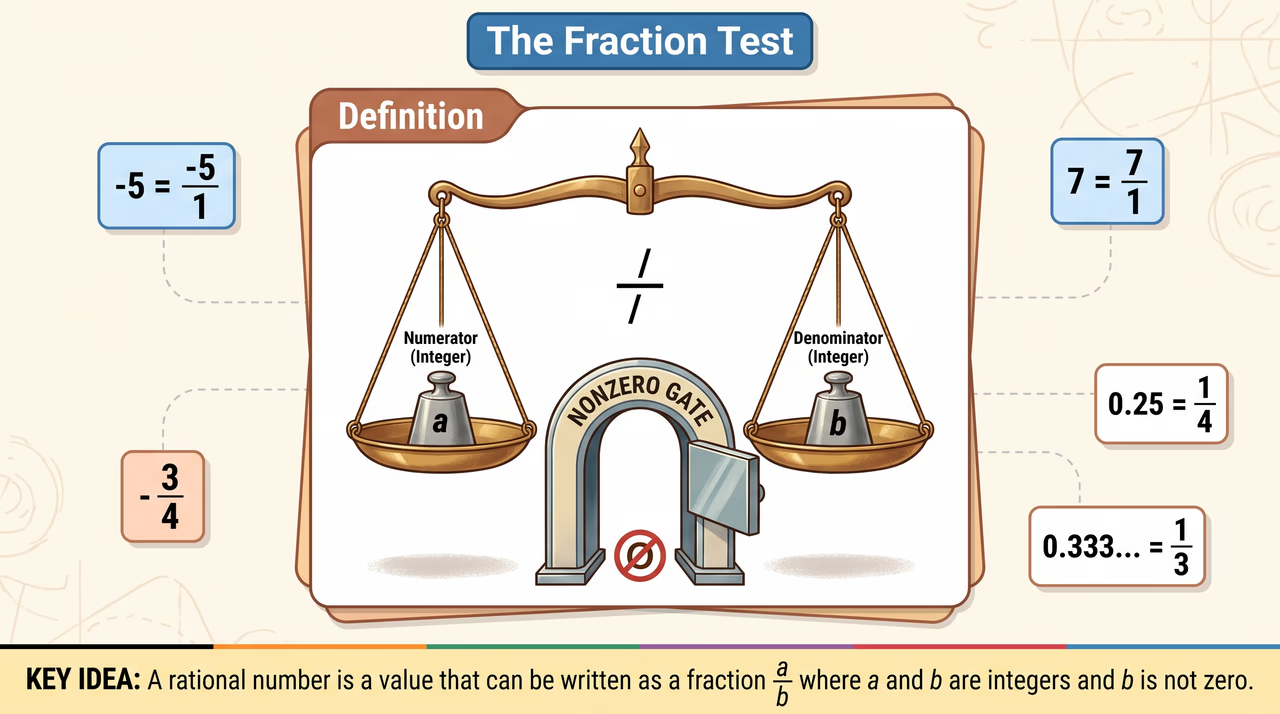
Definition: A value belongs to the rational class when it is a quotient made from two integers with a nonzero divisor. This exact test includes negative values, whole numbers, and many decimals. Use Figure 1 to review examples of valid rational numbers.
- The numerator and denominator must both be integers.
- A denominator of zero is never allowed in a valid fraction.
- Every integer can use denominator one to show rational form.
- Equivalent fractions preserve rational classification exactly after reduction.
Worked example. Write negative two point five as negative twenty-five tenths. Both parts are integers, and the denominator is nonzero. Therefore the definition is satisfied; reduction is optional. Answer: Negative two point five is rational because it equals negative five over two, a quotient of integers..
Check question: Is a rational number, and why?
- No, because the denominator of a rational number cannot be zero.
- No, because the numerator is larger than the denominator.
- Yes, because both and are integers.
- Yes, because it evaluates to , which is a rational number.
Show answer
No, because the denominator of a rational number cannot be zero. A rational number is defined as a quotient of two integers where the denominator is non-zero. Because has a zero in the denominator, it represents division by zero, which is undefined. Therefore, it is not a rational number.