
Skip to content

Grade 10 · Core Mathematics · Lesson 11 of 11

Communicating Real-Number Solutions

A Grade 10 Core Mathematics CBE lesson from the sub-strand Real Numbers. In it, learners combine whole numbers, fractions, and decimals in a daily-life calculation.

Strand Numbers and AlgebraSub-strand Real NumbersLesson code 10CM-11-L1140 minutes · 2 slides

KICD learning outcome (f)

Promote the use of real numbers in day-to-day activities.

By the end of this lesson, learners should be able to

  1. Combine whole numbers, fractions, and decimals in a daily-life calculation.
  2. Check whether a result is plausible in context.
  3. Communicate a conclusion with units and stated assumptions.

Key vocabulary

Estimate
A nearby value used to judge whether an answer is sensible.
Estimate five kilometres before calculating a route total.
Conversion
Changing a quantity into an equivalent unit or representation.
Convert three-quarters of an hour into forty-five minutes.
Assumption
A condition accepted temporarily to construct a solution.
Assume each packet contains the same mass before dividing.

Lesson preview

Slide 1 · Translate a Situation into NumbersOpening · 18 min
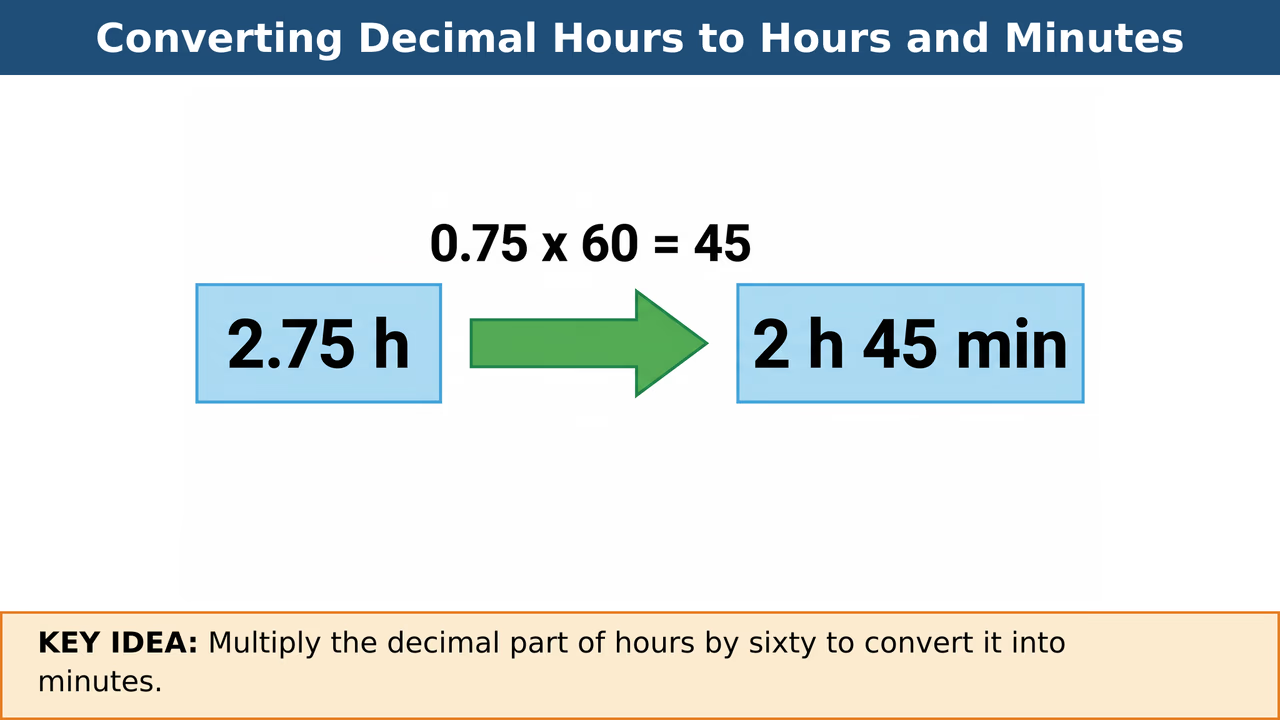
A calculation demonstrating how to convert a decimal time of two point seven five hours into hours and minutes.
Figure 1: A calculation demonstrating how to convert a decimal time of two point seven five hours into hours and minutes.

Before calculating, identify what each number measures, choose compatible units, and decide which operation answers the question. This translation step prevents correct arithmetic from answering the wrong problem.

  • Underline all quantities and circle their units first.
  • Convert mixed units before combining measured quantities.
  • Estimate the expected size of the answer beforehand.
  • Write the operation in words before using symbols.
Worked example. Separate two point seven five into two hours and zero point seven five hour. Multiply zero point seven five by sixty minutes per hour. Compute the product as forty-five minutes. Combine the parts. Answer: Two point seven five hours equals two hours forty-five minutes..

Check question: A workshop starts at 8:35 and lasts for 2.75 hours. Why is it incorrect to find the finish time by calculating 8.35+2.75=11.10?

  1. The 0.75 represents a fraction of an hour, while the 35 represents minutes out of 60.
  2. The decimal 0.75 means 75 minutes, which must be added to 35 minutes to find the correct time.
  3. The start time of 8:35 must be converted into minutes and then multiplied by 2.75.
  4. The calculation is actually correct, and the workshop will finish exactly at 11:10.
Show answer

The 0.75 represents a fraction of an hour, while the 35 represents minutes out of 60. Clock times and standard decimals use different place value systems. The 35 in 8:35 stands for 35 minutes (out of 60). The 0.75 in 2.75 hours represents a decimal fraction of a full hour. Since 0.75 hours equals 45 minutes, the decimal must be converted first before adding it to a clock time.

Slide 2 · Explain the Decision ClearlyClosing · 22 min
A five-step audit checklist for solving real-number problems, illustrating the process with an example about ordering school buses.
Figure 2: A five-step audit checklist for solving real-number problems, illustrating the process with an example about ordering school buses.

Teach the full lesson on the projector

This lesson, and every other Grade 1–10 CBE lesson, comes ready to project with the EAP ClassKit. It runs without electricity or internet.

  • Both slides with diagrams and class activities
  • Teacher notes, SNE adaptations and assessment checks
  • Homework and the other 10 lessons in this sub-strand

All 11 lessons in Real Numbers

  1. 1Sorting Whole Numbers by StructureClassify whole numbers as odd, even, prime and composite in different situations
  2. 2Classifying Numbers in SituationsClassify whole numbers as odd, even, prime and composite in different situations
  3. 3Recognising Rational and Irrational NumbersClassify real numbers as rational and irrational in different situations
  4. 4Justifying Real-Number ClassificationsClassify real numbers as rational and irrational in different situations
  5. 5Finding Reciprocals by DivisionDetermine the reciprocal of real numbers by division
  6. 6Reciprocals with Signs and DecimalsDetermine the reciprocal of real numbers by division
  7. 7Using Tools to Find ReciprocalsDetermine the reciprocal of real numbers by use of mathematical tables and calculators
  8. 8Reciprocals in Fraction ComputationApply reciprocal of real numbers in mathematical computations
  9. 9Reciprocal Methods for RatesApply reciprocal of real numbers in mathematical computations
  10. 10Real Numbers in Daily DecisionsPromote the use of real numbers in day-to-day activities
  11. 11Communicating Real-Number SolutionsPromote the use of real numbers in day-to-day activities