
Skip to content

Grade 10 · Core Mathematics · Lesson 6 of 11

Reciprocals with Signs and Decimals

A Grade 10 Core Mathematics CBE lesson from the sub-strand Real Numbers. In it, learners determine reciprocals of negative real numbers.

Strand Numbers and AlgebraSub-strand Real NumbersLesson code 10CM-11-L640 minutes · 2 slides

KICD learning outcome (c)

Determine the reciprocal of real numbers by division.

By the end of this lesson, learners should be able to

  1. Determine reciprocals of negative real numbers.
  2. Convert terminating decimals before finding their reciprocals.
  3. Explain why zero remains excluded.

Key vocabulary

Sign
The positive or negative indication attached to a number.
A negative reciprocal keeps the original number's negative sign.
Terminating decimal
A decimal representation ending after a finite number of places.
Zero point two is a terminating decimal equal to one-fifth.

Lesson preview

Slide 1 · The Sign Stays with the ReciprocalOpening · 18 min
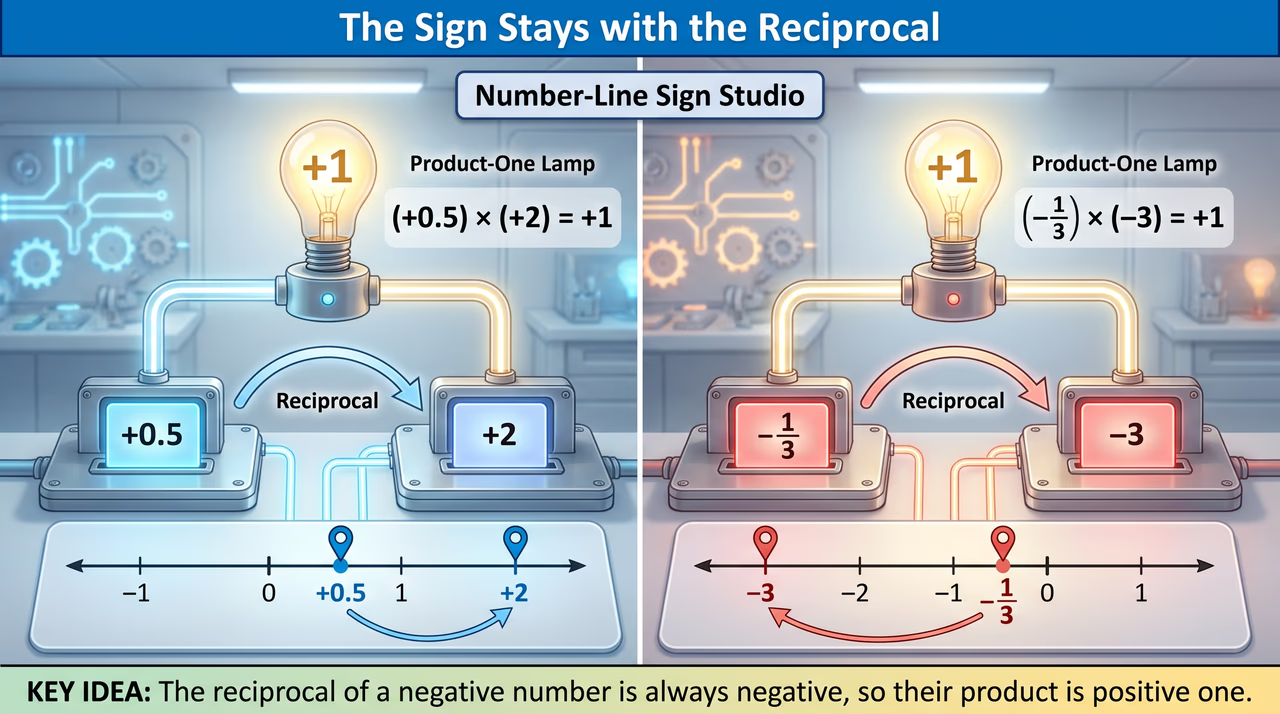
A diagram demonstrating that multiplying a positive or negative number by its reciprocal always results in positive one.
Figure 1: A diagram demonstrating that multiplying a positive or negative number by its reciprocal always results in positive one.

The reciprocal of a negative number must also be negative: multiplying a negative number by a negative answer gives the required positive one. The sign is part of the number and cannot be discarded. Use Figure 1 to see how signs are preserved when finding a reciprocal.

  • The reciprocal of a positive real number is positive.
  • The reciprocal of a negative real number is negative.
  • Two negative factors multiply to produce a positive product.
  • Use multiplication to confirm the predicted sign reasoning.
Worked example. Write one divided by negative three-sevenths. Invert the fraction and retain the negative sign: negative seven-thirds. Multiply negative three-sevenths by negative seven-thirds to check. Answer: The reciprocal is negative seven-thirds, and the product is one..

Check question: What is the reciprocal of −8?

  1. −18
  2. 18
  3. 8
  4. −8
Show answer

−18. The reciprocal of a negative number must also be negative. Dividing 1 by −8 gives −18, and multiplying −8 by −18 gives positive 1.

Slide 2 · Turn Decimals into Exact FractionsPractice · 22 min
A visual flowchart showing the conversion of decimals into exact fractions before inverting them to find their reciprocals.
Figure 2: A visual flowchart showing the conversion of decimals into exact fractions before inverting them to find their reciprocals.

Teach the full lesson on the projector

This lesson, and every other Grade 1–10 CBE lesson, comes ready to project with the EAP ClassKit. It runs without electricity or internet.

  • Both slides with diagrams and class activities
  • Teacher notes, SNE adaptations and assessment checks
  • Homework and the other 10 lessons in this sub-strand

All 11 lessons in Real Numbers

  1. 1Sorting Whole Numbers by StructureClassify whole numbers as odd, even, prime and composite in different situations
  2. 2Classifying Numbers in SituationsClassify whole numbers as odd, even, prime and composite in different situations
  3. 3Recognising Rational and Irrational NumbersClassify real numbers as rational and irrational in different situations
  4. 4Justifying Real-Number ClassificationsClassify real numbers as rational and irrational in different situations
  5. 5Finding Reciprocals by DivisionDetermine the reciprocal of real numbers by division
  6. 6Reciprocals with Signs and DecimalsDetermine the reciprocal of real numbers by division
  7. 7Using Tools to Find ReciprocalsDetermine the reciprocal of real numbers by use of mathematical tables and calculators
  8. 8Reciprocals in Fraction ComputationApply reciprocal of real numbers in mathematical computations
  9. 9Reciprocal Methods for RatesApply reciprocal of real numbers in mathematical computations
  10. 10Real Numbers in Daily DecisionsPromote the use of real numbers in day-to-day activities
  11. 11Communicating Real-Number SolutionsPromote the use of real numbers in day-to-day activities