
Slide 1 · Roots and Perfect SquaresOpening · 18 min
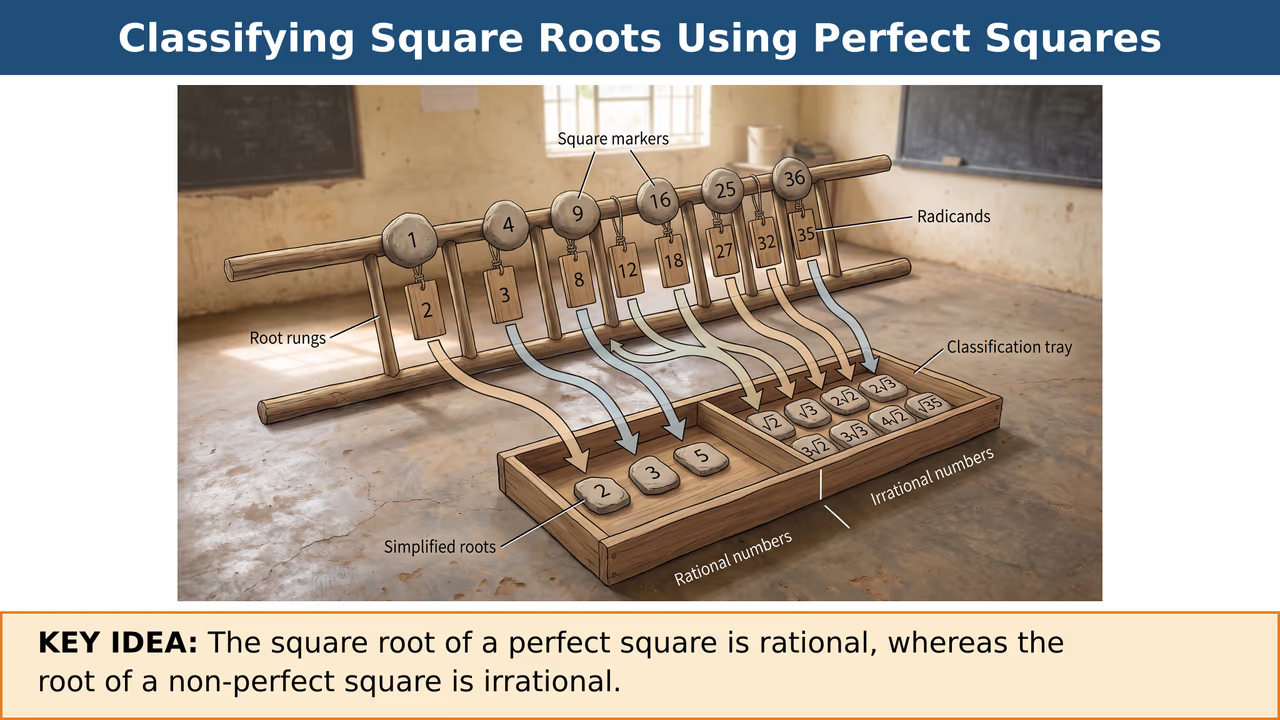
A root can be rational when it simplifies to an integer or fraction, but a root of a positive non-perfect square remains irrational. Check the exact radicand to guarantee a precise classification, rather than trusting a rounded calculator approximation. Use Figure 1 to visualise how simplifying exact roots determines their rational or irrational classification.
- Perfect squares have exact whole-number square roots.
- A positive whole number that is not a perfect square has an irrational root.
- Simplify exact roots before assigning classifications confidently.
- Rounded calculator displays cannot establish exact rationality.
Worked example. Since nine times nine equals eighty-one, its square root equals nine, which is rational. Twelve lies between nine and sixteen and is not a perfect square. Therefore square root of twelve cannot simplify to an integer and is irrational. Answer: Square root of eighty-one is rational; square root of twelve is irrational..
Check question: Why is classified as a rational number?
- It simplifies exactly to , and every integer can be written as a fraction over .
- Because is a positive integer, and the square roots of all positive integers are rational.
- It results in a non-terminating decimal, which is a defining property of a rational number.
- Any number written with a square root symbol is automatically considered a rational number.
Show answer
It simplifies exactly to , and every integer can be written as a fraction over . The root simplifies exactly to the integer . Since can be written as , it satisfies the definition of a rational number without relying on a decimal approximation.
