Slide 1 · Probability Bounds and Complementary EventsOpening · 10 min

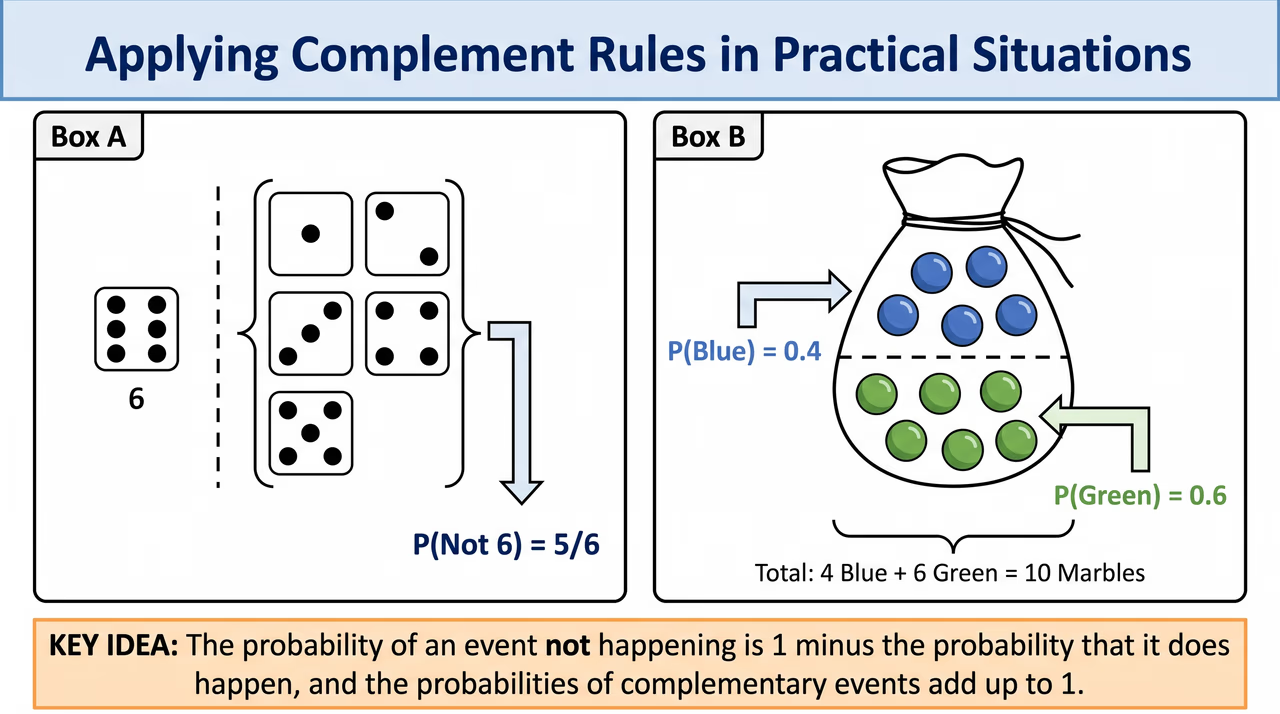
The probability of any event is a number from 0 to 1 inclusive, written . If an event cannot happen, , making it an impossible event. If an event is guaranteed to occur, , making it a certain event. Since an event either occurs or does not occur, the event and its complement represent mutually exclusive and exhaustive outcomes. Therefore, or .
- An event 's probability lies between 0 and 1 inclusive, written .
- An event with probability 0 is impossible, while an event with probability 1 is certain.
- The complement represents the event that does not occur in a trial.
- Because and cover all outcomes, and .
Worked example. Let be the event that the bean seed germinates, so . The complement is the event that the seed does not germinate. Use the complement law: . By definition, an outcome with probability 0 is an impossible event. Answer: The probability of not germinating is , and a probability 0 outcome is impossible..
Check question: If the probability that it rains at a weather station on Mashujaa Day is 0.35, what is the probability that it does not rain?
- 0.35
- 0.55
- 0.65
- 0.75
Show answer
0.65. Using the complement law, .