
Skip to content

Grade 10 · Core Mathematics · Lesson 7 of 12

Determining Probability of Independent Events and Multi-Stage Selections

A Grade 10 Core Mathematics CBE lesson from the sub-strand Probability 1. In it, learners define independent events and state the multiplication law of probability.

Strand Statistics and ProbabilitySub-strand Probability 1Lesson code 10CM-32-L740 minutes · 4 slides

KICD learning outcome (d)

Determine the probability of mutually exclusive events and independent events.

By the end of this lesson, learners should be able to

  1. Define independent events and state the multiplication law of probability
  2. Calculate probabilities of compound independent events using formula and outcome space tables
  3. Combine multiplication and addition laws to solve multi-stage event problems
  4. Distinguish between sampling with replacement and sampling without replacement in sequential probability problems

Key vocabulary

Independent events
Events where the occurrence of one outcome does not affect the probability of another outcome.
Tossing a head on a coin and rolling a four on a die are independent events.
Multiplication law
A formula stating P(S and T)=P(S)×P(T) for independent events.
Using the multiplication law gives P(Head and 4)=12×16=112.
Compound event
An outcome formed by combining two or more simple independent or mutually exclusive events.
Getting exactly two hits out of three independent target shots is a compound event.
With replacement
Returning a selected item to the container before making the subsequent random selection.
Drawing a red counter, replacing it, and drawing again ensures trials remain independent.
Without replacement
Keeping a selected item, which changes the sample space for all subsequent selections.
Drawing a counter without replacement changes the total count denominator from ten to nine.
Sample space
The complete collection of all possible outcomes resulting from a random experiment.
For picking three items from a box, the sample space lists every possible outcome.

Lesson preview

Slide 1 · Independent Events and the Multiplication Law of ProbabilityOpening · 10 min
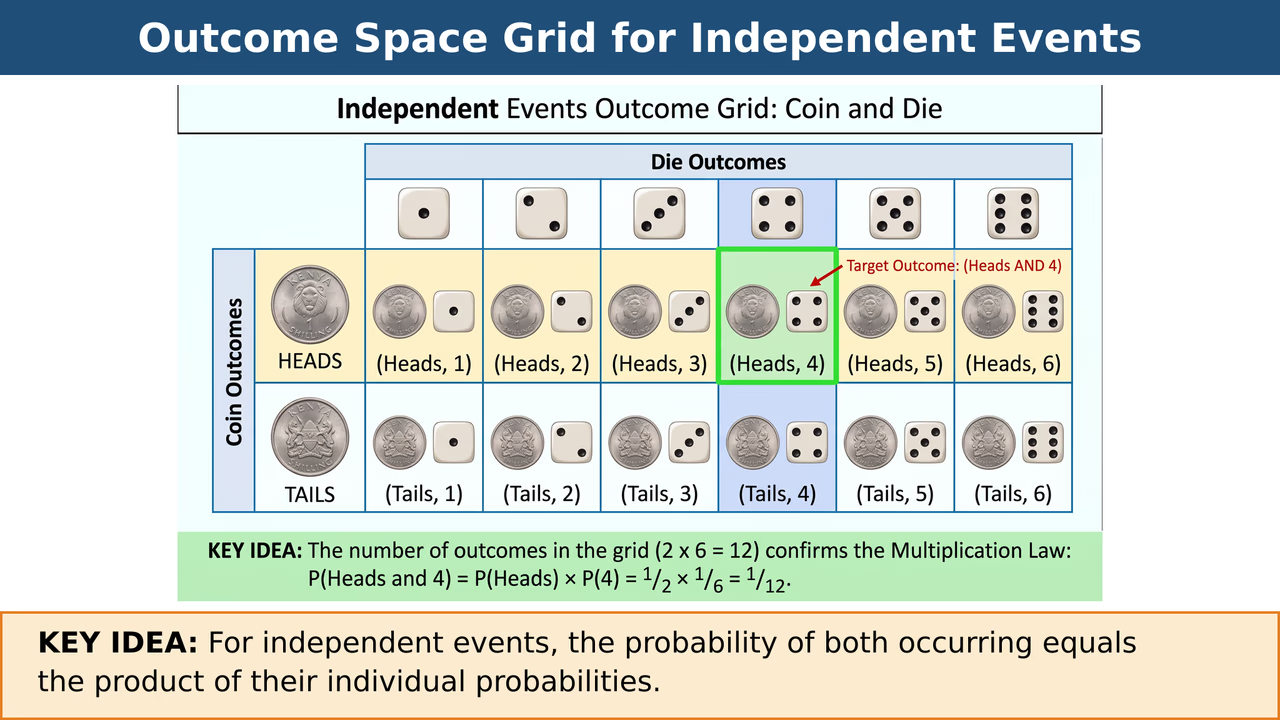
An outcome space grid shows all twelve possible combinations when tossing a coin and rolling a standard six-sided die simultaneously.
Figure 1: An outcome space grid shows all twelve possible combinations when tossing a coin and rolling a standard six-sided die simultaneously.

Two events are independent when the occurrence of one event does not alter the probability of the other event occurring. When tossing a coin and rolling a die simultaneously, the outcome on the coin has no effect on the die score. For independent events S and T, the probability that both occur is given by the multiplication law: P(S and T)=P(S)×P(T). We can verify this relationship using an outcome space grid. Look at Figure 1 to see how an outcome space grid organises all possible combinations.

  • Events are independent when the occurrence of one outcome does not affect the occurrence of another.
  • The multiplication law states that P(S and T)=P(S)×P(T) for independent events.
  • Combined sample spaces for two independent experiments can be displayed in an outcome space grid table.
  • Counting favourable cells in an outcome space table confirms the result obtained from the multiplication law.
Worked example. Identify P(Head)=12. Numbers greater than 4 on a six-sided die are 5 and 6, so P(Die>4)=26=13. Since coin toss and die roll are independent events, apply P(Head and >4)=P(Head)×P(Die>4). Compute: 12×13=16. Answer: 16.

Check question: A fair coin is tossed and a standard six-sided die is rolled. What is the probability of getting a Tail on the coin and an odd number on the die?

  1. 14
  2. 112
  3. 12
  4. 1
Show answer

14. P(Tail)=12 and P(Odd)=36=12. Since they are independent events, the multiplication law applies: P(Tail and Odd)=12×12=14.

Slide 2 · Combining Multiplication and Addition Laws for Independent TrialsModel · 10 min
A tree diagram illustrates the eight possible outcome sequences when three archers each attempt to hit a target.
Figure 2: A tree diagram illustrates the eight possible outcome sequences when three archers each attempt to hit a target.

Teach the full lesson on the projector

This lesson, and every other Grade 1–10 CBE lesson, comes ready to project with the EAP ClassKit. It runs without electricity or internet.

  • All 4 slides with diagrams and class activities
  • Teacher notes, SNE adaptations and assessment checks
  • Homework and the other 11 lessons in this sub-strand

All 12 lessons in Probability 1

  1. 1Performing Probability Experiments and Finding Experimental ProbabilityPerform experiments involving probabilities in different situations
  2. 2Empirical Probabilities and Experimental InvestigationsPerform experiments involving probabilities in different situations
  3. 3Identifying Range of Probability and Complementary EventsIdentify the range of probability in different situations
  4. 4Generating Probability Space of EventsGenerate probability space of different events
  5. 5Generating Probability Space for Compound EventsGenerate probability space of different events
  6. 6Determining Probability of Mutually Exclusive Events and Introduction to Independent EventsDetermine the probability of mutually exclusive events and independent events
  7. 7Determining Probability of Independent Events and Multi-Stage SelectionsDetermine the probability of mutually exclusive events and independent events
  8. 8Probability Bounds, Complementary Events, and the Addition LawApply the laws of probability in different situations
  9. 9Applying Laws of ProbabilityApply the laws of probability in different situations
  10. 10Determining Probability of Independent Events Using Tree DiagramsDetermine the probability of independent events using tree diagrams
  11. 11Tree Diagrams for Multi-Stage Independent EventsDetermine the probability of independent events using tree diagrams
  12. 12Applications of Probability in Real-Life ContextsAppreciate the application of probability in real-life situations