
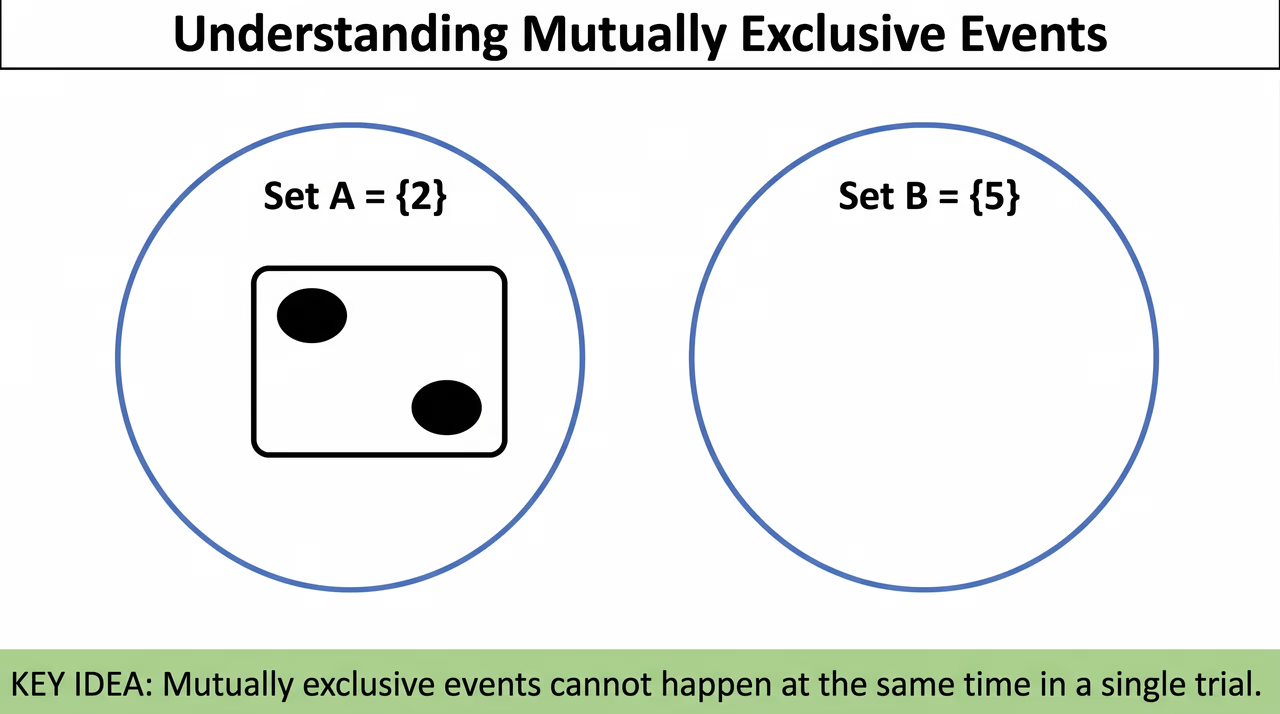
When conducting a single probability trial, such as rolling a die or drawing a single card, two outcomes are mutually exclusive if they cannot happen at the same time. For example, a single roll of a die cannot show both a 2 and a 5 simultaneously. Recording the face that shows up and noting the remaining unshown faces helps us observe that the occurrence of one outcome strictly prevents the simultaneous occurrence of the other.
- In a single experiment, mutually exclusive events cannot occur simultaneously during the same trial.
- Rolling a fair six-sided die once produces exactly one visible top face out of six possible outcomes.
- The set of faces that do not show up forms the complementary set of the observed face.
- Comparing outcome sets confirms whether two events share any common outcomes or are mutually exclusive.
Check question: A single fair six-sided die is tossed once. Event A is 'getting an even number' and Event B is 'getting a prime number'. Which statement correctly determines whether Events A and B are mutually exclusive?
- They are not mutually exclusive because rolling a 2 satisfies both events.
- They are mutually exclusive because they are independent events.
- They are mutually exclusive because an even number cannot be a prime number.
- They are not mutually exclusive because rolling a 4 satisfies both events.
Show answer
They are not mutually exclusive because rolling a 2 satisfies both events. The outcomes for Event A (even number) are {2, 4, 6}. The outcomes for Event B (prime number) are {2, 3, 5}. Since the outcome 2 is in both sets, the events can occur at the same time if a 2 is rolled. Therefore, they are not mutually exclusive.
