
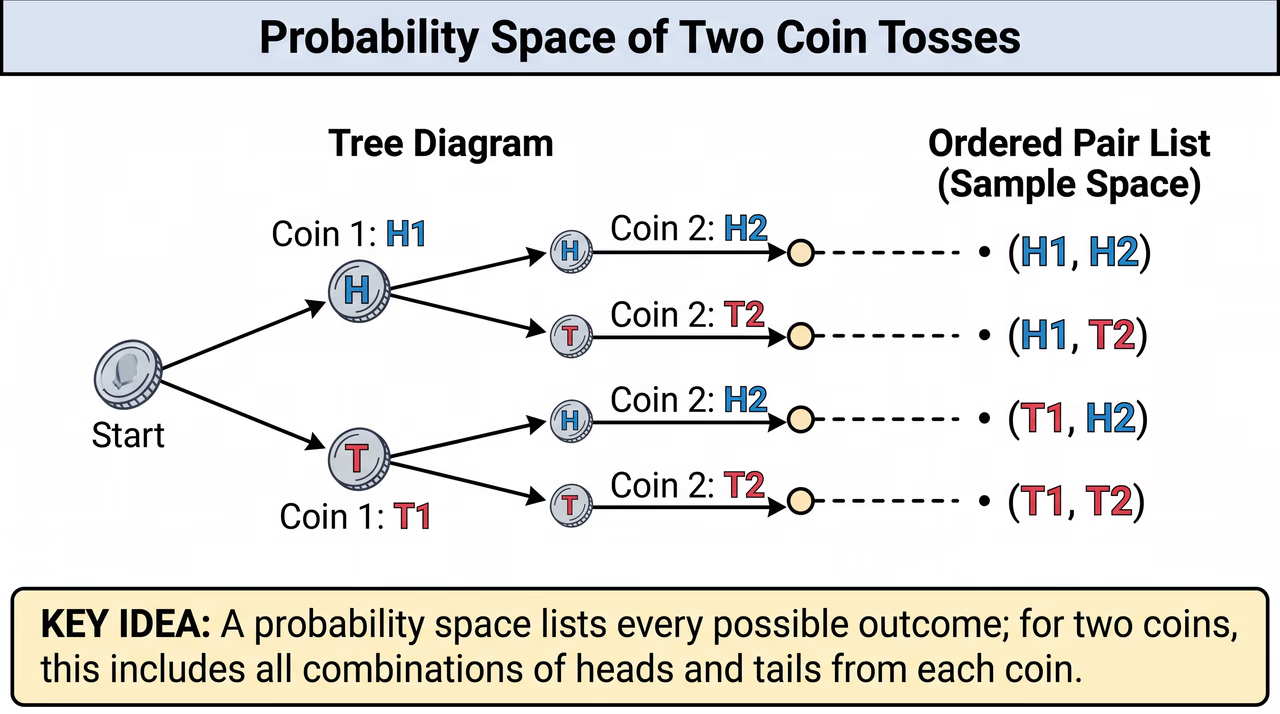
Constructing a probability space for a random experiment means writing down every single outcome that could occur. For instance, when flipping two distinct coins simultaneously, we can denote the heads and tails of the first coin as and , and those of the second coin as and . The complete set of paired results forms the sample space, also termed the outcome space or possibility space. Use Figure 1 to see how a tree diagram represents this sample space.
- A probability space or sample space contains every possible outcome of a random experiment.
- Labelling coin outcomes like and prevents confusion during outcome listing.
- Two tossed coins produce four combined outcomes: and .
- The total number of outcomes for independent events is found by multiplying individual outcome counts.
Check question: A coin with faces and a 3-sided spinner with numbers are spun and tossed together. List all outcomes in the sample space and state the total number of outcomes.
- {}; total = 6 outcomes
- {}; total = 5 outcomes
- {}; total = 2 outcomes
- {}; total = 3 outcomes
Show answer
{}; total = 6 outcomes. Pairing each of the 2 coin outcomes with each of the 3 spinner numbers gives total outcomes.
