
Skip to content

Grade 10 · Core Mathematics · Lesson 9 of 13

Determining Symmetrical Axes and Rotational Orders in 3D Shapes

A Grade 10 Core Mathematics CBE lesson from the sub-strand Rotation. In it, learners define rotational axes and self-matching turn counts for three-dimensional figures.

Strand Measurements and GeometrySub-strand RotationLesson code 10CM-23-L940 minutes · 2 slides

KICD learning outcome (e)

Determine the axis and order of rotational symmetry in solids.

By the end of this lesson, learners should be able to

  1. Define rotational axes and self-matching turn counts for three-dimensional figures.
  2. Determine symmetrical axes and rotational orders for square-base pyramids and triangular prisms.

Key vocabulary

Axis of symmetry
A line around which a 3D figure turns to coincide with its original posture.
The line joining top vertex V to base centre P forms a valid axis.
Order of rotational symmetry
Number of matching positions achieved during one complete turn of 360∘.
This pyramid exhibits a rotational order of 4 around line VP.
Triangular prism
A three-dimensional solid having two congruent parallel triangular ends joined by three rectangular sides.
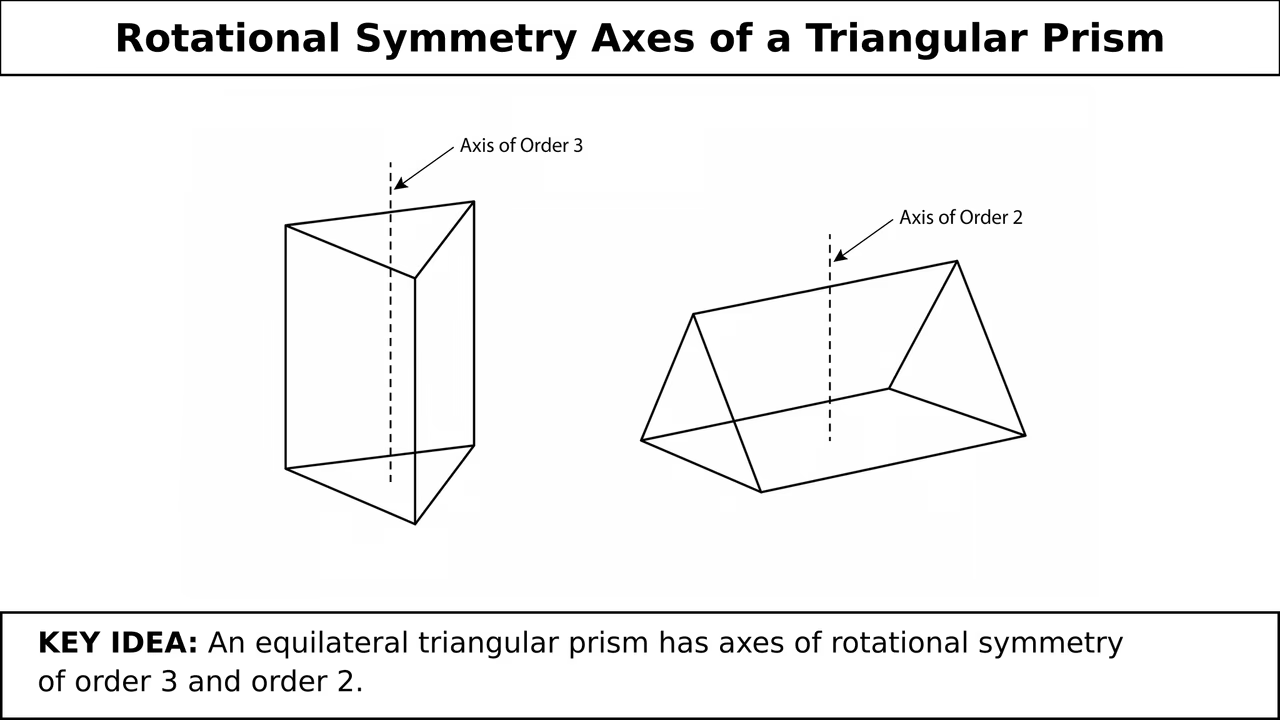
An equal-sided triangular prism contains four separate axes of rotation.

Lesson preview

Slide 1 · Axes and Rotational Orders in PyramidsOpening · 18 min
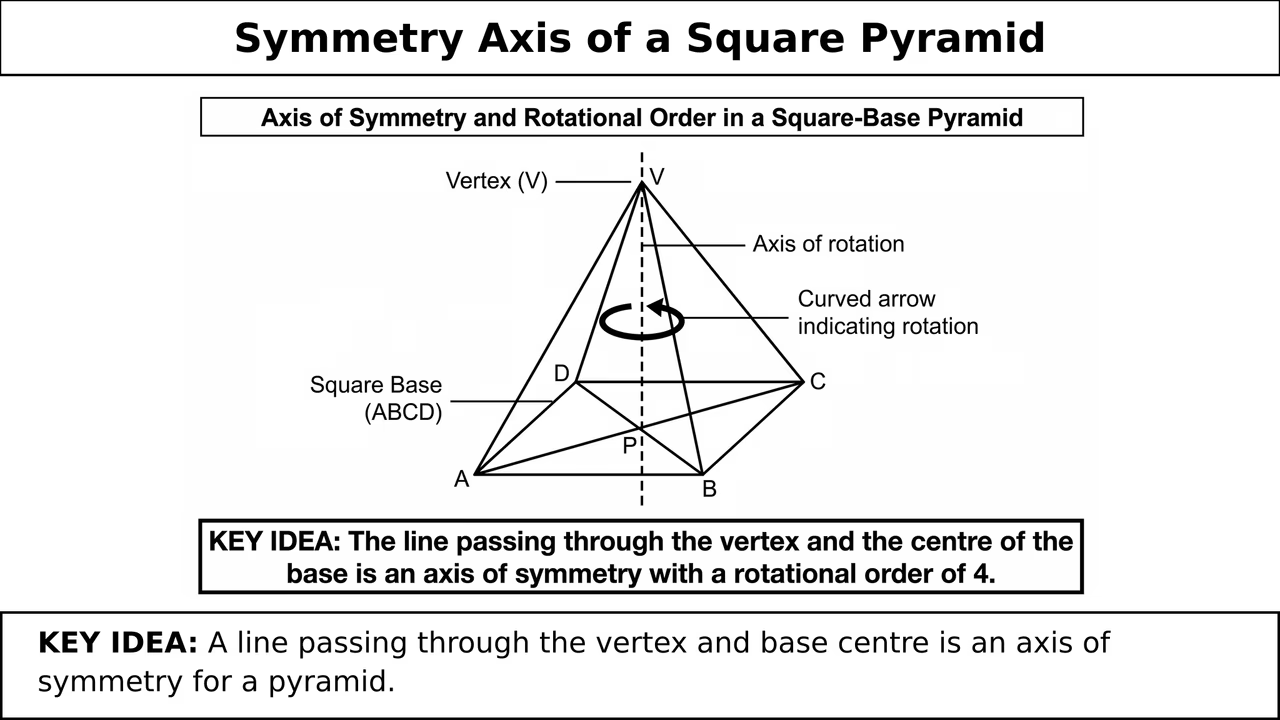
A square-based pyramid demonstrates rotational symmetry around a vertical axis passing through its vertex and base centre.
Figure 1: A square-based pyramid demonstrates rotational symmetry around a vertical axis passing through its vertex and base centre.

A symmetry axis in a three-dimensional figure is a straight line around which the figure rotates to match its starting shape. KEY IDEA: The line passing through the vertex and the centre of the base is an axis of symmetry. The count of coincident positions during a full 360∘ revolution defines its rotational order.

  • A line around which a figure turns into matching postures is a symmetry axis.
  • Rotational order measures how many times a figure matches itself in one turn.
  • Piercing a square pyramid from top apex V to base centre P creates a vertical axis.
  • Take safety precautions with sharp points when inserting wires into physical classroom models.
Worked example. Examine the base shape, which is a square featuring 4 equal sides and 90∘ rotational symmetry. Divide one full turn of 360∘ by the 4 symmetric positions: 360∘÷4=90∘. Count all overlapping positions in a single 360∘ revolution, which totals 4. Answer: The minimum turn angle is 90∘, and the rotational order around line VP is 4..

Check question: A right pyramid has a regular octagonal base. What is its rotational order about the axis passing through its vertex and the centre of its base?

  1. 4
  2. 6
  3. 8
  4. 16
Show answer

8. A regular octagon has 8 equal sides. Turning the pyramid about its central axis yields 8 matching alignment positions in one full turn of 360∘. Therefore, its rotational order is 8.
Slide 2 · Rotational Symmetry of PrismsModel · 22 min
Two 3D line drawings of equilateral triangular prisms. On the left, the prism st
Figure 2: Two 3D line drawings of equilateral triangular prisms. On the left, the prism st

Teach the full lesson on the projector

This lesson, and every other Grade 1–10 CBE lesson, comes ready to project with the EAP ClassKit. It runs without electricity or internet.

  • Both slides with diagrams and class activities
  • Teacher notes, SNE adaptations and assessment checks
  • Homework and the other 12 lessons in this sub-strand

All 13 lessons in Rotation

  1. 1Properties of Rotation: Centre, Angle, and CongruenceDetermine the properties of rotation in different situations
  2. 2Properties of Rotation and Evaluating Rotational TransformationsDetermine the properties of rotation in different situations
  3. 3Rotating Shapes on a Plane SurfaceRotate an object given the centre and angle of rotation on a plane surface and the Cartesian plane
  4. 4Rotating Objects on the Cartesian PlaneRotate an object given the centre and angle of rotation on a plane surface and the Cartesian plane
  5. 5Rotating Objects on the Cartesian Plane About Any Pivot PointRotate an object given the centre and angle of rotation on a plane surface and the Cartesian plane
  6. 6Finding the Pivot Centre and Angle of TurnDetermine the centre and angle of rotation given an object and its image
  7. 7Determining Centre and Angle of RotationDetermine the centre and angle of rotation given an object and its image
  8. 8Determining the Order of Rotational Symmetry of Plane FiguresDetermine the order of rotational symmetry of plane figures
  9. 9Determining Symmetrical Axes and Rotational Orders in 3D ShapesDetermine the axis and order of rotational symmetry in solids
  10. 10Rotational Symmetry in 3D Solids: Axes and OrdersDetermine the axis and order of rotational symmetry in solids
  11. 11Deducing Congruence from RotationDeduce congruence from rotation
  12. 12Deducing Congruence from Rotation and Identifying TransformationsDeduce congruence from rotation
  13. 13Applications of Rotation and Rotational Symmetry in Real LifeAppreciate the application of rotation in real-life situations