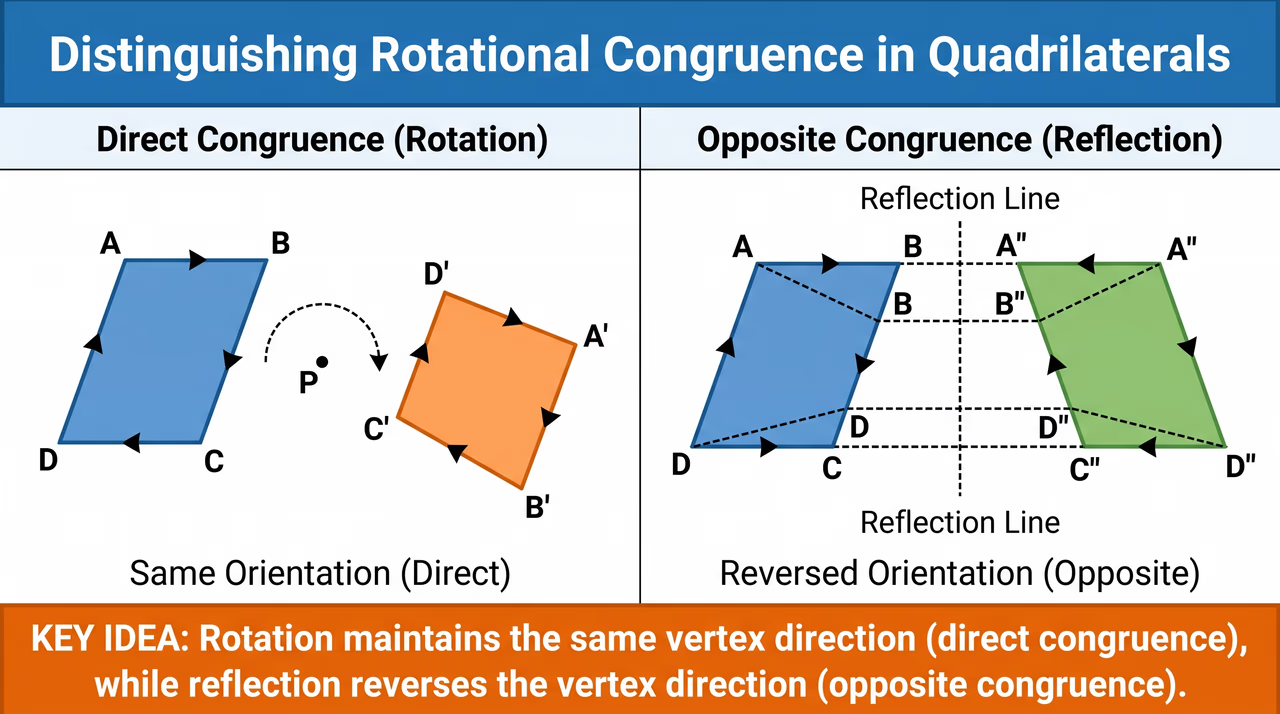
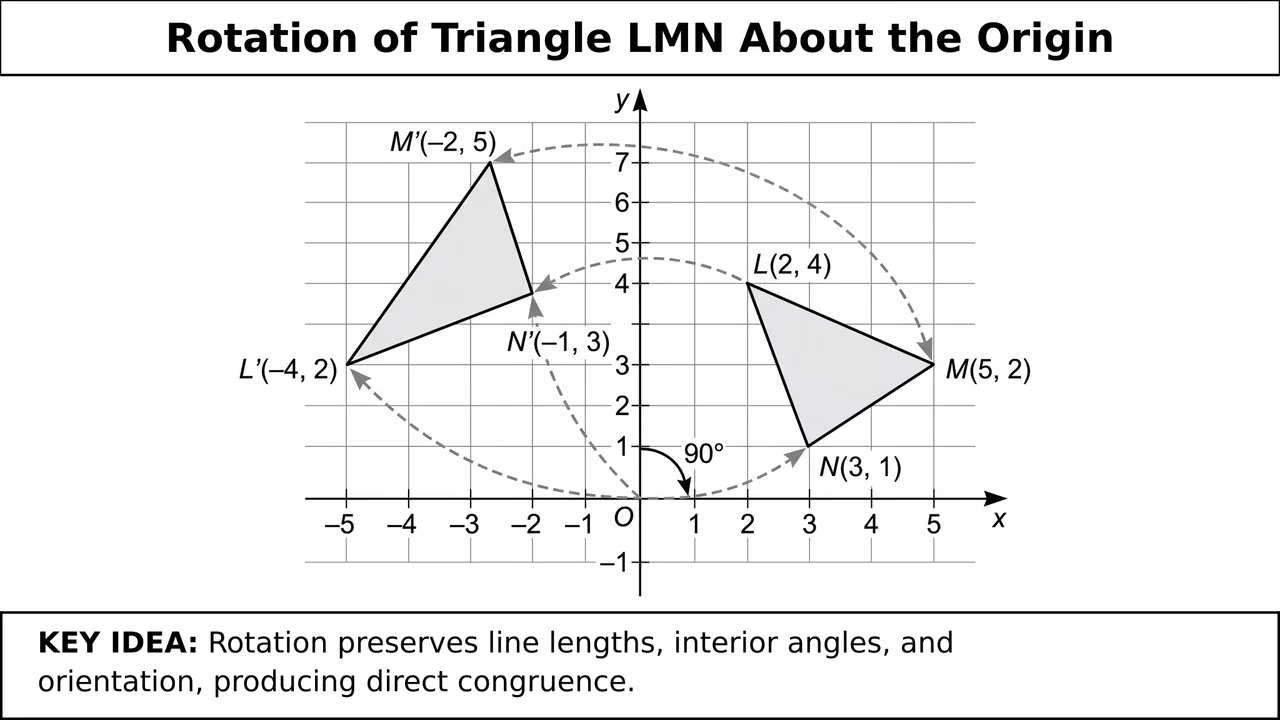
When an object undergoes a rotation about a centre point , every point turns through the exact same angle and direction. This rigid movement preserves all line lengths and interior angles, ensuring the object and its image have identical size and shape. Furthermore, rotation preserves the sense of orientation: tracing vertices in order around the object and image moves in the same direction. Therefore, rotation produces direct congruence between an object and its image.
- Rotation maps an object onto an image while preserving all side lengths and interior angle measurements.
- Because size and shape are strictly preserved, any rotated figure is congruent to its original object.
- Rotation maintains the sense of orientation, meaning vertex order direction remains unchanged.
- Figures related by rotation are directly congruent because they can align without flipping across a line.
Check question: Triangle with vertices , , and is rotated about the origin to form image triangle . What are the coordinates of , and what type of congruence exists between the two triangles?
- ; directly congruent
- ; oppositely congruent
- ; directly congruent
- ; oppositely congruent
Show answer
; directly congruent. A rotation about the origin uses the rule , mapping to . Because a rotation preserves side lengths, interior angles, and the sense of orientation (vertex order), the resulting shapes are directly congruent.