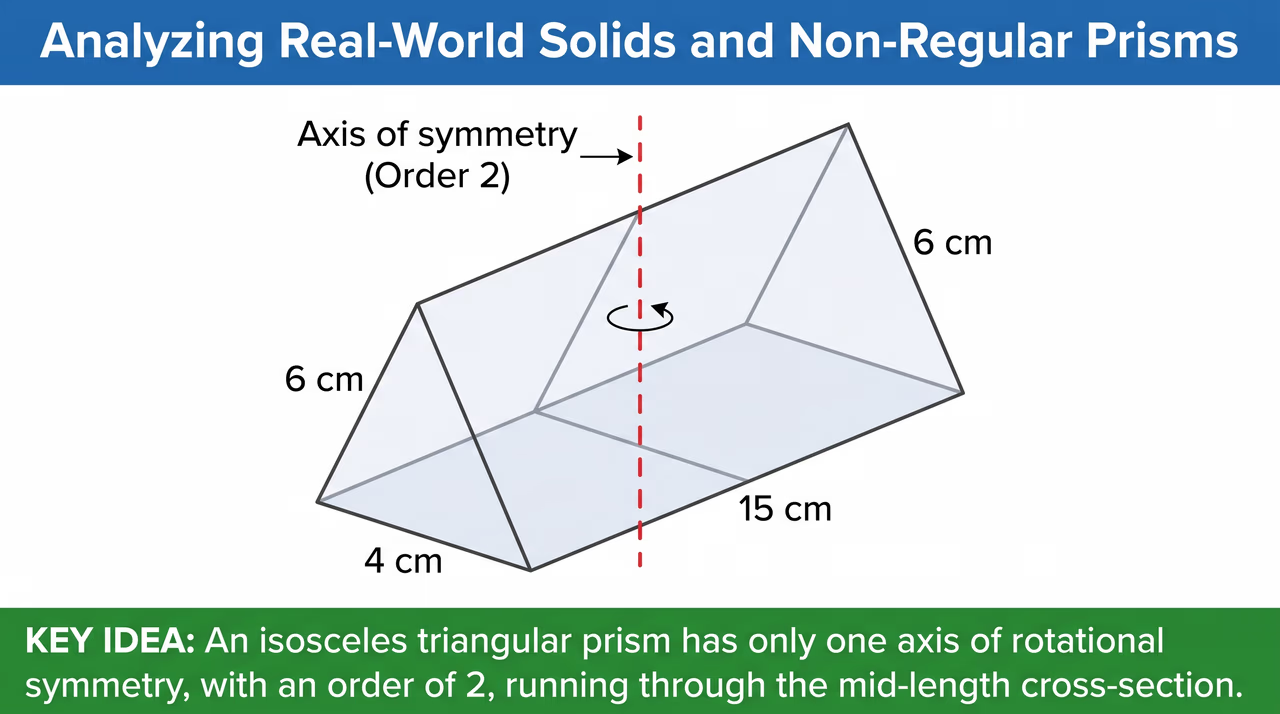
When analysing 3D solids such as regular polygonal prisms and cylinders, rotational axes pass through geometric centres or midpoints. A regular hexagonal prism has a principal longitudinal axis extending through the centres of both hexagonal bases, giving an order of rotational symmetry of 6. Additionally, it possesses 6 transverse axes lying in its mid-length cross-section, each giving an order of rotational symmetry of 2. A regular pentagonal prism similarly has 1 principal axis of order 5 and 5 transverse axes of order 2. Use Figure 1 to see these axes on a regular hexagonal prism.
- A principal axis connecting opposite base centroids gives rotational order equal to the number of base polygon sides.
- A regular hexagonal prism has one principal axis of order 6 passing through both hexagonal base centres.
- Transverse axes lie along the mid-length plane connecting edge midpoints or face centroids, each having order 2.
- A closed cylinder has one central axis of infinite rotational order and infinitely many transverse order-2 axes.
Check question: A solid right cylinder has a height of and circular radius of . What is the order of rotational symmetry about its main longitudinal axis?
- Infinite
- 2
- 5
- 15
Show answer
Infinite. Since a circle maps onto itself for any angle of rotation, turning the cylinder about its main longitudinal axis by any angle leaves it unchanged, resulting in an infinite order of rotational symmetry.