Skip to content

Grade 10 · Core Mathematics · Lesson 13 of 13

Applications of Rotation and Rotational Symmetry in Real Life

A Grade 10 Core Mathematics CBE lesson from the sub-strand Rotation. In it, learners determine angles described by clock hands during clockwise rotational motion.

Strand Measurements and GeometrySub-strand RotationLesson code 10CM-23-L1340 minutes · 2 slides

KICD learning outcome (g)

Appreciate the application of rotation in real-life situations.

By the end of this lesson, learners should be able to

  1. Determine angles described by clock hands during clockwise rotational motion.
  2. Identify axes of symmetry and order of rotational symmetry in physical models and cylindrical tanks.

Key vocabulary

Clockwise turn
Rotation moving in the same directional sense as the hands of a standard circular clock.
Turning a clock minute hand from twelve to three represents a clockwise turn of ninety degrees.
Axis of symmetry
A fixed line about which a three-dimensional object rotates to self-match its original shape.
A wire passing through vertex V and base centre C creates a vertical axis of symmetry.
Rotational order
The number of times an object matches its original shape during a full turn.
The cylindrical tank has a rotational order of two about its horizontal midpoint axis.

Lesson preview

Slide 1 · Rotational Movement in Clock Faces and Pyramid ModelsOpening · 18 min
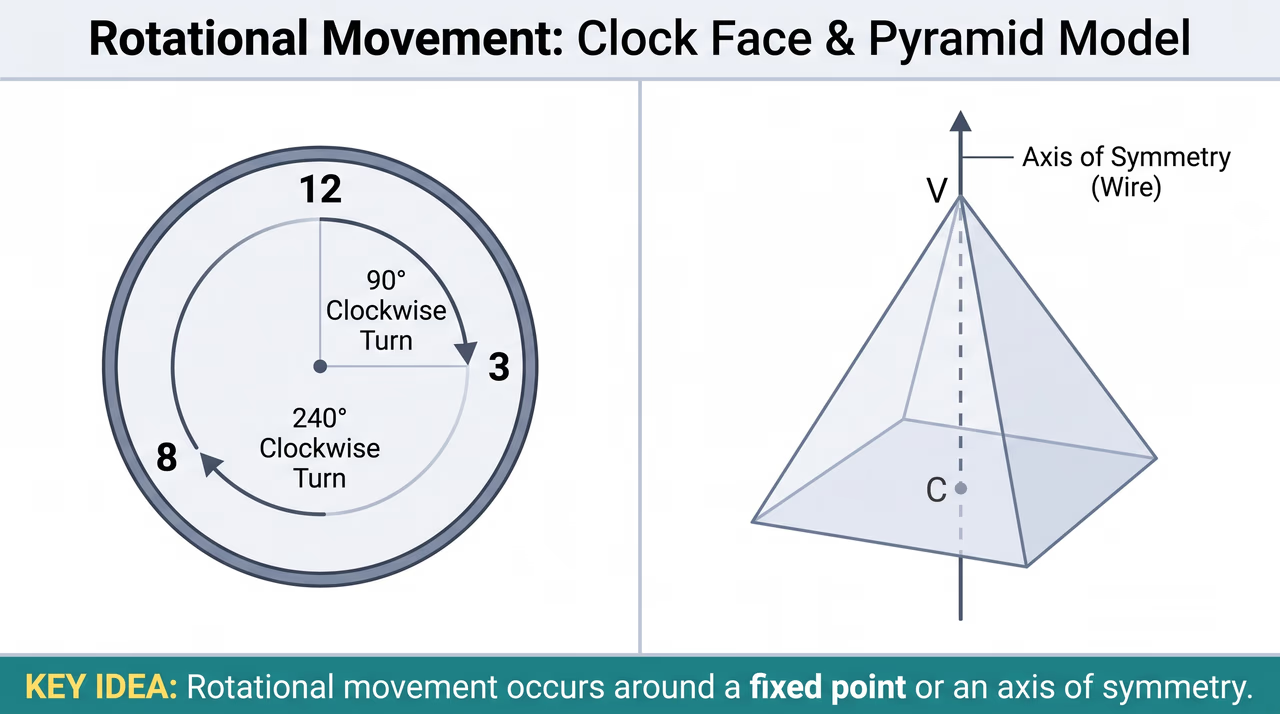
A clock face illustrating clockwise turns of 90 and 240 degrees, alongside a square-based pyramid with a central vertical axis of symmetry.
Figure 1: A clock face illustrating clockwise turns of 90 and 240 degrees, alongside a square-based pyramid with a central vertical axis of symmetry.

Rotational motion and symmetry are fundamental principles applied in everyday apparatus like mechanical clocks, windmills, and engineering models. On a standard clock face, moving clockwise from 12 covers 360° per full turn, where each minute mark represents 6°. For three-dimensional physical structures like a square-based pyramid, passing a central rigid wire through vertex V and base centre C creates an axis of symmetry. Turning the pyramid about this vertical wire reveals how spatial shapes repeat their appearance during rotation. Use Figure 1 to visualise the rotational turns and the pyramid's axis of symmetry.

  • Clock hands execute uniform clockwise rotational movement about a fixed centre point over measured time intervals.
  • Each hour mark on a clock face represents a clockwise turn of exactly 30 degrees from the top.
  • A rigid wire inserted through vertex V and base centre C forms a vertical axis of symmetry.
  • Rotating a square-based pyramid a full turn about its central axis yields four self-matching spatial positions.
Worked example. A complete circle contains 360∘ divided into 12 equal hour intervals, so each interval is 360∘12=30∘. From 12 to 3 is 3 hour intervals: 3×30∘=90∘. From 12 to 8 is 8 hour intervals: 8×30∘=240∘. Answer: The clockwise angles turned are 90∘ to reach 3 and 240∘ to reach 8..

Check question: A square-based pyramid model is mounted on a stiff wire passing through its top vertex and the centre of its base. What is the angle between successive matching positions as the pyramid rotates about this wire?

  1. 45∘
  2. 90∘
  3. 180∘
  4. 360∘
Show answer

90∘. A regular square base has 4 equal side orientations, so one full turn of 360∘ gives 360∘÷4=90∘ between self-matching positions.

Slide 2 · Rotational Symmetry in Real-World Cylindrical SolidsClosing · 22 min
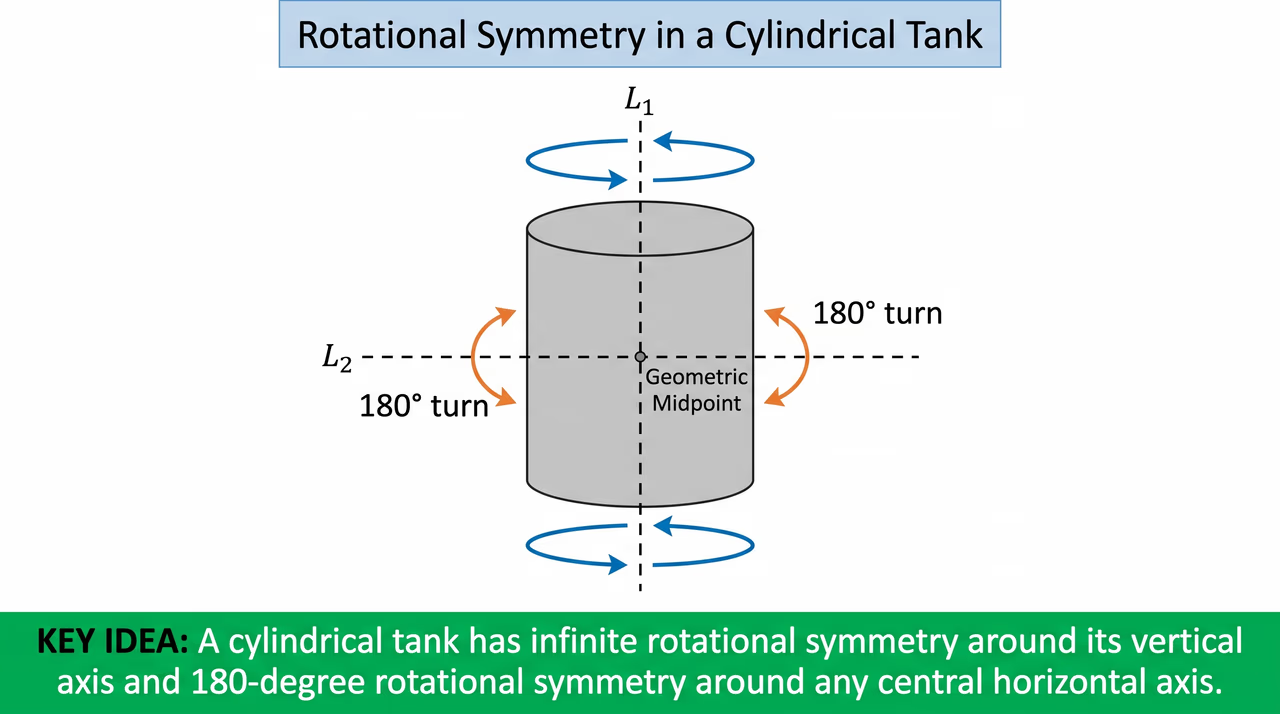
A model of a cylindrical tank demonstrating a vertical axis of continuous rotation and a horizontal axis for a 180-degree turn.
Figure 2: A model of a cylindrical tank demonstrating a vertical axis of continuous rotation and a horizontal axis for a 180-degree turn.

Teach the full lesson on the projector

This lesson, and every other Grade 1–10 CBE lesson, comes ready to project with the EAP ClassKit. It runs without electricity or internet.

  • Both slides with diagrams and class activities
  • Teacher notes, SNE adaptations and assessment checks
  • Homework and the other 12 lessons in this sub-strand

All 13 lessons in Rotation

  1. 1Properties of Rotation: Centre, Angle, and CongruenceDetermine the properties of rotation in different situations
  2. 2Properties of Rotation and Evaluating Rotational TransformationsDetermine the properties of rotation in different situations
  3. 3Rotating Shapes on a Plane SurfaceRotate an object given the centre and angle of rotation on a plane surface and the Cartesian plane
  4. 4Rotating Objects on the Cartesian PlaneRotate an object given the centre and angle of rotation on a plane surface and the Cartesian plane
  5. 5Rotating Objects on the Cartesian Plane About Any Pivot PointRotate an object given the centre and angle of rotation on a plane surface and the Cartesian plane
  6. 6Finding the Pivot Centre and Angle of TurnDetermine the centre and angle of rotation given an object and its image
  7. 7Determining Centre and Angle of RotationDetermine the centre and angle of rotation given an object and its image
  8. 8Determining the Order of Rotational Symmetry of Plane FiguresDetermine the order of rotational symmetry of plane figures
  9. 9Determining Symmetrical Axes and Rotational Orders in 3D ShapesDetermine the axis and order of rotational symmetry in solids
  10. 10Rotational Symmetry in 3D Solids: Axes and OrdersDetermine the axis and order of rotational symmetry in solids
  11. 11Deducing Congruence from RotationDeduce congruence from rotation
  12. 12Deducing Congruence from Rotation and Identifying TransformationsDeduce congruence from rotation
  13. 13Applications of Rotation and Rotational Symmetry in Real LifeAppreciate the application of rotation in real-life situations