Skip to content

Grade 10 · Core Mathematics · Lesson 1 of 13

Properties of Rotation: Centre, Angle, and Congruence

A Grade 10 Core Mathematics CBE lesson from the sub-strand Rotation. In it, learners identify the centre and turn angle in clockwise and anticlockwise directions.

Strand Measurements and GeometrySub-strand RotationLesson code 10CM-23-L140 minutes · 2 slides

KICD learning outcome (a)

Determine the properties of rotation in different situations.

By the end of this lesson, learners should be able to

  1. Identify the centre and turn angle in clockwise and anticlockwise directions.
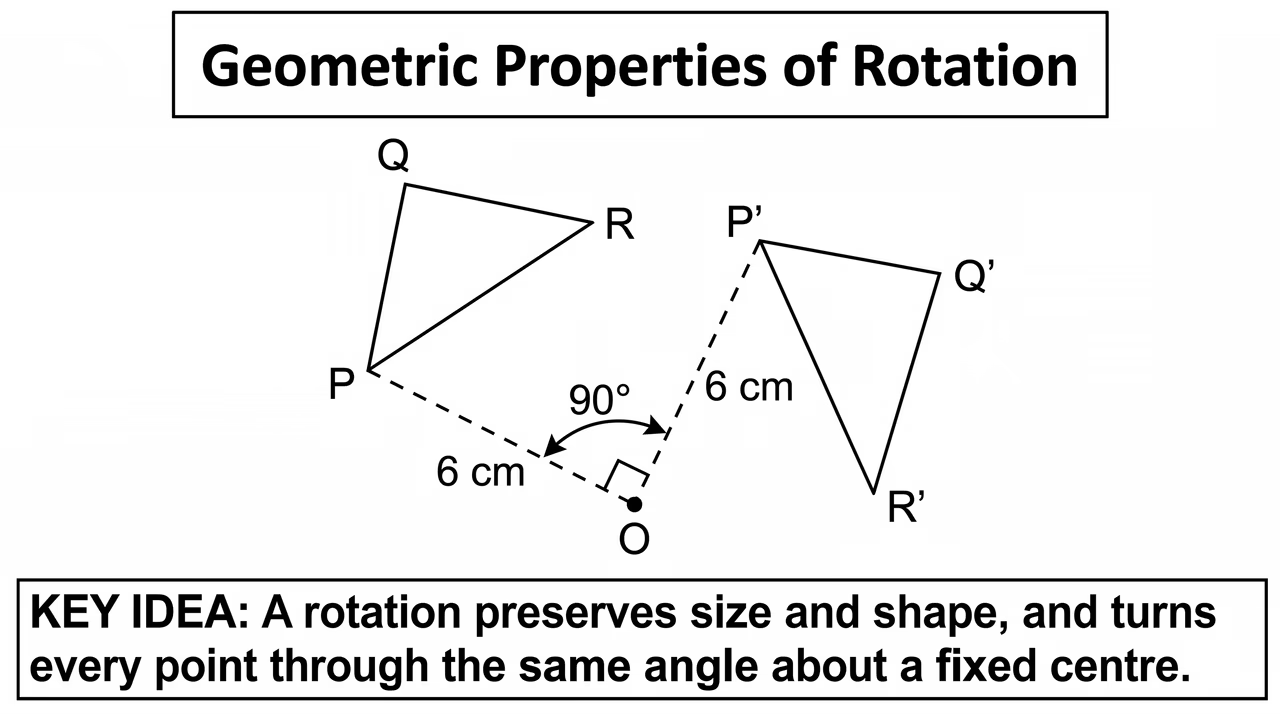
  2. Demonstrate that an object point and its mapped image lie at equal distances from the transformation centre.
  3. Verify that an object and its rotated image are congruent.

Key vocabulary

Centre of rotation
The fixed point around which all points of a figure turn during a geometric rotation.
The central pivot of a clock face serves as the fixed pivot for all moving hands.
Angle of rotation
The measure of turn in degrees through which a figure rotates about a centre.
Turning the minute hand from twelve to three creates a negative ninety degree angle of rotation.
Congruent
Having identical shape and size, with equal corresponding lengths and angle measurements.
The original triangle and its rotated image are congruent because their dimensions remain unchanged.
Invariant point
A point that remains fixed in its original position during a geometric transformation.
The centre of rotation is the only invariant point when rotating a shape on a plane.

Lesson preview

Slide 1 · Introduction to Rotational Movement and DirectionOpening · 18 min
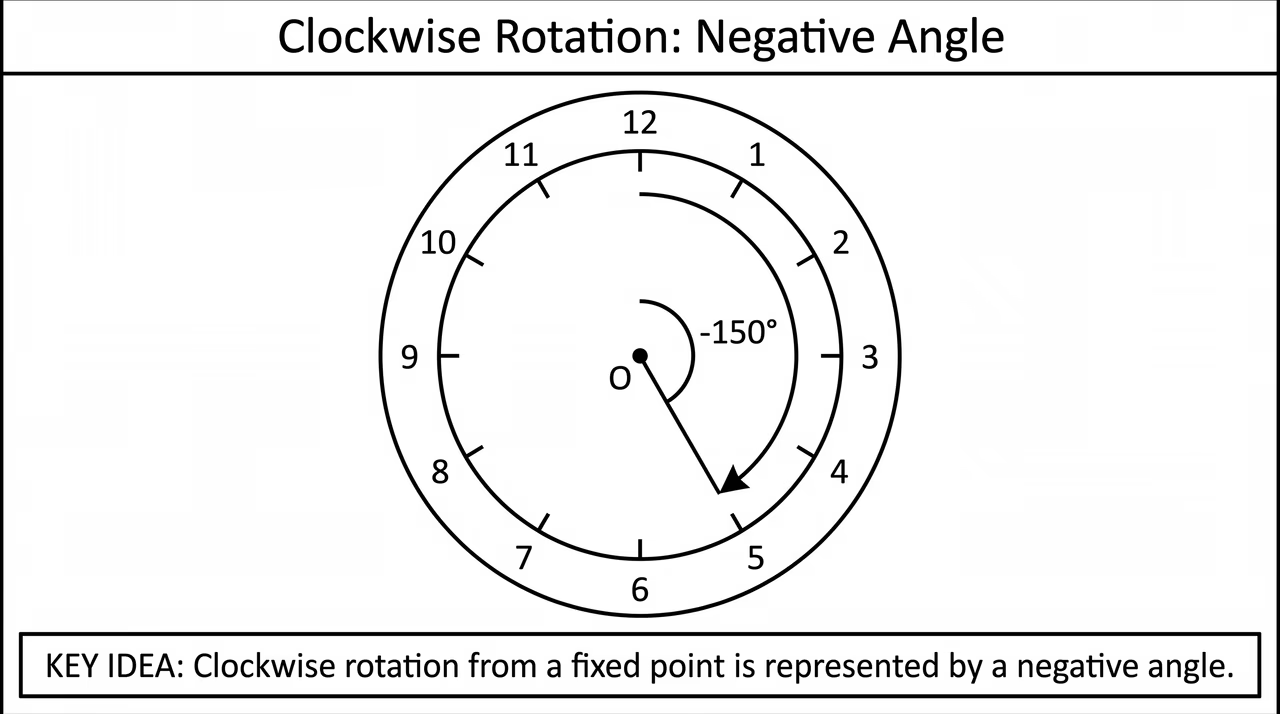
A circular clock face showing a clockwise rotation from the twelve to the five position, forming a negative angle of 150 degrees.
Figure 1: A circular clock face showing a clockwise rotation from the twelve to the five position, forming a negative angle of 150 degrees.

Rotation describes circular motion about a fixed pivot known as the turn centre. In daily life, we see rotation when clock hands move or wheel spokes turn. Mathematically, a rotation requires a pivot point and turn angle. Moving in an anticlockwise direction gives a positive angle of rotation, while moving in a clockwise direction gives a negative angle. By measuring turns from a central reference point, we analyse how shapes change orientation while preserving their overall size.

  • Rotation is a transformation where every point turns around a fixed point called the centre of rotation.
  • Clockwise movements represent negative rotational angles, whereas anticlockwise movements represent positive rotational angles in geometry.
  • Each hour mark on a circular clock face represents a turn of thirty degrees from the centre point.
  • An object's shape and size remain completely unchanged after undergoing any amount of rotational movement.
Worked example. A full revolution of 12 numbered positions on a clock dial equals 360∘. Moving clockwise from position 12 to position 5 covers 5 equal sectors: 512×360∘=150∘. By mathematical convention, clockwise rotations are negative, so the angle is −150∘. Answer: −150∘ (or 150∘ clockwise).

Check question: A pointer on a 12-position circular dial initially at position 12 is rotated clockwise to position 10. What is the angle of rotation in degrees?

  1. −300∘
  2. 300∘
  3. −60∘
  4. 60∘
Show answer

−300∘. Moving clockwise from position 12 to 10 covers 10 out of 12 sectors on the circular dial. The angle covered is 1012×360∘=300∘. By mathematical convention, clockwise rotations are negative, so the angle is written as −300∘.

Slide 2 · Geometric Properties of RotationPractice · 22 min
A ninety-degree rotation of triangle PQR around centre O to form a congruent image, maintaining equal pivot distances of six centimetres.
Figure 2: A ninety-degree rotation of triangle PQR around centre O to form a congruent image, maintaining equal pivot distances of six centimetres.

Teach the full lesson on the projector

This lesson, and every other Grade 1–10 CBE lesson, comes ready to project with the EAP ClassKit. It runs without electricity or internet.

  • Both slides with diagrams and class activities
  • Teacher notes, SNE adaptations and assessment checks
  • Homework and the other 12 lessons in this sub-strand

All 13 lessons in Rotation

  1. 1Properties of Rotation: Centre, Angle, and CongruenceDetermine the properties of rotation in different situations
  2. 2Properties of Rotation and Evaluating Rotational TransformationsDetermine the properties of rotation in different situations
  3. 3Rotating Shapes on a Plane SurfaceRotate an object given the centre and angle of rotation on a plane surface and the Cartesian plane
  4. 4Rotating Objects on the Cartesian PlaneRotate an object given the centre and angle of rotation on a plane surface and the Cartesian plane
  5. 5Rotating Objects on the Cartesian Plane About Any Pivot PointRotate an object given the centre and angle of rotation on a plane surface and the Cartesian plane
  6. 6Finding the Pivot Centre and Angle of TurnDetermine the centre and angle of rotation given an object and its image
  7. 7Determining Centre and Angle of RotationDetermine the centre and angle of rotation given an object and its image
  8. 8Determining the Order of Rotational Symmetry of Plane FiguresDetermine the order of rotational symmetry of plane figures
  9. 9Determining Symmetrical Axes and Rotational Orders in 3D ShapesDetermine the axis and order of rotational symmetry in solids
  10. 10Rotational Symmetry in 3D Solids: Axes and OrdersDetermine the axis and order of rotational symmetry in solids
  11. 11Deducing Congruence from RotationDeduce congruence from rotation
  12. 12Deducing Congruence from Rotation and Identifying TransformationsDeduce congruence from rotation
  13. 13Applications of Rotation and Rotational Symmetry in Real LifeAppreciate the application of rotation in real-life situations