
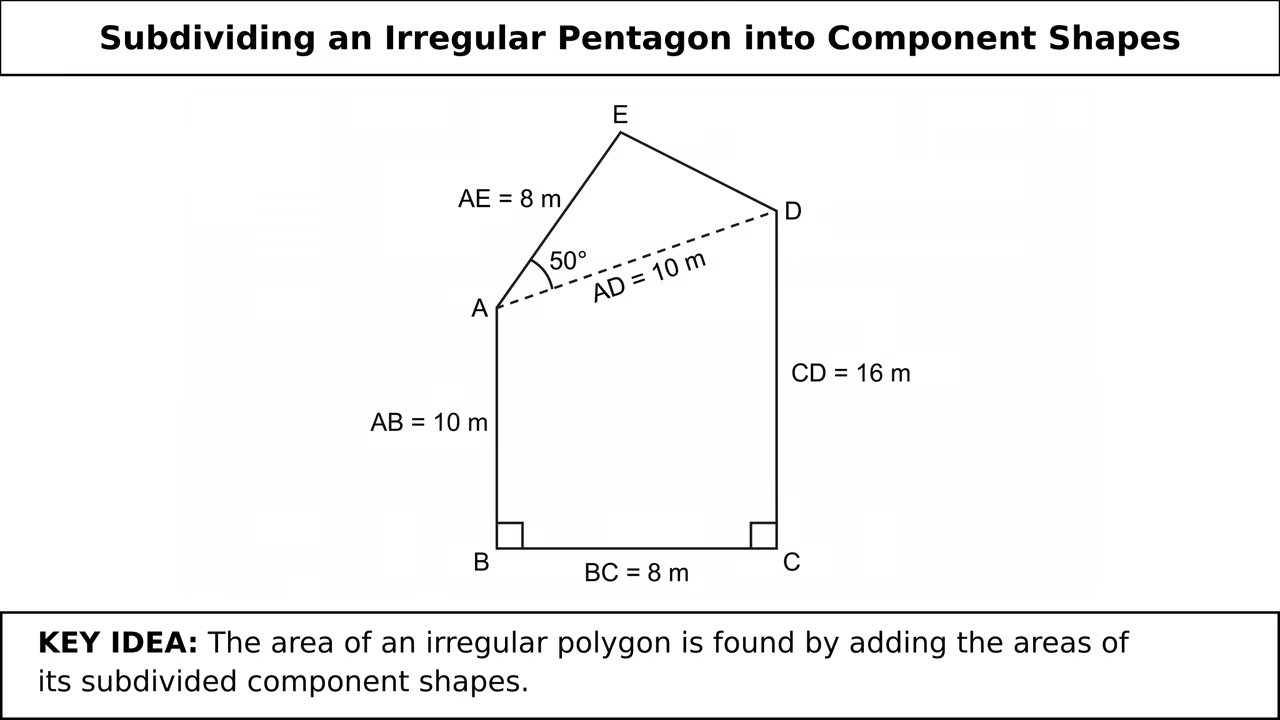
To determine the area of irregular polygons in different situations, we subdivide the complex floor plan or boundary into convenient geometrical shapes. By drawing internal connecting lines between key vertices, we partition the irregular polygon into familiar figures like triangles, rectangles, or trapeziums. We then calculate the area of each component shape independently and sum the areas. The area of an irregular polygon is always equal to the sum of the areas of its subdivided component shapes. Use Figure 1 to see how to partition an irregular polygon into familiar figures.
- An irregular polygon has non-equal side lengths or interior angles, requiring subdivision for area calculation.
- Subdivide complex composite plans into convenient geometrical shapes such as rectangles, trapeziums, and triangles.
- Calculate the area of each component sub-region using standard geometric or trigonometric area formulas.
- The area of an irregular polygon equals the sum of the areas of its subdivided component shapes.
Check question: A site layout consists of rectangle and triangle , drawn outside the rectangle on side . Rectangle has and . Triangle has base , side , and . What is the total area of ?
Show answer
. Area of rectangle . Area of triangle . Total area = .
