Skip to content

Grade 10 · Core Mathematics · Lesson 10 of 12

Determining Area of Irregular Polygons in Real Situations

A Grade 10 Core Mathematics CBE lesson from the sub-strand Area of Polygons. In it, learners partition real-world irregular shapes such as church walls and window frames into simpler geometric shapes.

Strand Measurements and GeometrySub-strand Area of PolygonsLesson code 10CM-25-L1040 minutes · 2 slides

KICD learning outcome (f)

Determine the area of irregular polygons in different situations.

By the end of this lesson, learners should be able to

  1. Partition real-world irregular shapes such as church walls and window frames into simpler geometric shapes.
  2. Apply right-angled trigonometry and the trigonometric area formula 12absin⁡C to determine missing dimensions and calculate total surface areas of complex polygonal networks.

Key vocabulary

Composite shape
A geometric figure formed by combining two or more basic polygons together.
The hall window was modelled as a composite shape of a rectangle and triangle.
Polygonal network
An arrangement of connected polygons sharing common boundary line segments or vertices.
The spider web formed a polygonal network divided into small adjacent triangular sections.

Lesson preview

Slide 1 · Area of Architectural Composite ShapesModel · 18 min
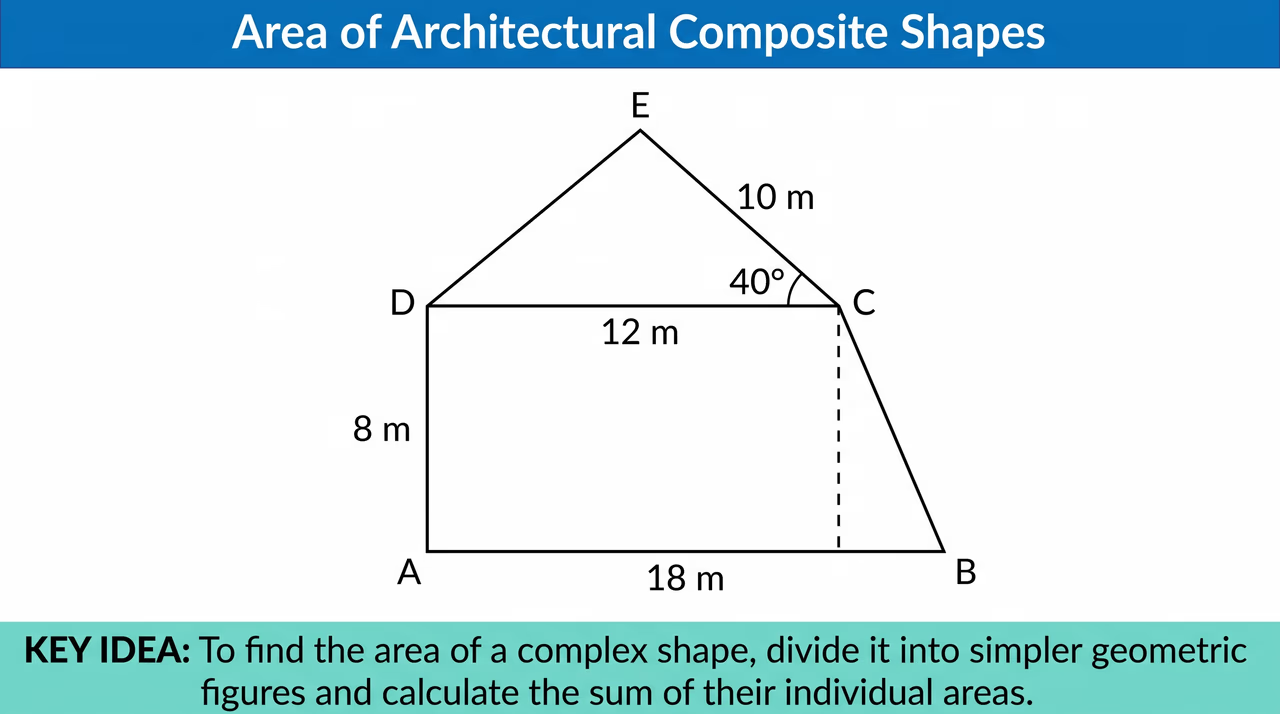
A composite polygon representing a church wall, consisting of a triangular roof above a trapezium base.
Figure 1: A composite polygon representing a church wall, consisting of a triangular roof above a trapezium base.

Irregular polygons in architectural designs, such as church walls and hall window frames, often consist of composite structures. To find the surface area of such complex real-life shapes, we divide the polygon into standard geometric figures like trapeziums, rectangles, and triangles. We calculate the individual area of each component using relevant geometric formulas, then sum these sub-areas to determine the total enclosed surface area accurately.

  • Identify composite real-world structures like church walls by partitioning them into simpler geometric regions.
  • Use standard formulas to compute component areas for rectangles, trapeziums, and non-right-angled triangles.
  • Ensure adjacent boundary segments match correctly when evaluating sub-shapes of an irregular figure.
  • Sum all component areas to determine the overall surface area of the irregular polygon.
Worked example. Subdivide the wall along CD into trapezium ABCD (below) and triangle CDE (above). Calculate trapezium area: Area1=0.5×(18+12)×8=120 m2. Calculate triangle area using 0.5absin⁡C: Area2=0.5×DC×CE×sin⁡(40∘)=0.5×12×10×sin⁡(40∘)=60×0.642788=38.5673 m2. Sum the component areas: Total Area=120+38.5673=158.5673≈158.57 m2. Answer: 158.57 m2.

Check question: A hall window is shaped as a composite polygon with a rectangular base measuring 4 m by 3 m and a triangular top with a base of 4 m and a height of 2.5 m. What is its total surface area?

  1. 17 m2
  2. 22 m2
  3. 11 m2
  4. 12 m2
Show answer

17 m2. The area of the rectangular base is 4×3=12 m2. The area of the triangular top is 0.5×4×2.5=5 m2. The total area is the sum of these two regions: 12+5=17 m2.

Slide 2 · Area of Multi-Region Polygonal NetworksPractice · 22 min
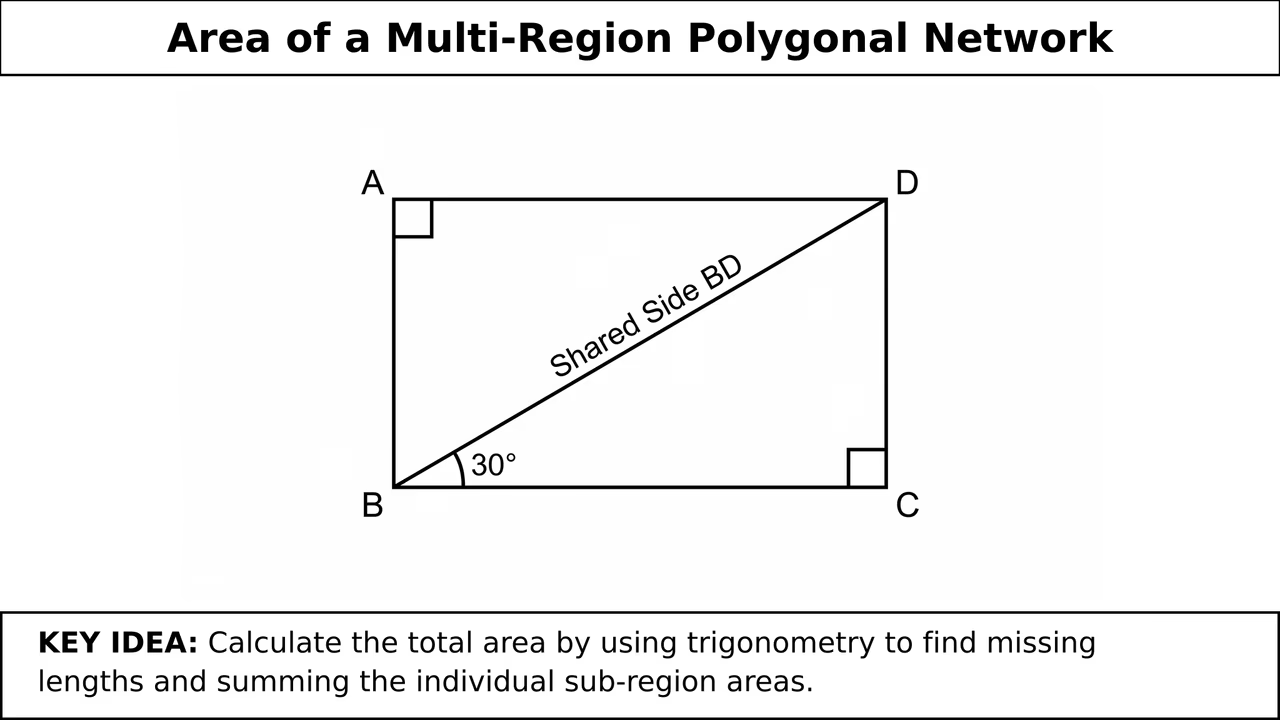
A rectangular shape that has been divided into two right-angled triangles by a diagonal line.
Figure 2: A rectangular shape that has been divided into two right-angled triangles by a diagonal line.

Teach the full lesson on the projector

This lesson, and every other Grade 1–10 CBE lesson, comes ready to project with the EAP ClassKit. It runs without electricity or internet.

  • Both slides with diagrams and class activities
  • Teacher notes, SNE adaptations and assessment checks
  • Homework and the other 11 lessons in this sub-strand

All 12 lessons in Area of Polygons

  1. 1Deriving and Applying the Formula for Area of a TriangleDerive the formula for the area of a triangle given two sides and an included angle
  2. 2Area of a Triangle Using Two Sides and an Included AngleWork out the area of a triangle given two sides and an included angle
  3. 3Determining Area of a Triangle using Heron's FormulaDetermine the area of a triangle using Heron's formula
  4. 4Area of a Triangle Using Heron's FormulaDetermine the area of a triangle using Heron's formula
  5. 5Determining Area of Quadrilaterals in Different Situations: Parallelograms and TrapeziumsDetermine the area of quadrilaterals in different situations
  6. 6Determining Area of Quadrilaterals in Different Situations: Kites and Complex FiguresDetermine the area of quadrilaterals in different situations
  7. 7Area of Regular Polygons: Heptagons and OctagonsWork out the area of regular heptagon and octagon
  8. 8Area of Regular Polygons: Heptagons and Octagons (Lesson 2)Work out the area of regular heptagon and octagon
  9. 9Determining Area of Irregular Polygons by Shape SubdivisionDetermine the area of irregular polygons in different situations
  10. 10Determining Area of Irregular Polygons in Real SituationsDetermine the area of irregular polygons in different situations
  11. 11Exploring Area of Polygons in Real-Life SituationsExplore the area of polygons as used in real-life situations
  12. 12Applying Polygon Area Calculations in Real-Life SituationsExplore the area of polygons as used in real-life situations