
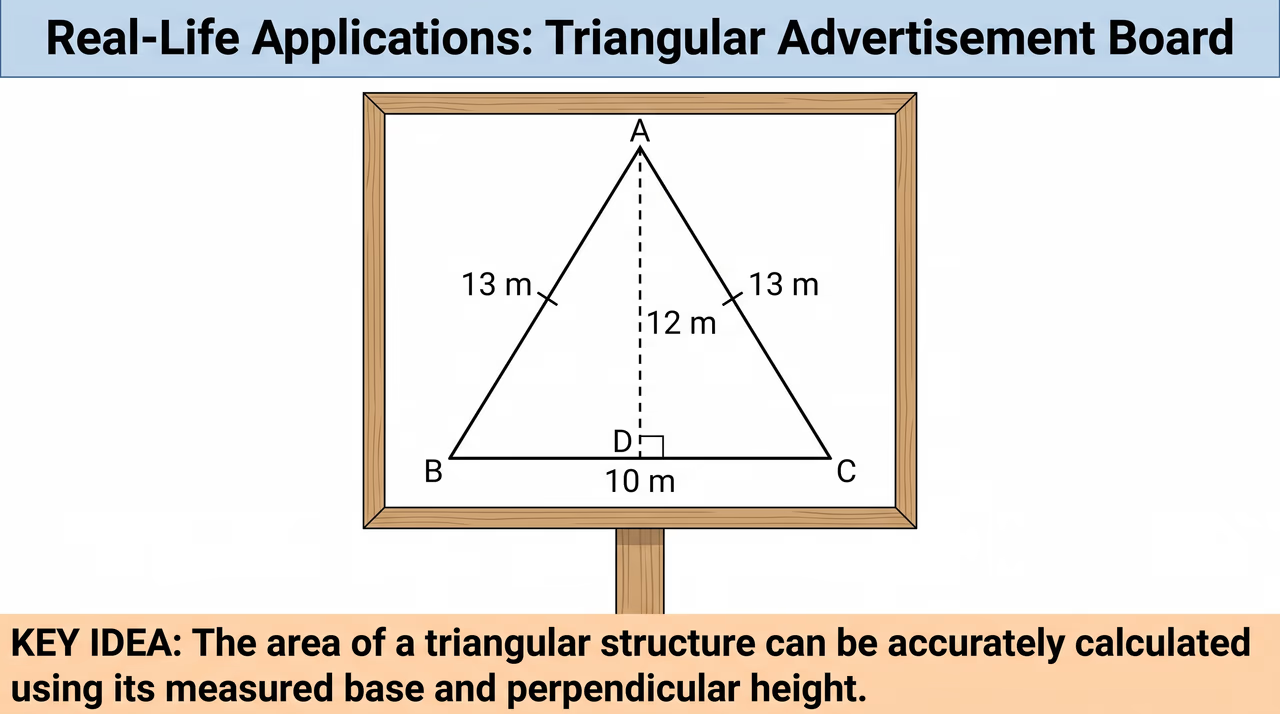
Everyday objects and physical structures such as advertisement boards, triangular garden flower beds, and school field sections can be modelled using geometric polygons. By measuring available dimensions like side lengths, perpendicular heights, or interior angles, we can select the appropriate formula—such as , , or Heron's formula—to accurately evaluate total surface area and solve practical financial problems like painting or fencing costs. Use Figure 1 to see how to identify the base and perpendicular height of an advertisement board.
- Real-life triangular structures like ad boards and flower beds can be measured using appropriate area formulas.
- When two side lengths and an included angle are known, apply the formula Area = ½ ab sin C.
- For triangles with three known side lengths, calculate semi-perimeter s and apply Heron's formula for area.
- Empirical measurements using perpendicular height yield matching area values to trigonometric and algebraic methods.
Check question: A triangular flower bed in a school compound has side lengths of 8 m and 11 m with an included angle of 60°. Calculate its area to 2 decimal places.
- 22.00 m²
- 38.11 m²
- 44.00 m²
- 76.21 m²
Show answer
38.11 m². To find the area of the triangular flower bed when two side lengths and the included angle are given, use the formula . Substituting the given values: .
