
Skip to content

Grade 10 · Core Mathematics · Lesson 8 of 12

Area of Regular Polygons: Heptagons and Octagons (Lesson 2)

A Grade 10 Core Mathematics CBE lesson from the sub-strand Area of Polygons. In it, learners determine the total area of regular octagons and heptagons given side lengths in practical contexts.

Strand Measurements and GeometrySub-strand Area of PolygonsLesson code 10CM-25-L840 minutes · 2 slides

KICD learning outcome (e)

Work out the area of regular heptagon and octagon.

By the end of this lesson, learners should be able to

  1. Determine the total area of regular octagons and heptagons given side lengths in practical contexts.
  2. Perform cost calculations for real-world polygonal surfaces based on area.
  3. Calculate unknown side lengths of regular heptagons and octagons given their total surface area.

Key vocabulary

Apothem
The perpendicular distance from the centre of a regular polygon to any of its sides.
The altitude of each central triangle represents the apothem of the regular octagonal gazebo floor.
Inverse Calculation
Reversing a standard formula to solve for an unknown input from a known output.
We perform an inverse calculation to find side length from the total heptagon area.

Lesson preview

Slide 1 · Calculating Areas of Regular Heptagons and Octagons from Side LengthsModel · 18 min
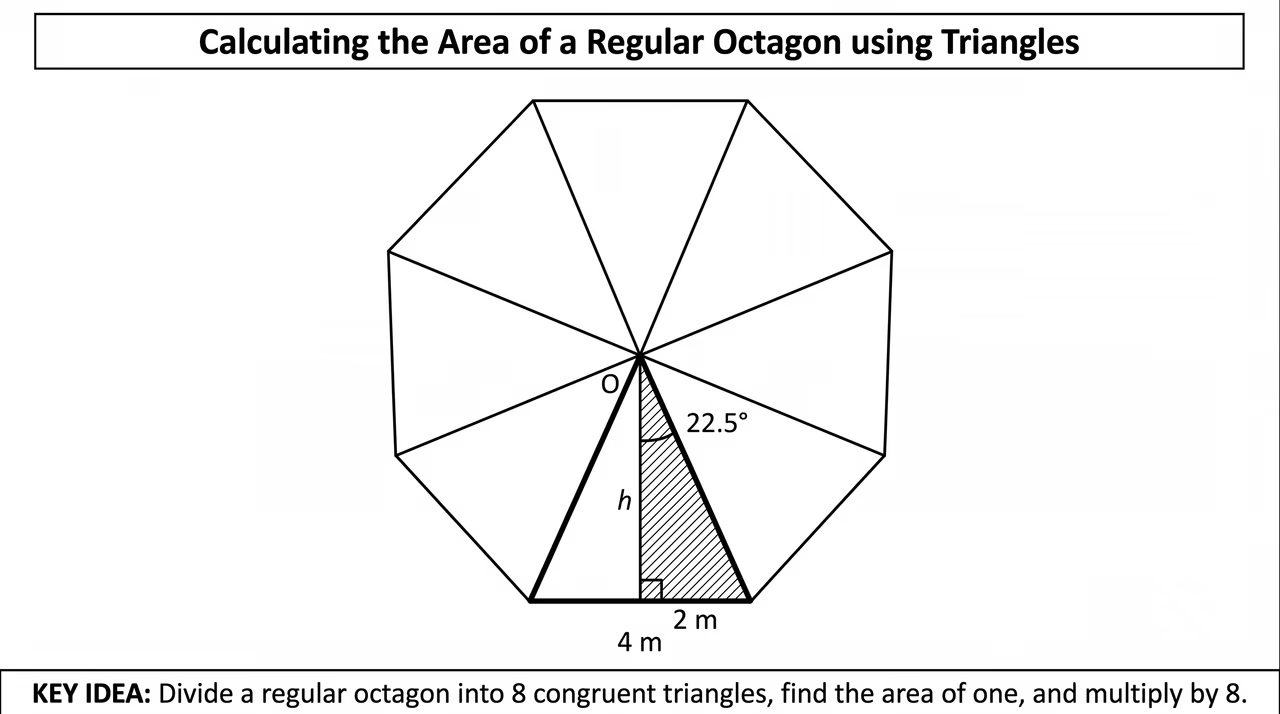
A regular octagon is divided into eight central triangles, highlighting one isosceles triangle with its altitude, half-angle, and base measurements.
Figure 1: A regular octagon is divided into eight central triangles, highlighting one isosceles triangle with its altitude, half-angle, and base measurements.

To find the area of a regular octagon or heptagon when given its side length, we decompose the polygon into congruent central triangles. By halving a central isosceles triangle, we form a right-angled triangle. We use the tangent trigonometric ratio with the half-angle and half-side to calculate the triangle's altitude, find the area of one central triangle, and multiply by the total number of sides.

  • Dividing a regular octagon into eight congruent triangles gives a central angle of 45∘ for each triangle.
  • Halving the central angle forms a right-angled triangle where altitude is found using the tangent trigonometric ratio.
  • The total area equals eight times the area of one central triangle computed using base and altitude.
  • Tiling costs are calculated by multiplying total surface area in square metres by cost per square metre.
Worked example. Central angle for one triangle = 360∘÷8=45∘. Half-angle = 22.5∘. Half-side length = 4 m÷2=2 m. Altitude h=2tan⁡(22.5∘)≈4.8284 m. Area of 1 central triangle = 0.5×4 m×4.8284 m≈9.6568 m2. Total area of octagon = 8×9.6568 m2=77.2544 m2≈77.25 m2. Total tiling cost = 77.2544 m2×600=Ksh 46,352.64. Answer: Area = 77.25 m², Total Cost = Ksh 46,352.64.

Check question: A regular heptagonal patio has a side length of 14 m. Calculate its surface area to two decimal places.

  1. 101.75 m²
  2. 273.53 m²
  3. 712.25 m²
  4. 1424.49 m²
Show answer

712.25 m². Central angle = 360∘÷7≈51.4286∘, half-angle ≈25.7143∘. Altitude h=7÷tan⁡(25.7143∘)≈14.5357 m. Area of 1 triangle = 0.5×14×14.5357=101.7499 m2. Total heptagon area = 7×101.7499≈712.25 m2.

Slide 2 · Solving Inverse and Real-World Problems Involving Regular PolygonsPractice · 22 min
A regular heptagon has one central triangle extracted, showing its area, base, and altitude expressed in terms of the side length.
Figure 2: A regular heptagon has one central triangle extracted, showing its area, base, and altitude expressed in terms of the side length.

Teach the full lesson on the projector

This lesson, and every other Grade 1–10 CBE lesson, comes ready to project with the EAP ClassKit. It runs without electricity or internet.

  • Both slides with diagrams and class activities
  • Teacher notes, SNE adaptations and assessment checks
  • Homework and the other 11 lessons in this sub-strand

All 12 lessons in Area of Polygons

  1. 1Deriving and Applying the Formula for Area of a TriangleDerive the formula for the area of a triangle given two sides and an included angle
  2. 2Area of a Triangle Using Two Sides and an Included AngleWork out the area of a triangle given two sides and an included angle
  3. 3Determining Area of a Triangle using Heron's FormulaDetermine the area of a triangle using Heron's formula
  4. 4Area of a Triangle Using Heron's FormulaDetermine the area of a triangle using Heron's formula
  5. 5Determining Area of Quadrilaterals in Different Situations: Parallelograms and TrapeziumsDetermine the area of quadrilaterals in different situations
  6. 6Determining Area of Quadrilaterals in Different Situations: Kites and Complex FiguresDetermine the area of quadrilaterals in different situations
  7. 7Area of Regular Polygons: Heptagons and OctagonsWork out the area of regular heptagon and octagon
  8. 8Area of Regular Polygons: Heptagons and Octagons (Lesson 2)Work out the area of regular heptagon and octagon
  9. 9Determining Area of Irregular Polygons by Shape SubdivisionDetermine the area of irregular polygons in different situations
  10. 10Determining Area of Irregular Polygons in Real SituationsDetermine the area of irregular polygons in different situations
  11. 11Exploring Area of Polygons in Real-Life SituationsExplore the area of polygons as used in real-life situations
  12. 12Applying Polygon Area Calculations in Real-Life SituationsExplore the area of polygons as used in real-life situations