
Skip to content

Grade 10 · Core Mathematics · Lesson 7 of 12

Area of Regular Polygons: Heptagons and Octagons

A Grade 10 Core Mathematics CBE lesson from the sub-strand Area of Polygons. In it, learners determine central angles for regular heptagons and octagons.

Strand Measurements and GeometrySub-strand Area of PolygonsLesson code 10CM-25-L740 minutes · 2 slides

KICD learning outcome (e)

Work out the area of regular heptagon and octagon.

By the end of this lesson, learners should be able to

  1. Determine central angles for regular heptagons and octagons.
  2. Calculate the area of a regular octagon given its circumradius using trigonometry.
  3. Work out the area of a regular heptagon given its side length using right-angled triangle altitude derivation.

Key vocabulary

Heptagon
A flat geometric shape bounded by seven straight line sides and seven interior angles.
A regular heptagon has seven equal sides and seven congruent central isosceles triangles.
Octagon
A flat geometric shape bounded by eight straight line sides and eight interior angles.
An octagon decomposes into eight identical triangles meeting at its central point.
Altitude
The perpendicular distance measured from a vertex to the opposite base of a polygon.
The altitude of each triangle in the heptagon is calculated as 29.07 cm.

Lesson preview

Slide 1 · Area of Regular Octagons from Central TrianglesOpening · 18 min
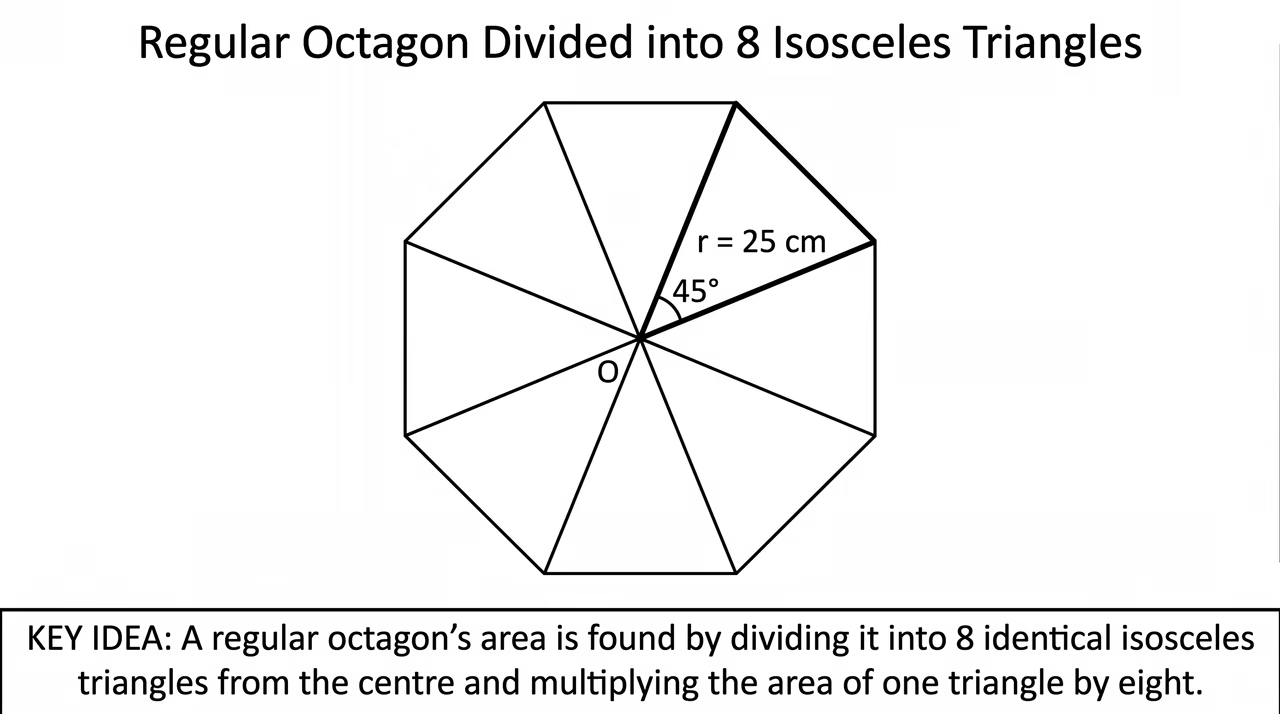
A regular octagon is divided into eight congruent isosceles triangles, with one triangle's circumradius and central angle labelled.
Figure 1: A regular octagon is divided into eight congruent isosceles triangles, with one triangle's circumradius and central angle labelled.

To find the area of regular polygons like heptagons and octagons, we divide the shape into congruent isosceles triangles joined at the central point. For a regular octagon, joining all vertices to the centre forms eight identical triangles. The central angle of each triangle is 360∘÷8=45∘. When given the circumradius r from the centre to a vertex, the area of one triangle is 12r2sin⁡45∘. Multiplying this triangular area by eight gives the total area of the regular octagon.

  • A regular polygon can be split from its central point into congruent isosceles triangles.
  • An octagon contains eight identical isosceles triangles meeting at a total angle of 360°.
  • Central angle for a regular octagon is 360° divided by 8, giving 45°.
  • Triangle area using sine formula equals half product of radius squared and sine of central angle.
Worked example. Identify the number of sides n=8 and circumradius r=25 cm. Calculate central angle θ=360∘8=45∘. Calculate area of one triangle: Areatriangle=12×252×sin⁡45∘≈12×625×0.707107=220.9709 cm2. Multiply by 8 for total area: Areaoctagon=8×220.9709=1767.77 cm2. Answer: 1767.77 cm2.

Check question: A regular octagonal wall clock has a radius from its centre to each vertex measuring 16 cm. What is the area of the clock face to 2 decimal places?

  1. 90.51 cm2
  2. 724.08 cm2
  3. 1236.08 cm2
  4. 1448.15 cm2
Show answer

724.08 cm2. First, find the central angle of the regular octagon: 360∘÷8=45∘. Next, find the area of one of the eight central triangles: 12×16×16×sin⁡45∘≈90.5097 cm2. Finally, multiply by 8 to find the total area of the octagon: 8×90.5097=724.0776≈724.08 cm2.

Slide 2 · Area of Regular Heptagons Given Side LengthModel · 22 min
A regular heptagon is divided into central triangles, alongside a single isosceles triangle showing its base, perpendicular height, and bisected central angle.
Figure 2: A regular heptagon is divided into central triangles, alongside a single isosceles triangle showing its base, perpendicular height, and bisected central angle.

Teach the full lesson on the projector

This lesson, and every other Grade 1–10 CBE lesson, comes ready to project with the EAP ClassKit. It runs without electricity or internet.

  • Both slides with diagrams and class activities
  • Teacher notes, SNE adaptations and assessment checks
  • Homework and the other 11 lessons in this sub-strand

All 12 lessons in Area of Polygons

  1. 1Deriving and Applying the Formula for Area of a TriangleDerive the formula for the area of a triangle given two sides and an included angle
  2. 2Area of a Triangle Using Two Sides and an Included AngleWork out the area of a triangle given two sides and an included angle
  3. 3Determining Area of a Triangle using Heron's FormulaDetermine the area of a triangle using Heron's formula
  4. 4Area of a Triangle Using Heron's FormulaDetermine the area of a triangle using Heron's formula
  5. 5Determining Area of Quadrilaterals in Different Situations: Parallelograms and TrapeziumsDetermine the area of quadrilaterals in different situations
  6. 6Determining Area of Quadrilaterals in Different Situations: Kites and Complex FiguresDetermine the area of quadrilaterals in different situations
  7. 7Area of Regular Polygons: Heptagons and OctagonsWork out the area of regular heptagon and octagon
  8. 8Area of Regular Polygons: Heptagons and Octagons (Lesson 2)Work out the area of regular heptagon and octagon
  9. 9Determining Area of Irregular Polygons by Shape SubdivisionDetermine the area of irregular polygons in different situations
  10. 10Determining Area of Irregular Polygons in Real SituationsDetermine the area of irregular polygons in different situations
  11. 11Exploring Area of Polygons in Real-Life SituationsExplore the area of polygons as used in real-life situations
  12. 12Applying Polygon Area Calculations in Real-Life SituationsExplore the area of polygons as used in real-life situations