
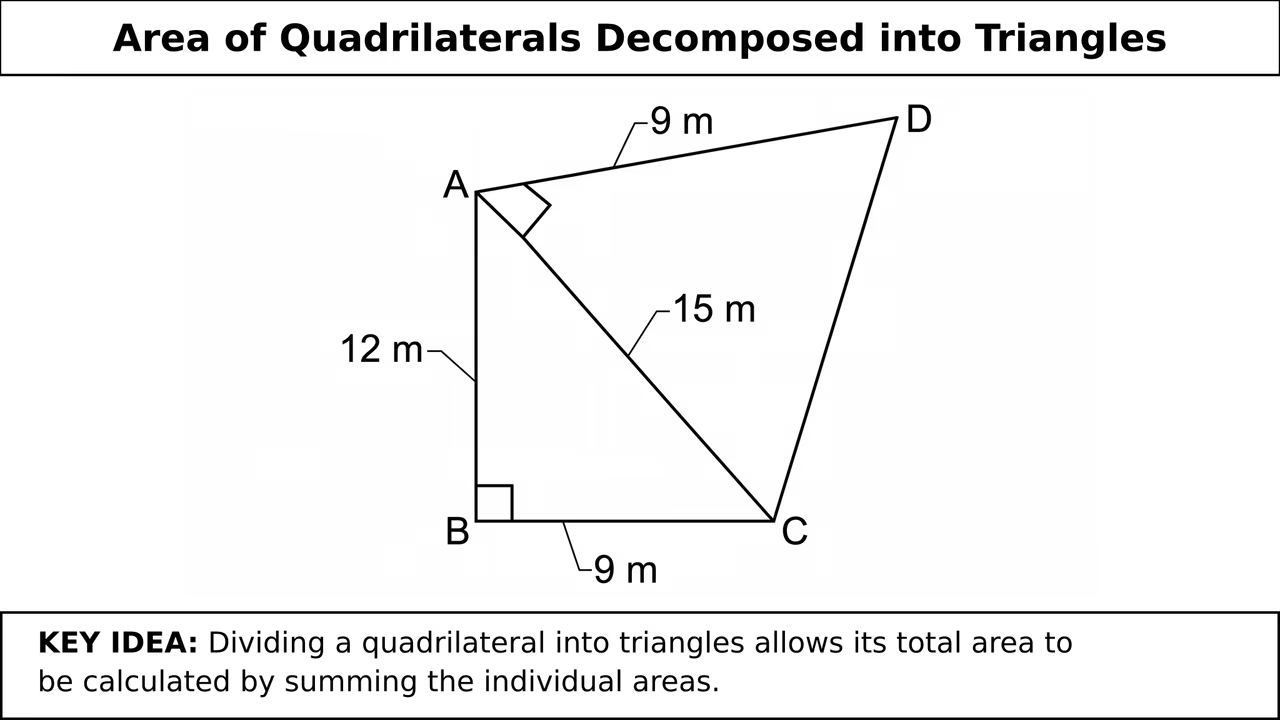
Many real-world objects in our immediate environment, such as flower beds, plots of land, and vegetable gardens, are shaped as quadrilaterals. When determining the area of quadrilaterals in different situations, we can decompose the shape into simpler figures like triangles. If a right-angled triangle forms part of the quadrilateral, we can calculate any unknown perpendicular height using Pythagoras' theorem before finding the combined surface area.
- Real-life items like agricultural plots and tiles are often quadrilateral in shape.
- Decomposing complex quadrilaterals into two triangles simplifies the total area calculation.
- Pythagoras' theorem helps find an unknown perpendicular height when right angles exist.
- Summing the individual triangular areas gives the total surface area of the quadrilateral.
Check question: A quadrilateral field is divided by diagonal . In right-angled triangle , and the base . Triangle has a perpendicular height to base of . What is the total area of field ?
Show answer
. First, calculate the perpendicular height using Pythagoras' theorem: . The area of . The area of . Total area .
