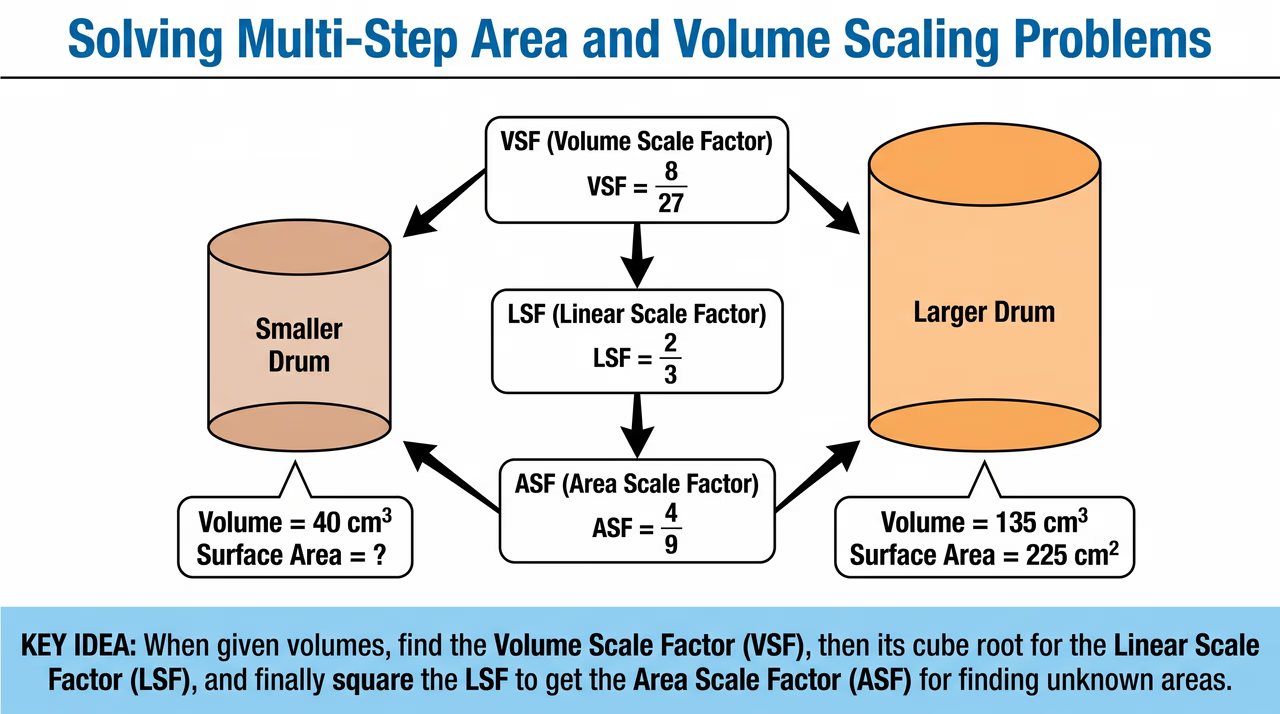
When working with similar three-dimensional figures, the linear scale factor (LSF) relates corresponding lengths. The area scale factor (ASF) equals , whereas the volume scale factor (VSF) equals . Given a cubic ratio, taking its cube root determines the linear multiplier. Squaring that linear multiplier then provides the surface ratio, allowing computation of unknown surface areas or dimensions across matching solids.
- The linear scale factor is derived from the ratio of any two matching linear measurements.
- Cubing the linear scale factor yields the volume scale factor relating capacities of matching solids.
- Taking the cube root of the volume multiplier restores the linear multiplier between matching figures.
- Squaring the restored linear scale factor gives the area scale factor needed for surface area calculations.
Check question: Two similar spherical balloons have radii of and . Compute the linear scale factor of enlargement from the smaller balloon to the larger balloon, and the corresponding volume scale factor.
- Linear scale factor = , Volume scale factor =
- Linear scale factor = , Volume scale factor =
- Linear scale factor = , Volume scale factor =
- Linear scale factor = , Volume scale factor =
Show answer
Linear scale factor = , Volume scale factor = . The linear scale factor (LSF) for the enlargement is the larger radius divided by the smaller radius: . Cubing this linear multiplier yields the volume scale factor (VSF): .