
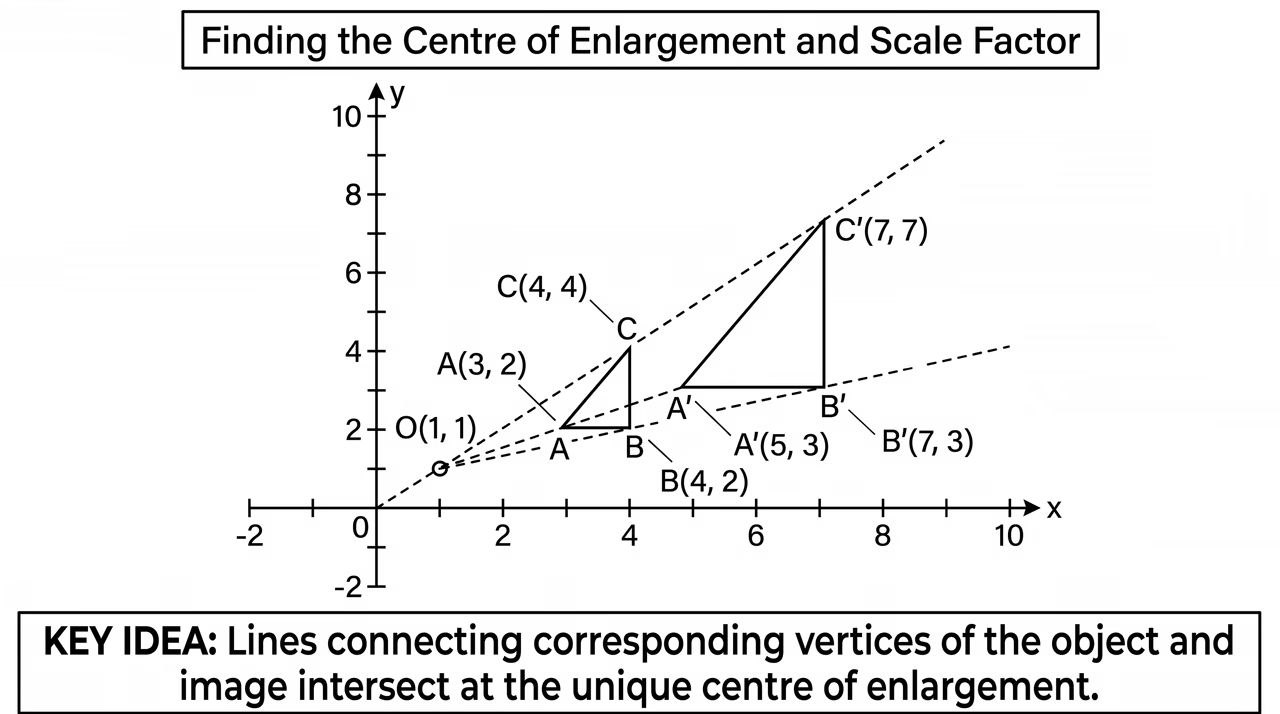
When a figure undergoes enlargement, straight lines joining matching pairs of vertices intersect at a unique common location known as the centre of enlargement. Connecting matching vertices like to and to reveals this intersection. The linear scale factor is the ratio of any image side length to its corresponding object side length, or the ratio of distance from the centre of enlargement to an image point over the distance to the matching object point. Use Figure 1 to see how connecting corresponding vertices reveals the centre of enlargement.
- Lines passing through matching object and image vertices intersect at the unique centre of enlargement.
- The linear scale factor compares the length of an image side to its corresponding object side.
- Distances measured from the centre of enlargement to matching vertices share the exact same scalar ratio.
- Scale factor equals the image distance divided by object distance from the centre of enlargement.
Check question: A quadrilateral with side is enlarged to with side . Line passes through and , while line passes through and . What are the centre of enlargement and the linear scale factor?
- Centre of enlargement and linear scale factor
- Centre of enlargement and linear scale factor
- Centre of enlargement and linear scale factor
- Centre of enlargement and linear scale factor
Show answer
Centre of enlargement and linear scale factor . The centre of enlargement is the point where the lines passing through corresponding vertices intersect. Both line and line pass through , so this must be the centre of enlargement. The linear scale factor is the ratio of the image length to the corresponding object length: .
