
Skip to content

Grade 10 · Core Mathematics · Lesson 4 of 11

Constructing Images under Geometric Enlargement

A Grade 10 Core Mathematics CBE lesson from the sub-strand Similarity and Enlargement. In it, learners construct the image of a shape under a negative linear scale factor by extending rays through the centre of enlargement.

Strand Measurements and GeometrySub-strand Similarity and EnlargementLesson code 10CM-21-L440 minutes · 3 slides

KICD learning outcome (b)

Construct the image of an object under an enlargement given the centre of enlargement and the linear scale factor (L.S.F).

By the end of this lesson, learners should be able to

  1. Construct the image of a shape under a negative linear scale factor by extending rays through the centre of enlargement.
  2. Calculate coordinates of an enlarged image given a non-origin centre of enlargement and positive scale factor.
  3. Construct images on the Cartesian plane using fractional scale factors with origin as the centre of enlargement.

Key vocabulary

Centre of enlargement
the fixed point from which all object and image points are projected.
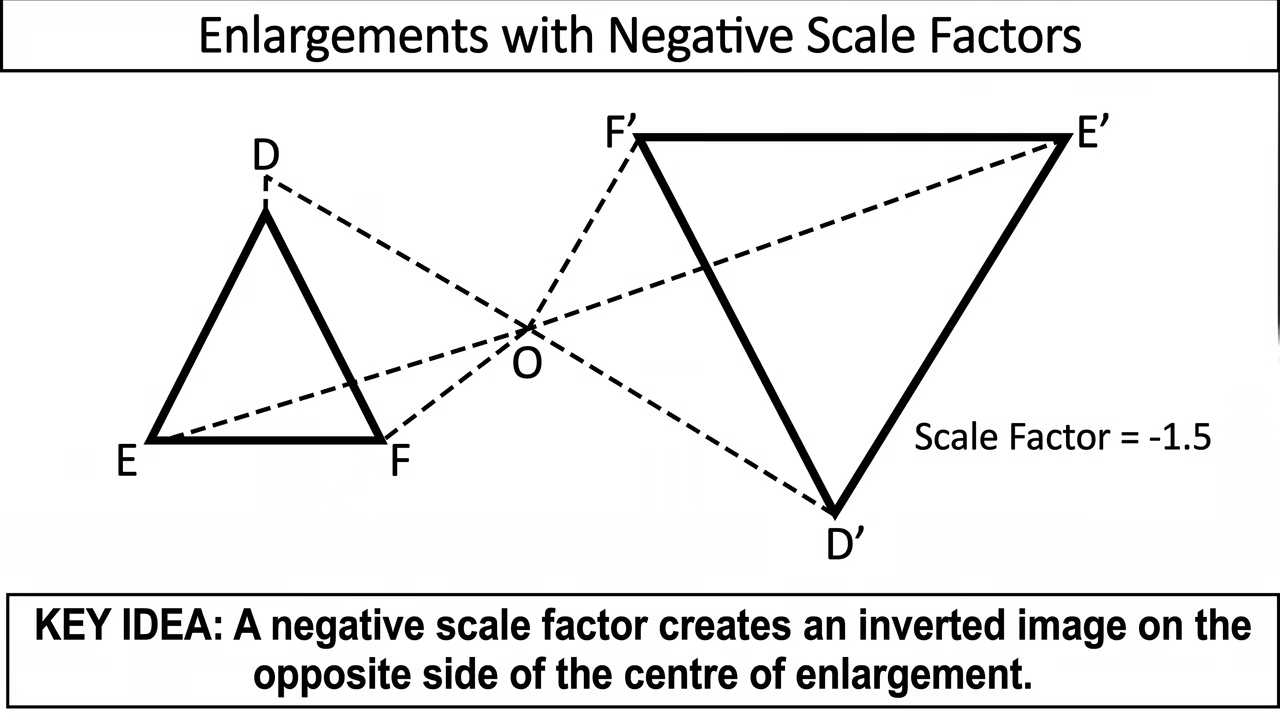
Point O is the centre of enlargement used to locate image triangle D'E'F'.
Linear scale factor
the ratio of image distance from centre to corresponding object distance.
The linear scale factor of -1.5 flips the image to the opposite side.
Image point
the resulting point after applying a geometric transformation to an object point.
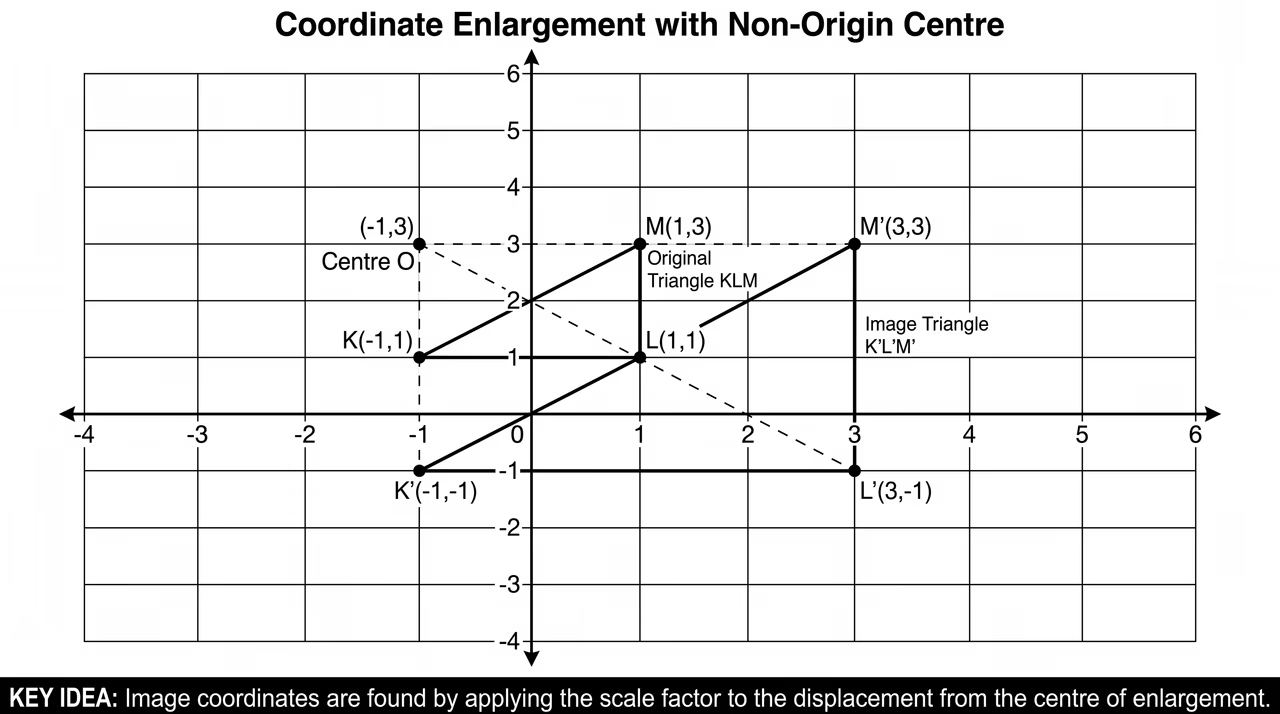
Vertex K'(-1, -1) is the image point of K(-1, 1) after enlargement.
Origin
the intersection point of axes on a coordinate grid with coordinates (0, 0).
Enlarging rectangle WXYZ from the origin scales each coordinate directly by factor k.

Lesson preview

Slide 1 · Enlargements with Negative Scale FactorsOpening · 12 min
A triangle is enlarged through a central point with a negative scale factor to form an inverted image on the opposite side.
Figure 1: A triangle is enlarged through a central point with a negative scale factor to form an inverted image on the opposite side.

When an enlargement has a negative linear scale factor, the image and object lie on opposite sides of the centre of enlargement. Ray lines drawn from object vertices through the centre point are extended beyond it. Distances from the centre to image vertices equal the object distance multiplied by the magnitude of the scale factor. The resulting figure is inverted relative to the object. Use Figure 1 to see how the image and object lie on opposite sides.

  • A negative linear scale factor places the image on the opposite side of the centre of enlargement.
  • Ray projection lines must extend through the centre of enlargement to locate negative scale factor images.
  • The distance from the centre to an image vertex equals the absolute scale factor times object distance.
  • Negative scale factor enlargements produce inverted images that maintain mathematical similarity to the original object.
Worked example. Calculate the absolute magnitude of the scale factor: ∣k∣=∣−1.5∣=1.5. Multiply each distance from centre O by 1.5: OD′=1.5×4 cm=6 cm. Calculate remaining image distances: OE′=1.5×6 cm=9 cm and OF′=1.5×5 cm=7.5 cm. Measure these distances along rays extended through centre O on the opposite side of O from D, E, F. Answer: OD′=6 cm, OE′=9 cm, OF′=7.5 cm on the opposite side of O..

Check question: Triangle RST is enlarged with centre O and scale factor k=−2. If the distance OR=3.5 cm, what is the distance OR′ and where is R′ located?

  1. 7 cm on the opposite side of O from R
  2. 7 cm on the same side of O as R
  3. −7 cm on the opposite side of O from R
  4. 1.5 cm on the opposite side of O from R
Show answer

7 cm on the opposite side of O from R. Calculate the magnitude of the scale factor: ∣−2∣=2. Multiply the original distance by this magnitude: 3.5 cm×2=7 cm. Because the scale factor k=−2 is negative, the image point R′ lies on the opposite side of the centre O from R.
Slide 2 · Coordinate Enlargement with Non-Origin CentreModel · 14 min
A triangle on a Cartesian plane is enlarged from a centre point that is not the origin to form a larger shape.
Figure 2: A triangle on a Cartesian plane is enlarged from a centre point that is not the origin to form a larger shape.

Teach the full lesson on the projector

This lesson, and every other Grade 1–10 CBE lesson, comes ready to project with the EAP ClassKit. It runs without electricity or internet.

  • All 3 slides with diagrams and class activities
  • Teacher notes, SNE adaptations and assessment checks
  • Homework and the other 10 lessons in this sub-strand

All 11 lessons in Similarity and Enlargement

  1. 1Determining Centre of Enlargement and Linear Scale FactorDetermine the centre of enlargement and the linear scale factor for similar figures
  2. 2Finding the Central Point of Dilation and Scale FactorsDetermine the centre of enlargement and the linear scale factor for similar figures
  3. 3Constructing Images under Enlargement with Positive and Negative Scale FactorsConstruct the image of an object under an enlargement given the centre of enlargement and the linear scale factor (L.S.F)
  4. 4Constructing Images under Geometric EnlargementConstruct the image of an object under an enlargement given the centre of enlargement and the linear scale factor (L.S.F)
  5. 5Calculating Area and Volume Scale Factors for Similar FiguresDetermine the area and volume scale factor of different figures and solids
  6. 6Determining Area and Volume Scale FactorsDetermine the area and volume scale factor of different figures and solids
  7. 7Connecting Length, Surface Area, and Volume RatiosRelate linear scale factor, area scale factor, and volume scale factor in enlargements
  8. 8Connecting Linear, Surface Area, and Volumetric Scale Factors in Similar SolidsRelate linear scale factor, area scale factor, and volume scale factor in enlargements
  9. 9Applications of Similarity and Enlargement in Real LifeApply similarity and enlargement to real-life situations
  10. 10Applying Similarity and Enlargement in Real-Life ContextsApply similarity and enlargement to real-life situations
  11. 11Appreciating Similarity and Enlargement in Real-Life ApplicationsAppreciate the use of similarity and enlargement in real-life situations