Slide 1 · Establishing the Relationship Between Scale FactorsOpening · 18 min
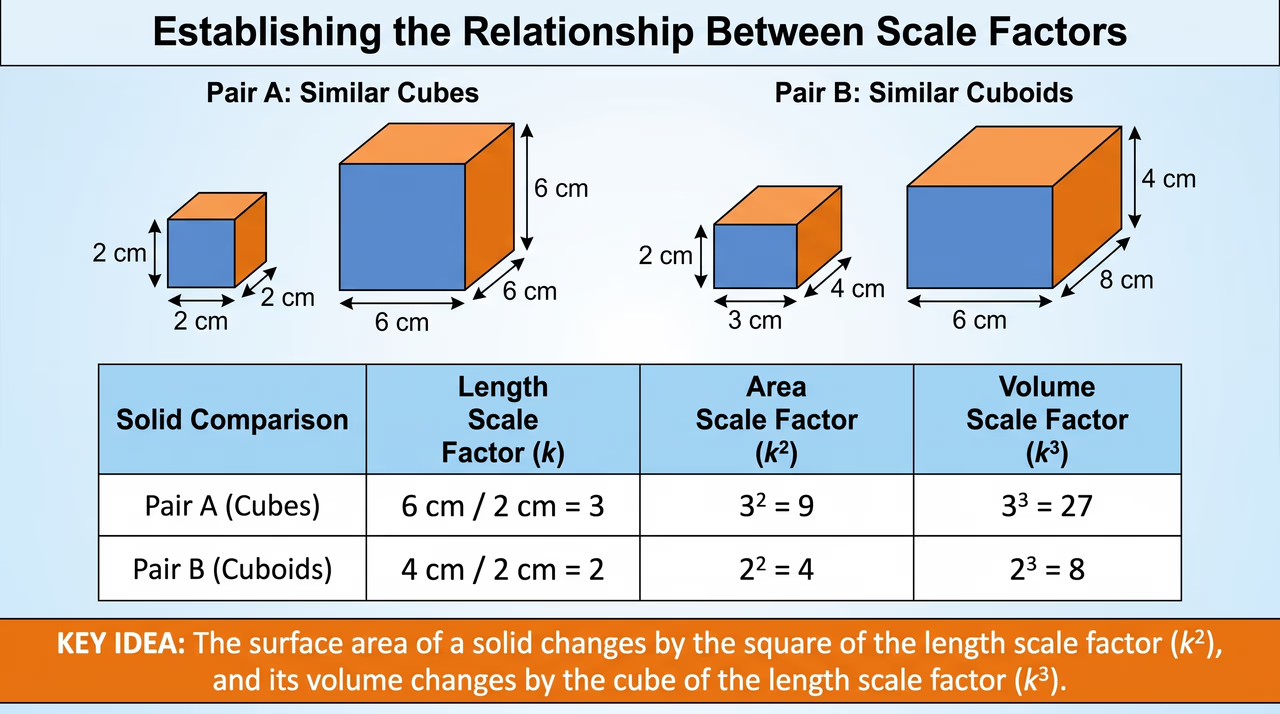
When a solid shape is enlarged, every linear dimension changes by a linear scale factor, denoted as . Comparing corresponding surface areas shows that area expands by , known as the area scale factor. Similarly, comparing volumes reveals that volume increases by , termed the volume scale factor. This fundamental relationship allows us to determine surface areas and volumes directly from length ratios without recalculating individual dimensions.
- The linear scale factor is the ratio of any two corresponding lengths on similar shapes.
- The area scale factor equals the square of the linear scale factor, so .
- The volume scale factor equals the cube of the linear scale factor, so .
- Comparing ratios in a structured table confirms that area depends on and volume on .
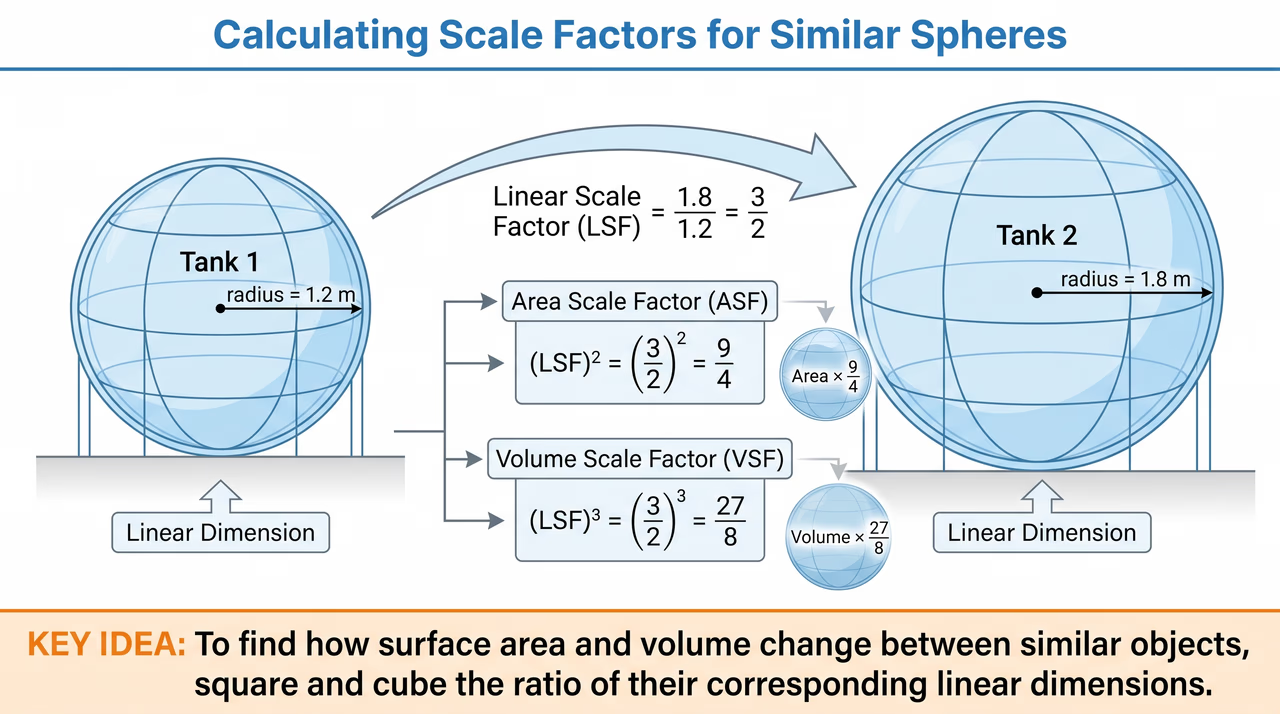
Worked example. Calculate the linear scale factor by simplifying the ratio of corresponding lengths: . Use the relationship that the area scale factor is the square of the linear scale factor: . Square the fraction: . Answer: Linear scale factor = and Area scale factor = .
Check question: Two similar triangular wooden blocks have corresponding base lengths of and . What is the area scale factor?
Show answer
. The linear scale factor is . Squaring this linear ratio gives the area scale factor as .