
Skip to content

Grade 10 · Core Mathematics · Lesson 6 of 11

Determining Area and Volume Scale Factors

A Grade 10 Core Mathematics CBE lesson from the sub-strand Similarity and Enlargement. In it, learners determine the volume scale factor of similar solids by computing and comparing their volumes.

Strand Measurements and GeometrySub-strand Similarity and EnlargementLesson code 10CM-21-L640 minutes · 2 slides

KICD learning outcome (c)

Determine the area and volume scale factor of different figures and solids.

By the end of this lesson, learners should be able to

  1. Determine the volume scale factor of similar solids by computing and comparing their volumes
  2. Calculate the area scale factor of similar plane figures by comparing their surface areas
  3. Apply area and volume scale factors to solve mathematical and real-life scaling problems

Key vocabulary

Volume scale factor
The ratio obtained by dividing the volume of one solid by that of a similar solid.
The volume scale factor of a 2 cm cube to a 6 cm cube is 127.
Area scale factor
The ratio obtained by dividing the area of one figure by that of a similar figure.
A 20 cm2 figure enlarged to 80 cm2 has an area scale factor of 4.

Lesson preview

Slide 1 · Volume Scale Factor of Similar SolidsModel · 18 min
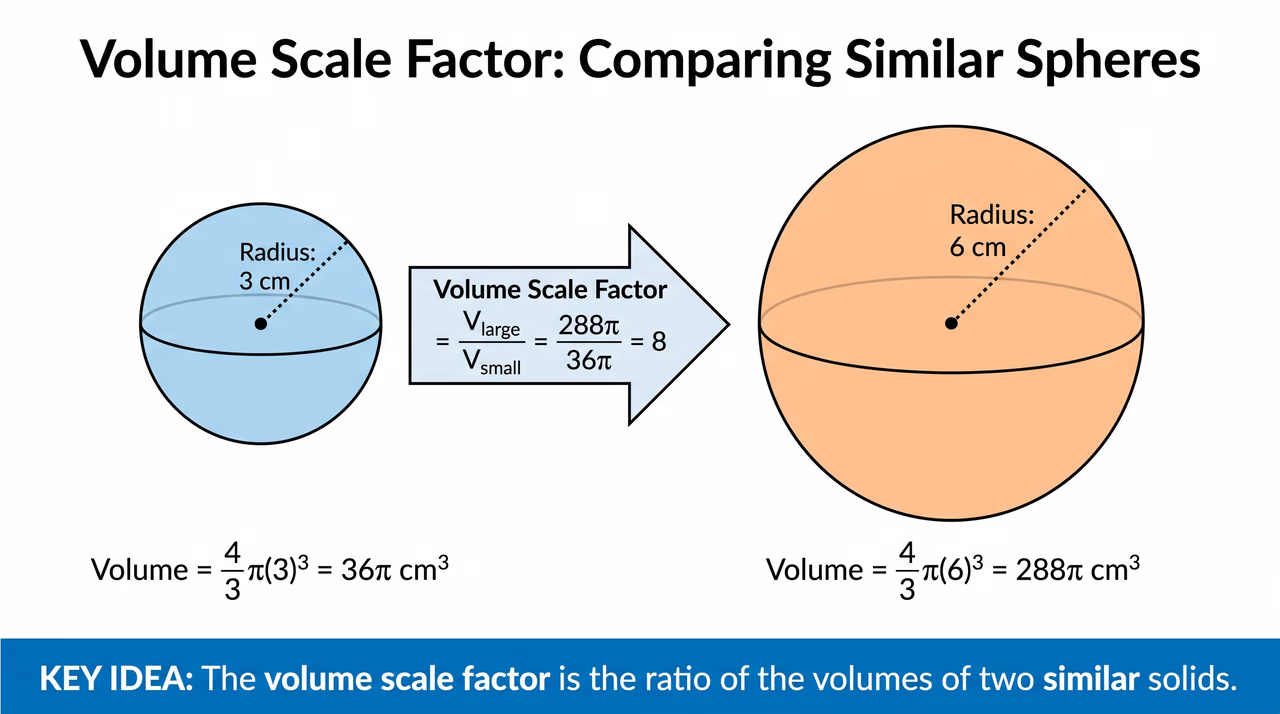
Two similar spheres with radii of 3 cm and 6 cm, showing their calculated volumes and the resulting volume scale factor.
Figure 1: Two similar spheres with radii of 3 cm and 6 cm, showing their calculated volumes and the resulting volume scale factor.

When comparing two similar three-dimensional solids, the ratio of their volumes defines the volume scale factor. To calculate this ratio, we compute the volume of both solids using their respective linear dimensions, such as radius, height, or side length, and then divide the volume of one solid by the volume of the corresponding similar solid. The ratio of the volumes of two similar solids is the volume scale factor. Use Figure 1 to see how the volume scale factor is calculated from the volumes of similar solids.

  • Similar solids have corresponding linear dimensions that are enlarged or reduced by a constant ratio.
  • The ratio of the volumes of two similar solids is the volume scale factor.
  • Computing solid volumes directly allows us to determine the volume scale factor between two shapes.
  • The volume scale factor compares the 3D space occupied by an object and its similar image.
Worked example. 1. Calculate volume of smaller sphere: V1=43×227×33=43×227×27=7927=11317 cm3. 2. Calculate volume of larger sphere: V2=43×227×63=43×227×216=63367=90517 cm3. 3. Divide smaller volume by larger volume to find the volume scale factor: V1V2=792/76336/7=7926336=18. Answer: The volume scale factor is 18..

Check question: Two similar cylinders have volumes of 50 cm3 and 400 cm3. What is the volume scale factor of the larger cylinder to the smaller cylinder?

  1. 8
  2. 18
  3. 2
  4. 350
Show answer

8. To find the volume scale factor of the larger cylinder to the smaller cylinder, divide the larger volume by the smaller volume: 400 cm350 cm3=8.

Slide 2 · Determining Area and Volume Scale Factors in PracticePractice · 22 min
A pair of rectangular tiles and a pair of cubes, demonstrating the calculation of area and volume scale factors from corresponding measurements.
Figure 2: A pair of rectangular tiles and a pair of cubes, demonstrating the calculation of area and volume scale factors from corresponding measurements.

Teach the full lesson on the projector

This lesson, and every other Grade 1–10 CBE lesson, comes ready to project with the EAP ClassKit. It runs without electricity or internet.

  • Both slides with diagrams and class activities
  • Teacher notes, SNE adaptations and assessment checks
  • Homework and the other 10 lessons in this sub-strand

All 11 lessons in Similarity and Enlargement

  1. 1Determining Centre of Enlargement and Linear Scale FactorDetermine the centre of enlargement and the linear scale factor for similar figures
  2. 2Finding the Central Point of Dilation and Scale FactorsDetermine the centre of enlargement and the linear scale factor for similar figures
  3. 3Constructing Images under Enlargement with Positive and Negative Scale FactorsConstruct the image of an object under an enlargement given the centre of enlargement and the linear scale factor (L.S.F)
  4. 4Constructing Images under Geometric EnlargementConstruct the image of an object under an enlargement given the centre of enlargement and the linear scale factor (L.S.F)
  5. 5Calculating Area and Volume Scale Factors for Similar FiguresDetermine the area and volume scale factor of different figures and solids
  6. 6Determining Area and Volume Scale FactorsDetermine the area and volume scale factor of different figures and solids
  7. 7Connecting Length, Surface Area, and Volume RatiosRelate linear scale factor, area scale factor, and volume scale factor in enlargements
  8. 8Connecting Linear, Surface Area, and Volumetric Scale Factors in Similar SolidsRelate linear scale factor, area scale factor, and volume scale factor in enlargements
  9. 9Applications of Similarity and Enlargement in Real LifeApply similarity and enlargement to real-life situations
  10. 10Applying Similarity and Enlargement in Real-Life ContextsApply similarity and enlargement to real-life situations
  11. 11Appreciating Similarity and Enlargement in Real-Life ApplicationsAppreciate the use of similarity and enlargement in real-life situations