
Skip to content

Grade 10 · Core Mathematics · Lesson 7 of 11

Determining the Equation of a Mirror Line

A Grade 10 Core Mathematics CBE lesson from the sub-strand Reflection and Congruence. In it, learners construct the mirror line geometrically for a given object and its reflection image.

Strand Measurements and GeometrySub-strand Reflection and CongruenceLesson code 10CM-22-L740 minutes · 3 slides

KICD learning outcome (d)

Determine the equation of the mirror line given an object and its image.

By the end of this lesson, learners should be able to

  1. Construct the mirror line geometrically for a given object and its reflection image.
  2. Determine the equation of a mirror line on a Cartesian grid given an object point and its image point.
  3. Find and verify the mirror line equation for multi-vertex figures such as triangles and parallelograms.

Key vocabulary

Perpendicular bisector
A line that cuts a line segment into two equal parts at right angles.
The mirror line m is the perpendicular bisector of segment KS.
Angle bisector
A line dividing a given angle into two equal adjacent angles.
The mirror line acts as an angle bisector between intersecting object and image rays.
Perpendicular gradient
The gradient of a line perpendicular to another, equal to its negative reciprocal.
Segment PP′ has gradient 1, so the mirror line perpendicular gradient is −1.
Coincides
Occupies the exact same position or line in space or on a graph.
The perpendicular bisector of AA′ coincides with the perpendicular bisector of BB′.

Lesson preview

Slide 1 · Constructing Mirror Lines for Object-Image PairsOpening · 12 min
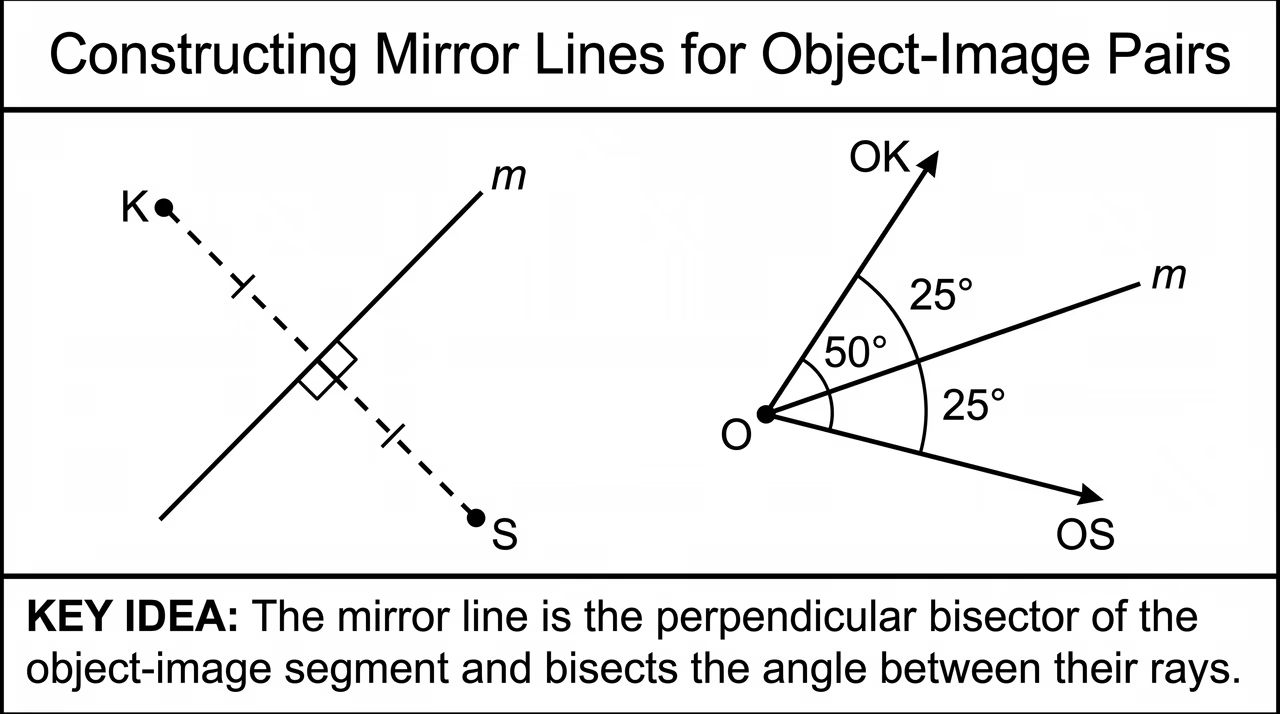
Two diagrams illustrating a mirror line acting as the perpendicular bisector of a line segment and the angle bisector of two meeting rays.
Figure 1: Two diagrams illustrating a mirror line acting as the perpendicular bisector of a line segment and the angle bisector of two meeting rays.

When an object point K is reflected to an image point S, the mirror line m is the perpendicular bisector of the line segment KS. Tracing or drawing line segment KS allows us to locate m at its midpoint at right angles. Furthermore, when an object ray and its image ray meet at an angle, the mirror line passes through their meeting point and bisects the angle between the two rays.

  • The mirror line m is the perpendicular bisector of segment KS joining object K to image S.
  • Tracing an object and its image helps locate midpoints to draw the mirror line accurately.
  • When object ray OA reflects to ray OA′, the mirror line passes through vertex O.
  • The mirror line bisects the angle formed between object ray OA and image ray OA′.
Worked example. Join point K to point S with a straight line segment KS. Construct the perpendicular bisector of segment KS, which forms the mirror line m. Since mirror line m reflects ray OK onto ray OS, line m bisects ∠KOS. Divide the angle by 2: 50∘2=25∘. Answer: Mirror line m is the perpendicular bisector of segment KS and makes 25∘ with ray OK..

Check question: Object ray OA and its reflection image ray OA′ meet at point O forming angle ∠AOA′=76∘. What angle does the mirror line passing through O make with ray OA?

  1. 152∘
  2. 76∘
  3. 38∘
  4. 14∘
Show answer

38∘. Because the mirror line reflects ray OA onto ray OA′, it acts as an angle bisector for ∠AOA′. Dividing the total angle 76∘ by 2 gives 38∘.

Slide 2 · Finding Mirror Line Equations using Perpendicular BisectorsModel · 14 min
A Cartesian grid displaying an object triangle and its reflection image, with the mirror line found using the perpendicular bisector of a segment.
Figure 2: A Cartesian grid displaying an object triangle and its reflection image, with the mirror line found using the perpendicular bisector of a segment.

Teach the full lesson on the projector

This lesson, and every other Grade 1–10 CBE lesson, comes ready to project with the EAP ClassKit. It runs without electricity or internet.

  • All 3 slides with diagrams and class activities
  • Teacher notes, SNE adaptations and assessment checks
  • Homework and the other 10 lessons in this sub-strand

All 11 lessons in Reflection and Congruence

  1. 1Identifying Lines of Symmetry in Plane FiguresIdentify lines of symmetry in plane figures
  2. 2Identifying Lines of Symmetry in Plane FiguresIdentify lines of symmetry in plane figures
  3. 3Properties of Reflection in Plane GeometryDetermine the properties of reflection in different situations
  4. 4Properties of Reflection in Plane GeometryDetermine the properties of reflection in different situations
  5. 5Reflecting Shapes on Plane Surfaces and Cartesian PlanesDraw an image given an object and a mirror line on plane surface and Cartesian plane
  6. 6Reflecting Shapes on the Cartesian PlaneDraw an image given an object and a mirror line on plane surface and Cartesian plane
  7. 7Determining the Equation of a Mirror LineDetermine the equation of the mirror line given an object and its image
  8. 8Determining the Equation of a Mirror LineDetermine the equation of the mirror line given an object and its image
  9. 9Direct and Opposite Congruence in Plane FiguresCarry out congruence tests for triangles
  10. 10Carrying Out Congruence Tests for TrianglesCarry out congruence tests for triangles
  11. 11Real-Life Applications of Reflection, Line Symmetry, and CongruencePromote use of reflection and congruence in real-life situations