
Skip to content

Grade 10 · Core Mathematics · Lesson 3 of 11

Properties of Reflection in Plane Geometry

A Grade 10 Core Mathematics CBE lesson from the sub-strand Reflection and Congruence. In it, learners identify that an object and its reflected image are congruent.

Strand Measurements and GeometrySub-strand Reflection and CongruenceLesson code 10CM-22-L340 minutes · 2 slides

KICD learning outcome (b)

Determine the properties of reflection in different situations.

By the end of this lesson, learners should be able to

  1. Identify that an object and its reflected image are congruent.
  2. Demonstrate that corresponding points on an object and its image are equidistant from the mirror line.
  3. Verify that the line segment connecting an object point to its reflected image is perpendicularly bisected by the mirror line.

Key vocabulary

Mirror line
A straight line acting as the axis across which an object is reflected.
A pencil's point and its reflected position sit equal distances from the axis.
Image
The figure produced by reflecting an object across a given line of reflection.
The image of a pencil placed 5 cm from a mirror lies 5 cm behind it.
Equidistant
Located at exactly the same distance from a reference line or point.
Vertex A and vertex A′ are equidistant from the mirror line M.
Perpendicular bisector
A line that divides a line segment into two equal parts at right angles.
Mirror axis M bisects segment AA′ perpendicularly into two equal halves.

Lesson preview

Slide 1 · Observing Reflection with Physical ObjectsOpening · 18 min
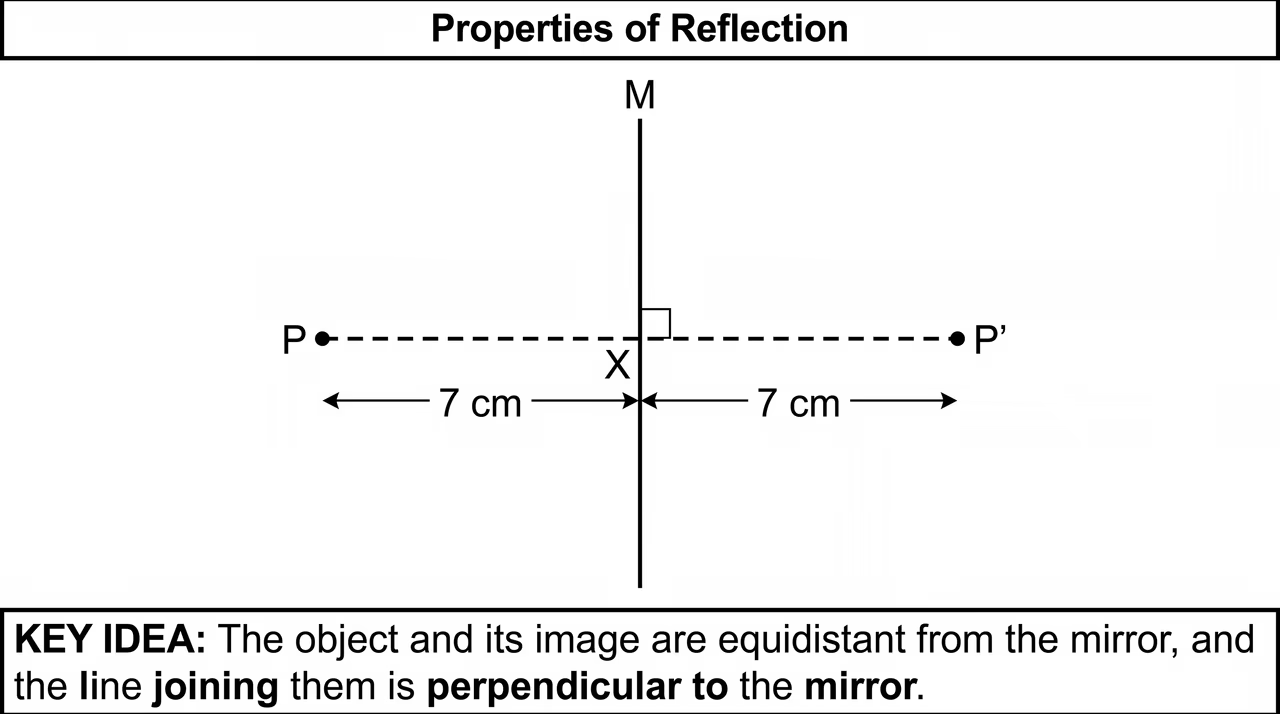
A point P and its reflected image P' are shown situated at equal distances of 7 cm on opposite sides of a vertical mirror.
Figure 1: A point P and its reflected image P' are shown situated at equal distances of 7 cm on opposite sides of a vertical mirror.

When an object such as a pencil is reflected in a flat mirror, its image appears directly opposite behind the mirror line. The image has the exact same length and shape as the original object. As you move the pencil closer to or further from the mirror surface, the image moves an equal distance on the other side. A line segment joining any point on the pencil to its corresponding point on the image forms a right angle with the mirror line. See Figure 1 for an illustration of a point and its image across a mirror line.

  • An object and its reflected image are identical in size and shape, making them congruent figures.
  • The distance from an object point to the mirror line equals the distance from the image point to the mirror line.
  • Moving an object towards or away from the mirror causes its image to move an equal distance oppositely.
  • The line segment connecting an object point to its reflected image point meets the mirror line at ninety degrees.
Worked example. The distance from object point P to the mirror line M is 7 cm. By reflection properties, the image point P′ is also 7 cm behind line M. Total distance PP′=7 cm+7 cm=14 cm. The line segment joining a point to its image is perpendicular to the mirror line, so the angle with line M is 90∘. Answer: Distance PP′=14 cm; angle with mirror line is 90∘..

Check question: A marker point Q is located 12 cm from a mirror line M. If Q′ is the image of Q, find the total length of segment QQ′ and the angle between segment QQ′ and mirror line M.

  1. Length QQ′=24 cm, angle is 90∘.
  2. Length QQ′=12 cm, angle is 90∘.
  3. Length QQ′=24 cm, angle is 180∘.
  4. Length QQ′=6 cm, angle is 90∘.
Show answer

Length QQ′=24 cm, angle is 90∘. Since the image Q′ is formed as far behind the mirror line M as the object Q is in front, the total distance QQ′=12 cm+12 cm=24 cm. The line segment connecting an object to its image is always perpendicular to the mirror line, forming an angle of 90∘.

Slide 2 · Geometric Reflection through Tracing and Paper FoldingModel · 22 min
Triangle ABC is reflected across vertical mirror line M to form image A'B'C' on a Cartesian plane, highlighting the perpendicular bisecting lines.
Figure 2: Triangle ABC is reflected across vertical mirror line M to form image A'B'C' on a Cartesian plane, highlighting the perpendicular bisecting lines.

Teach the full lesson on the projector

This lesson, and every other Grade 1–10 CBE lesson, comes ready to project with the EAP ClassKit. It runs without electricity or internet.

  • Both slides with diagrams and class activities
  • Teacher notes, SNE adaptations and assessment checks
  • Homework and the other 10 lessons in this sub-strand

All 11 lessons in Reflection and Congruence

  1. 1Identifying Lines of Symmetry in Plane FiguresIdentify lines of symmetry in plane figures
  2. 2Identifying Lines of Symmetry in Plane FiguresIdentify lines of symmetry in plane figures
  3. 3Properties of Reflection in Plane GeometryDetermine the properties of reflection in different situations
  4. 4Properties of Reflection in Plane GeometryDetermine the properties of reflection in different situations
  5. 5Reflecting Shapes on Plane Surfaces and Cartesian PlanesDraw an image given an object and a mirror line on plane surface and Cartesian plane
  6. 6Reflecting Shapes on the Cartesian PlaneDraw an image given an object and a mirror line on plane surface and Cartesian plane
  7. 7Determining the Equation of a Mirror LineDetermine the equation of the mirror line given an object and its image
  8. 8Determining the Equation of a Mirror LineDetermine the equation of the mirror line given an object and its image
  9. 9Direct and Opposite Congruence in Plane FiguresCarry out congruence tests for triangles
  10. 10Carrying Out Congruence Tests for TrianglesCarry out congruence tests for triangles
  11. 11Real-Life Applications of Reflection, Line Symmetry, and CongruencePromote use of reflection and congruence in real-life situations